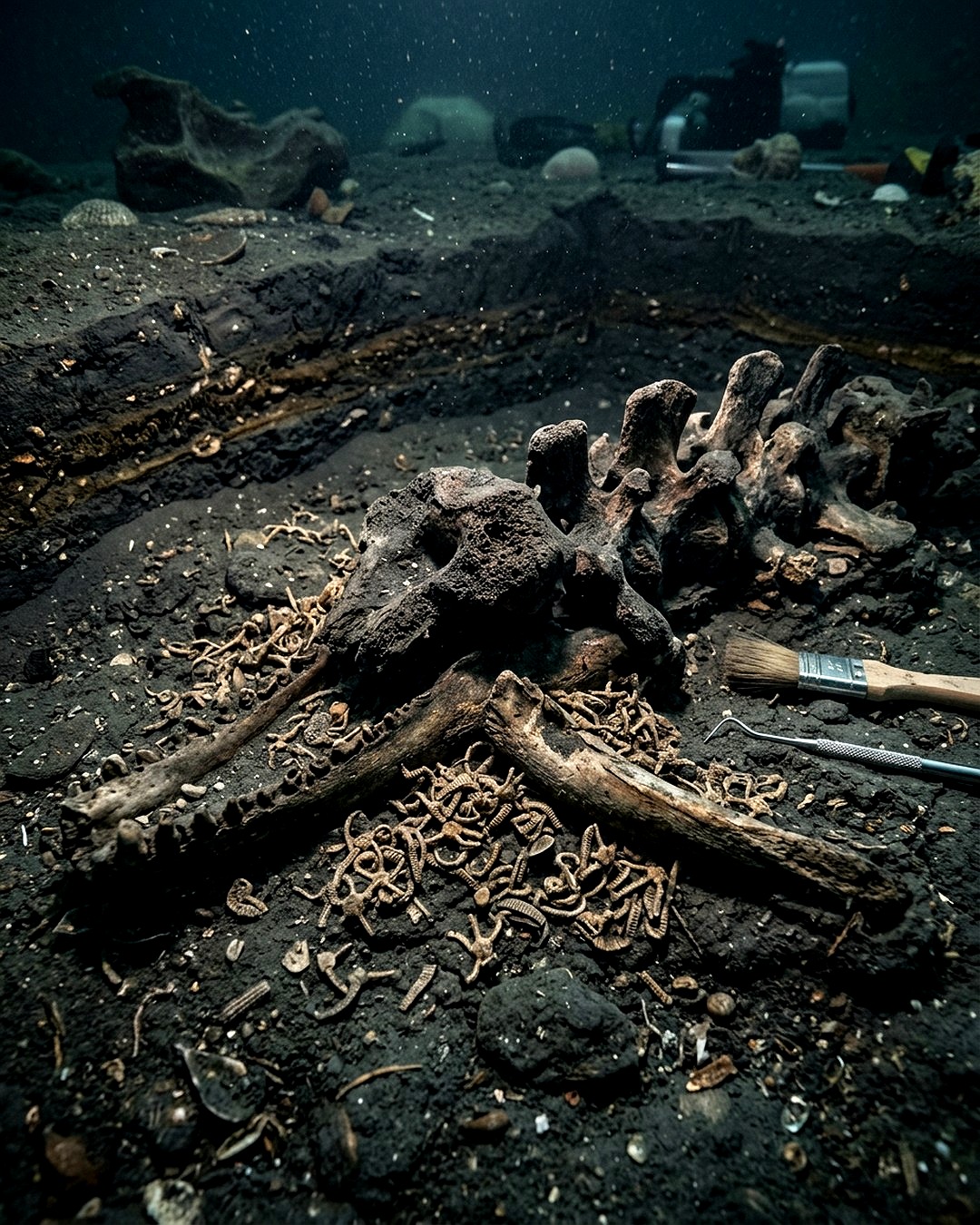
🐋 Ancient Whale Fall Ecosystem

SciTechDaily Paleontology Fossils MarineBiology Evolution Biodiversity

Resumo

Imagem de Capa do Mapa Mental
Imagem de Capa Gerada por IA

Paleontologists discovered a hidden ancient ecosystem surrounding a 9.5-million-year-old whale skeleton in Denmark. This fossil find provides rare evidence that ecological relationships seen in modern oceans existed millions of years ago. Researchers identified microscopic skeletal plates of a new brittle star species named Ophiura huebnerjenseni near the remains. Understanding these ancient whale falls helps scientists reconstruct prehistoric marine biodiversity and scavenger behaviors. The researchers argue that the concentration of brittle stars next to the whale skeleton is not a coincidence of ocean currents or fossil preservation. They systematically evaluated alternative explanations by comparing the brittle star remains with sea-urchin fragments found across all sediment samples. Because similar microfossils appeared everywhere while brittle stars clustered tightly by the bones, the authors maintain that the animals actively inhabited the carcass. This stance highlights how careful microfossil analysis can reveal hidden biological interactions in the fossil record. The team excavated sediment from a beaked whale's lower jaw and vertebrae during a 2018 dig at Denmark's Gram Clay Pit. They washed and sieved the clay before examining microscopic skeletal plates under scanning electron microscopy to differentiate the new species. Only three samples taken directly beside the whale bones contained the brittle star remains, while distant samples yielded none. Furthermore, researchers noted that this shallow-water site reflects early organic enrichment stages rather than deep-sea sulfide-based communities. Readers can apply these insights to appreciate how modern marine ecology relies on ancient evolutionary foundations stretching back millions of years. The discovery also connects paleontology to popular culture because the dark gray mud of the Gram Clay Pit shares geological origins with Germany's Wacken Open Air festival grounds. For researchers and enthusiasts alike, studying these fossilized ecosystems underscores the enduring complexity of ancient marine life.

Pontos-chave

01

🔹 Discovery of Ophiura huebnerjenseni

Paleontologists excavating fossil deposits in southern Denmark discovered microscopic skeletal plates belonging to a previously unknown species of brittle star named Ophiura huebnerjenseni. These remains were recovered from sediment collected during the 2018 excavation of a beaked whale's lower jaw and several vertebrae at the Gram Clay Pit. The new species provides potential early fossil evidence of brittle stars gathering around dead whales in ancient seas. Researchers washed, sieved, and examined individual microfossils using scanning electron microscopy to identify the subtle structural differences in the skeletal plates.

02

📊 Spatial Distribution and Carcass Proximity

The distribution of the brittle-star fossils suggested their close proximity to the whale was intentional rather than coincidental. Only three samples taken directly beside the whale bones contained brittle-star remains, while samples from the same layer farther from the skeleton yielded none. Lead author Ben Thuy explained that this localized concentration points directly to the organisms living on or close to the whale carcass. This spatial pattern demonstrates how ancient scavengers exploited localized food sources on the seafloor.

03

🛡️ Ruling Out Alternative Explanations

The research team investigated whether ocean currents or favorable preservation conditions could explain the unusual concentration of brittle-star skeletal plates. They used fragments of sea urchins, which share similar physical and chemical properties, as a baseline comparison across all collected sediment samples. Because sea-urchin fragments occurred in every studied sample at comparable sizes and mineral compositions, a preservation-only explanation became highly unlikely. This comparative approach strongly supported the interpretation that the brittle stars actively inhabited the whale environment.

04

🏛️ Context of the Gram Clay Pit Site

The Gram Clay Pit preserves sediments deposited beneath the ancient North Sea during the Late Miocene epoch approximately 9.5 million years ago. Although the site previously yielded numerous whale skeletons, exceptionally large megalodon vertebrae, and diverse marine invertebrates, brittle stars had escaped detection until now. Mette Elstrup noted that the site represents a shallow-water whale fall reflecting early organic enrichment stages without later deep-sea sulfide-based community stages. This geological setting offers a unique window into ancient shallow-water seabed food dynamics.

05

📌 Connection to Modern Whale Falls

A decomposing whale delivers a substantial supply of organic material to the seabed, creating temporary ecosystems known as whale falls that support successive scavenger communities. Although the fossils cannot establish what Ophiura huebnerjenseni ate or whether it depended exclusively on whale carcasses, researchers suspect it was a generalist species. This generalist species likely occupied the surrounding seabed and congregated wherever food became abundantly available, mimicking behaviors seen in modern oceans. The discovery bridges a gap by showing that modern ecological relationships involving whale falls have ancient origins.

06

🎸 Heavy Metal Festival Geological Link

The new brittle star species takes its specific name from Holger Hübner and Thomas Jensen, the founders of Germany's Wacken Open Air heavy metal festival. Lea Numberger-Thuy highlighted that the dark gray mud encountered by festivalgoers originates from the exact same geological deposits that preserved the ancient brittle stars. The clay accumulating on the bottom of the ancient North Sea thus ties together prehistoric paleontology and world-renowned music festival grounds. This whimsical connection brings ancient geological formations into a recognizable contemporary context for festival attendees worldwide.

Quer criar seu próprio mapa mental?

Faça login no Neumap AI e comece a criar seus próprios mapas mentais!

Começar