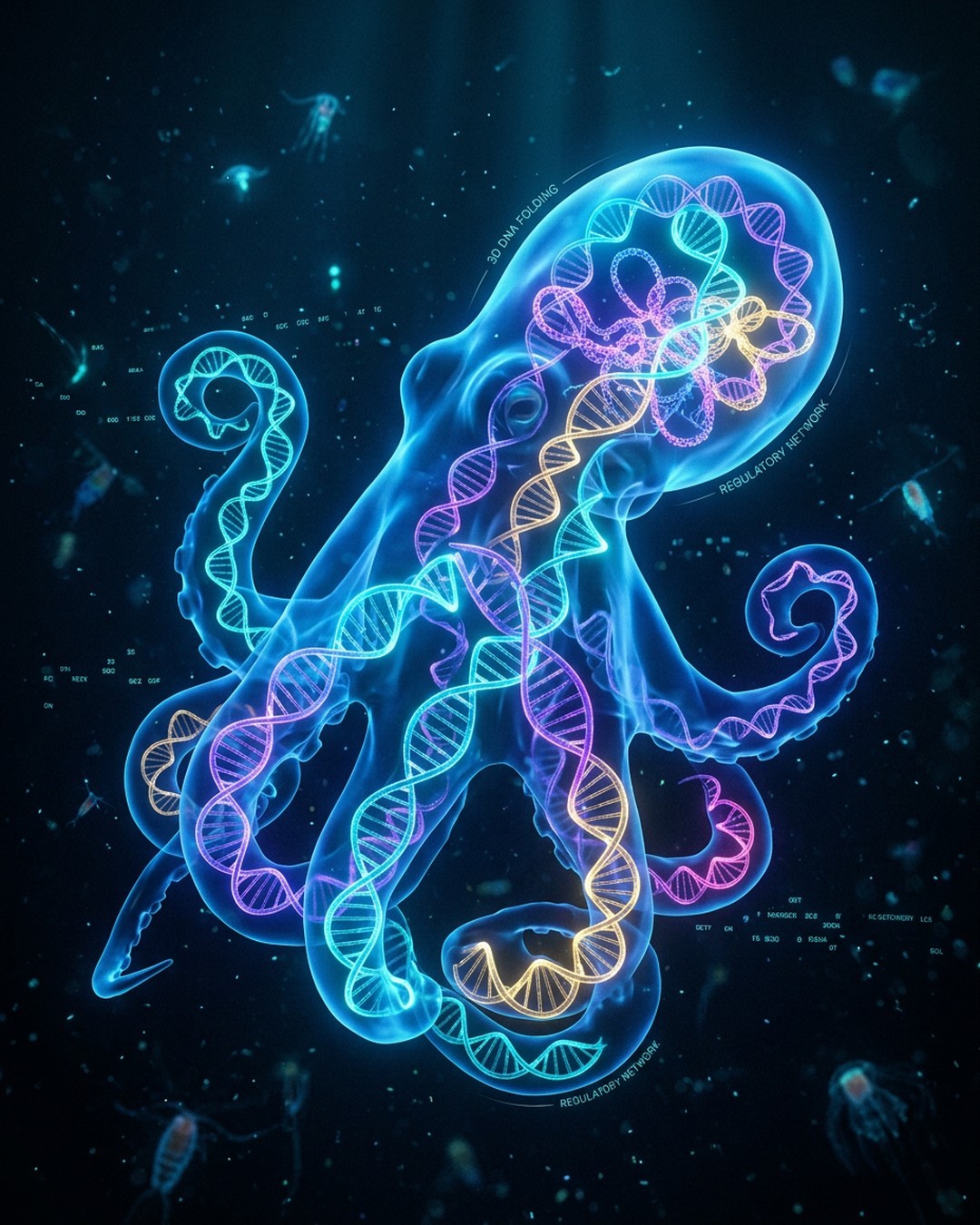
Why Are Octopuses So Smart? 3D DNA Folding

scitechdaily biology evolution genetics marine-biology

Resumo

Imagem de Capa do Mapa Mental
Imagem de Capa Gerada por IA

Recent scientific research published in Nature Communications on October 9, 2026, reveals that the extraordinary intelligence of cephalopods like octopuses, squid, and cuttlefish may be driven by three-dimensional DNA folding rather than gene sequence changes alone. Researchers at the University of Vienna discovered that ancient genome rearrangements caused distant DNA regions to become neighbors, establishing novel regulatory interactions known as regulatory entanglement. The study highlights the adaptive evolutionary role of physical genome architecture, where stable chromatin domains preserve fundamental biological functions while flexible chromatin loops provide evolutionary plasticity. Many of these flexible loops were identified near genes associated with sophisticated nervous systems, offering a compelling explanation for how complex invertebrate intelligence evolved. This research emphasizes that the three-dimensional conformation of genetic material actively guides evolutionary processes and biological complexity. By shifting the focus from linear gene sequences to spatial genome organization, scientists gain new perspectives on how advanced cognitive traits emerge across diverse species. These insights encourage researchers to investigate three-dimensional genomic folding when studying complex physiological traits in other organisms. Understanding regulatory entanglement bridges the gap between structural genetics and evolutionary biology, paving the way for future breakthroughs in evolutionary genomics.

Pontos-chave

01

🔹 Cephalopod Intelligence and DNA Architecture

【📌 Key Finding】Octopuses, squid, and cuttlefish possess remarkable intelligence and sophisticated nervous systems linked to the three-dimensional folding of their DNA rather than just gene sequences. 【🔸 Impact Factors】Published in Nature Communications on October 9, 2026, by researchers from the University of Vienna, the study demonstrates that ancient genome rearrangements reorganized how distant DNA regions interact. 【⭐ Data Support】Lead author Dr. Thea Rogers and colleagues showed that these structural alterations created new regulatory interactions that contributed to the evolution of complex invertebrate behavior.

02

🔸 Mechanism of Regulatory Entanglement

【📌 Key Finding】Extensive genome restructuring hundreds of millions of years ago brought previously separated DNA regions into close physical proximity. 【🔸 Impact Factors】This spatial realignment created opportunities for new regulatory connections, a process termed regulatory entanglement. 【⭐ Data Support】Over time, these interconnected networks allowed cephalopod genomes to evolve novel gene expression patterns while maintaining essential biological operations.

03

⭐ Evolution Rates of Chromatin Structures

【📌 Key Finding】Different levels of genome organization evolve at strikingly disparate rates across species, tissues, and developmental stages. 【🔸 Category Enumeration】Chromatin domains: remained relatively stable over evolutionary time / Chromatin loops: showed high variation and flexibility. 【⭐ Data Support】Flexible chromatin loops bring distant DNA sections into close proximity near genes associated with the cephalopod nervous system.

04

📊 Physical Influence on Evolutionary Processes

【📌 Key Finding】The physical arrangement of DNA actively influences evolutionary processes rather than merely reflecting historical genetic changes. 【🔸 Impact Factors】Stable chromatin domains help preserve existing regulatory organization, whereas dynamic chromatin loops provide opportunities for evolutionary adaptation. 【⭐ Data Support】This dual architectural system explains how complex biological traits like advanced cognition can successfully emerge and stabilize.

05

💡 Research Significance and Citation

【📌 Key Finding】The study titled 'Genome reorganisation and expansion shape 3D genome architecture and define a distinct regulatory landscape in coleoid cephalopods' was published on October 9, 2026. 【🔸 Impact Factors】Authored by Thea F. Rogers, Jessica Stock, Natalie Grace Schulz, Gözde Yalçin, Simone Rencken, Anton Weissenbacher, Tereza Clarence, Darrin T. Schultz, Clifton W. Ragsdale, Caroline B. Albertin, and Oleg Simakov. 【⭐ Data Support】DOI reference 10.1038/s41467-026-77625-7 in Nature Communications.

Quer criar seu próprio mapa mental?

Faça login no Neumap AI e comece a criar seus próprios mapas mentais!

Começar