Brain Stimulation Reliability and Pre-Stimulus States

ScitechDaily BrainStimulation Neuroscience EBRAINS Neuromodulation EpilepsyResearch

Resumo

Imagem de Capa do Mapa Mental
Imagem de Capa Gerada por IA

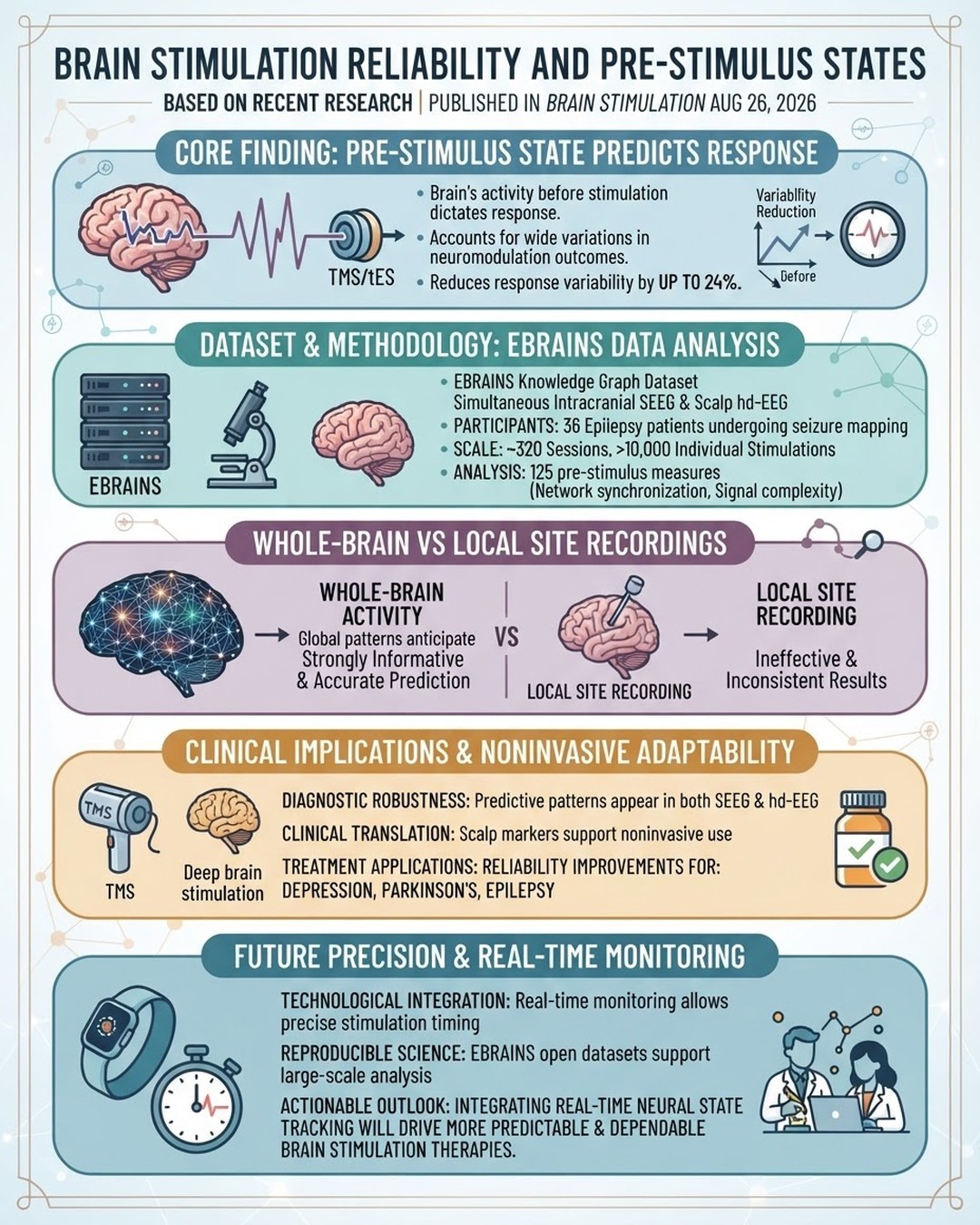
Recent scientific research published in Brain Stimulation on August 26, 2026, reveals that the brain's ongoing state of activity immediately before electrical or magnetic stimulation can significantly predict its response. By analyzing extensive brain recordings hosted by EBRAINS, researchers discovered that accounting for pre-stimulus brain states reduces response variability by as much as 24 percent. The authors emphasize that neuromodulation therapies, which treat conditions like depression, Parkinson's disease, and epilepsy, often suffer from inconsistent patient responses despite identical stimulation settings. Their findings indicate that whole-brain activity patterns are far more informative than local site recordings, with the strongest predictive power observed when targeting sensorimotor and visual networks. The study utilized a comprehensive EBRAINS dataset featuring simultaneous intracranial SEEG and scalp high-density EEG recordings from 36 epilepsy patients across approximately 320 sessions and over 10,000 individual stimulations. Evaluating 125 pre-stimulus measures such as network synchronization, functional connectivity, and signal complexity allowed scientists to pinpoint exact neural signatures that anticipate therapeutic outcomes. These insights pave the way for real-time brain state monitoring to enhance the precision and reliability of clinical neuromodulation therapies. Future medical applications could leverage these predictive signatures in noninvasive clinical devices to optimize the timing of electrical or magnetic pulses and ensure consistent therapeutic efficacy.

Pontos-chave

01

🔹 Core Research Finding and Publication Date

【📌 Key Finding】Published in Brain Stimulation on August 26, 2026, research by Giovanni Rabuffo and colleagues demonstrates that the brain's activity immediately before stimulation dictates its response. 【🔸 Impact Factors】Pre-stimulus brain states account for wide variations in neuromodulation outcomes, helping solve the problem of inconsistent patient responses. 【⭐ Data Support】Targeting specific pre-stimulus brain signatures reduced response variability by up to 24 percent across clinical trials.

02

🔸 Dataset and Methodology Analysis

【📌 Dataset Source】Researchers analyzed an EBRAINS-hosted Knowledge Graph dataset containing simultaneous intracranial SEEG and scalp hd-EEG recordings. 【🔸 Participant Metrics】The study examined 36 people with epilepsy who underwent intracranial electrical stimulation during medical seizure mapping. 【⭐ Evaluation Scale】Across approximately 320 sessions and more than 10,000 individual stimulations, scientists evaluated 125 pre-stimulus activity measures including network synchronization and signal complexity.

03

⭐ Whole-Brain Activity vs Local Site Recordings

【📌 Comparative Superiority】Whole-brain activity proved vastly more informative in predicting neural responses than recordings taken from a single local site. 【🔸 Network Specificity】Predictions reached their strongest accuracy when stimulation targeted the sensorimotor and visual networks. 【⚖️ Key Differences】Global connectivity patterns successfully anticipated therapeutic efficacy, whereas localized electrical tracking yielded highly inconsistent trial outcomes.

04

📊 Clinical Implications and Noninvasive Adaptability

【📌 Diagnostic Robustness】Predictive neural patterns appeared consistently in both intracranial SEEG and scalp hd-EEG recordings. 【🔸 Clinical Translation】The presence of matching surface scalp markers strengthens evidence that this predictive approach can be adapted for noninvasive clinical use. 【⭐ Treatment Applications】Neuromodulation therapies for depression, Parkinson's disease, and epilepsy stand to benefit significantly from these reliability improvements.

05

💡 Real-Time Monitoring and Future Precision

【📌 Technological Integration】Real-time monitoring of ongoing brain states can eventually allow clinicians to time neuromodulation with extreme precision. 【🔸 Reproducible Science】The findings highlight how open datasets on EBRAINS support large-scale reproducible analyses in neuroscience. 【⚡ Actionable Outlook】Integrating real-time neural state tracking into medical hardware will drive more predictable and dependable brain stimulation therapies.

Quer criar seu próprio mapa mental?

Faça login no Neumap AI e comece a criar seus próprios mapas mentais!

Começar