Human and Mouse Olfactory Processing Similarities

scitechdaily biology neuroscience olfactory-system mammalian-evolution

Resumo

Imagem de Capa do Mapa Mental
Imagem de Capa Gerada por IA

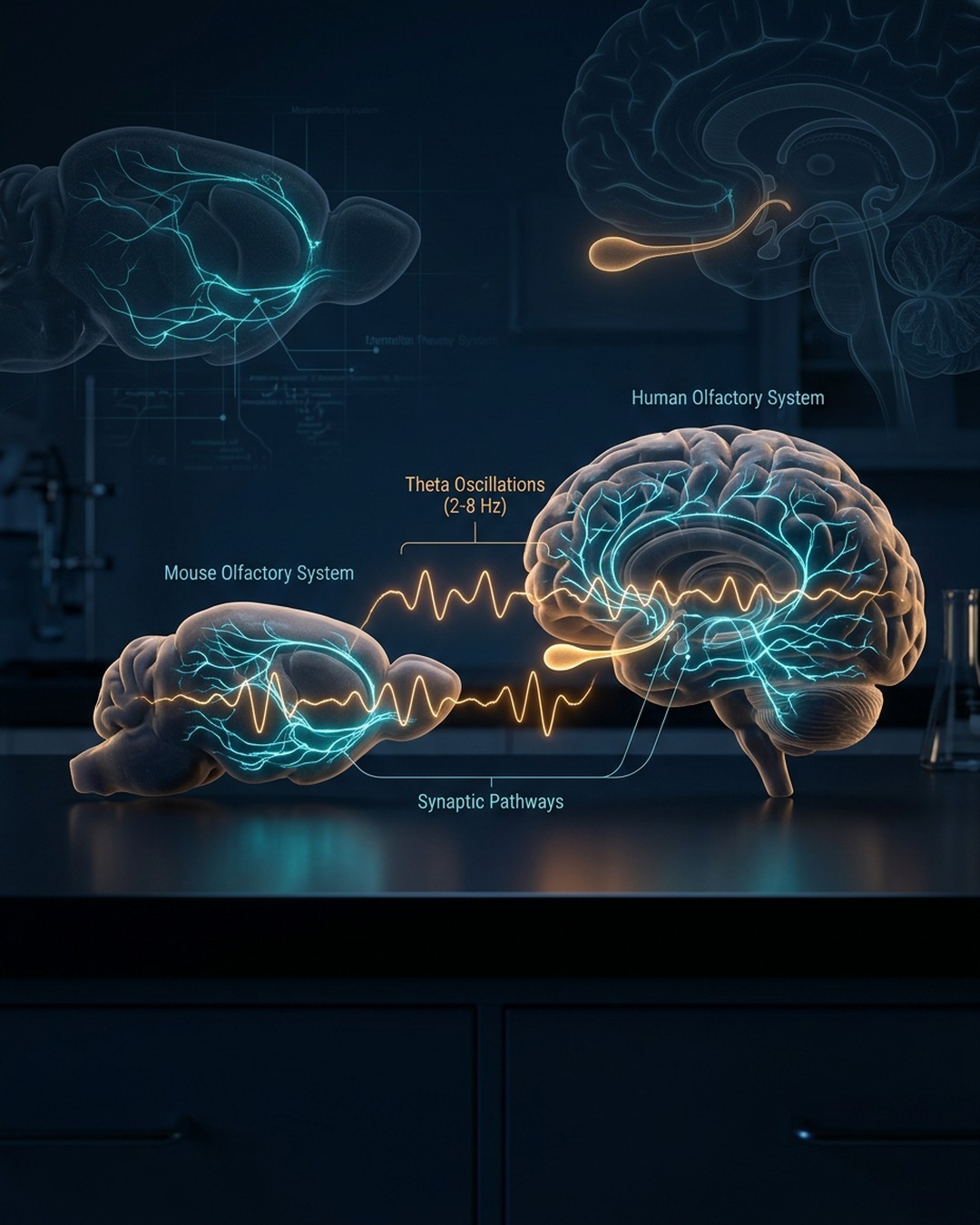
Two complementary studies published in Science Advances on August 4, 2026, by researchers at Northwestern University reveal that humans and mice share a similar ancient neural system for processing smells. Despite mice sniffing rapidly and humans breathing slowly, both species utilize comparable olfactory timing mechanisms. Specifically, mice perform a single intentional sniff when examining food, while humans generate theta oscillations (2 to 8 Hz) in the olfactory bulb during a single slow inhalation, enabling multiple internal processing cycles. The authors emphasize that olfaction is an active, volitional process rather than a passive response to odors, where breathing rate differences compress or expand identical underlying neural timing. The research demonstrates that evolution retained a core design across mammals, adjusting how it operates within distinct breathing patterns. The research establishes that a single deliberate sniff in mice is coordinated with head and paw movements and driven by the motor cortex, whereas a single slow human breath engages theta rhythms that structure faster neural activity for rapid odor analysis. These insights bridge the gap between rodent and human sensory biology. Understanding healthy olfactory circuits provides a vital baseline for neurological research, as sniffing alterations are closely linked to neurodegenerative conditions such as autism, Alzheimer's disease, and Parkinson's disease. Recognizing these conserved mechanisms can help researchers identify when and how sensory processing systems fail in pathology.

Pontos-chave

01

🔹 Shared Olfactory Timing Mechanisms Across Mammals

【📌 Key Finding】Published on August 4, 2026, in Science Advances, two Northwestern University studies demonstrate that humans and mice share an evolutionarily conserved neural system for processing smells. 【🔸 Impact Factors】While mice sniff rapidly multiple times per second and humans inhale slowly at over 10 times slower rates, both species achieve rapid odor identification through similar underlying timing structures. 【⭐ Data Support】Human olfactory bulb recordings reveal low-frequency theta oscillations (2 to 8 Hz) matching the frequency range of repeatedly sniffing rodents.

02

🔸 Intentional Foraging Sniffs in Mice

【📌 Key Finding】Research led by Mang Gao and John M. Barrett in Gordon M. G. Shepherd's lab used a multi-camera robotic system to track freely moving mice. 【🔸 Impact Factors】Mice perform a single, deliberate sniff coordinated precisely with head and forepaw movements when lifting food to their noses. 【⭐ Data Support】This volitional behavior ceases only when scientists silence the motor cortex, proving it is an active sensory sampling act rather than a passive reflex.

03

⭐ Theta Oscillations in Human Odor Processing

【📌 Key Finding】Research led by Andrew Sheriff and Christina Zelano recorded directly from the human olfactory bulb using high-precision, minimally invasive electrodes. 【🔸 Impact Factors】A single slow human inhalation triggers theta oscillations (2–8 Hz), allowing the brain to divide and organize odor information into multiple internal processing cycles. 【⭐ Data Support】While breathing and theta activity are fused in rodents, human slow breathing separates them, showing theta as an independently generated rhythm.

04

📊 Implications for Neurological Diseases

【📌 Key Finding】Alterations in sniffing behaviors and olfactory function are strongly associated with neurodegenerative and developmental disorders. 【🔸 Impact Factors】Recognizing how healthy mammalian smell circuits operate provides a foundation for identifying pathological breakdown. 【⭐ Data Support】The findings offer potential diagnostic biomarkers and insights for conditions such as autism, Alzheimer's disease, and Parkinson's disease.

05

💡 Active Sensory Perception and Evolution

【📌 Key Finding】Smell is an active decision-making process where timing is coordinated with movement, attention, and expectation. 【🔸 Impact Factors】Evolution did not invent a new human olfactory system; instead, it retained core mammalian neural design while adapting it to slower breathing patterns. 【⭐ Data Support】Both mice and humans successfully compress or expand neural timing to guide immediate actions like evaluating food quality.

Quer criar seu próprio mapa mental?

Faça login no Neumap AI e comece a criar seus próprios mapas mentais!

Começar