Black Holes May Not Be Bottomless Pits

scitechdaily astronomy black-hole university-of-warwick very-large-telescope

Resumo

Imagem de Capa do Mapa Mental
Imagem de Capa Gerada por IA

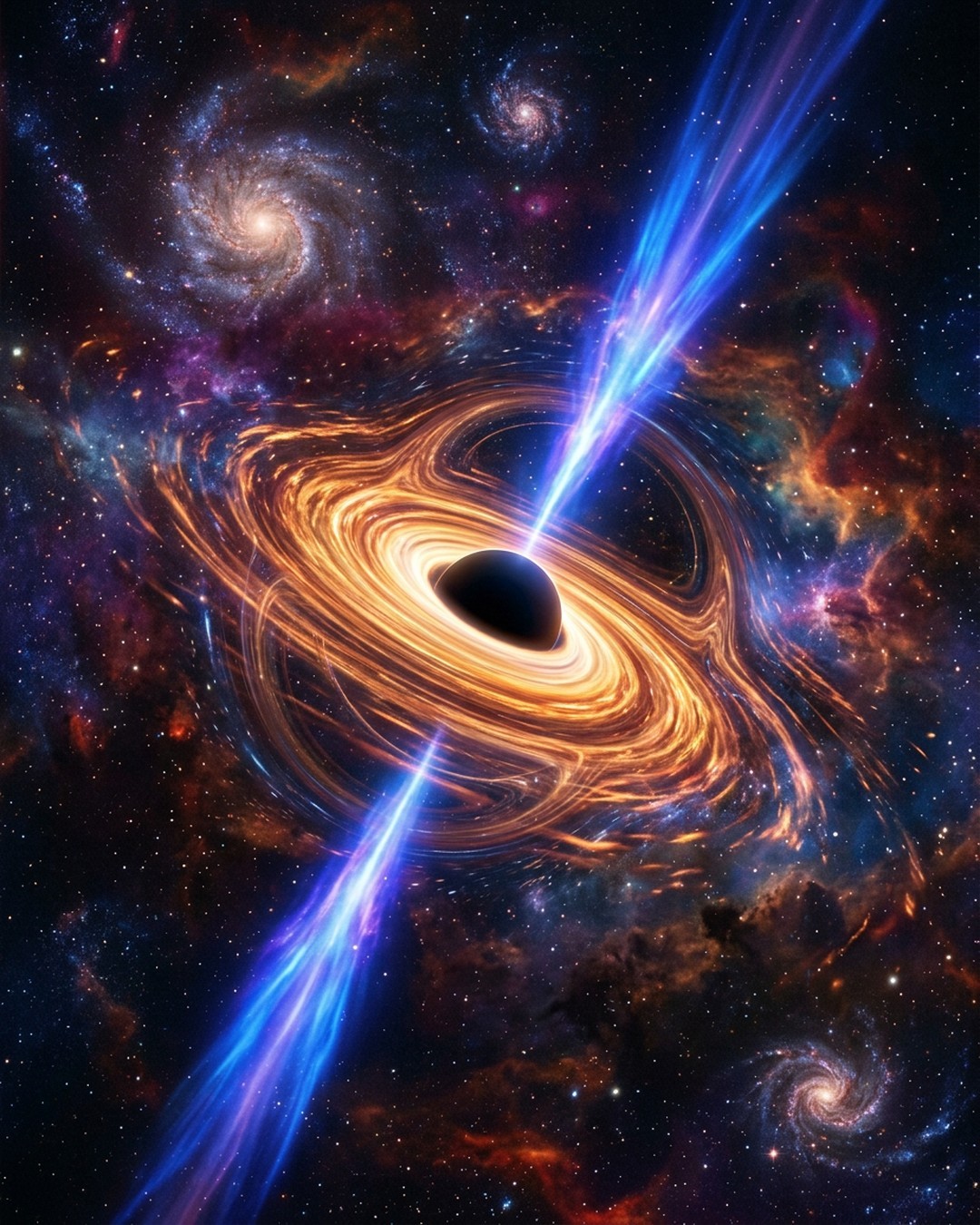
Astronomers led by the University of Warwick published findings on August 5, 2026, revealing that black holes may not act as simple bottomless pits that swallow everything in their path. Through detailed observations of the transient black hole system Swift J1727.8−1613 during its 2023 eruption using the European Southern Observatory's Very Large Telescope, researchers discovered that black holes function more like cosmic digestive systems that process and expel a significant amount of matter back into space. The author conveys the perspective that traditional views of black holes as unstoppable consumers are incomplete, demonstrating instead that they are active systems capable of redistributing matter through powerful jets and winds even after their primary outbursts have faded significantly. The research highlights that dense gas and powerful outflows continue to emerge even when the system dims to roughly one hundredth of its peak X-ray emission activity, implying that a substantial fraction of incoming stellar material may never actually reach the black hole. These insights change our understanding of binary star evolution in galaxies, suggesting that black holes are inefficient eaters and pointing toward new pathways for future astrophysical research into accretion discs and cosmic mass redistribution.

Pontos-chave

01

🔹 August 5, 2026 Discovery Overview

【📌 Key Finding】Astronomers led by the University of Warwick published research on August 5, 2026, showing that black holes are not simple bottomless pits but function like cosmic digestive systems.【🔸 Impact Factors】Observations of the transient black hole system Swift J1727.8−1613 captured via the European Southern Observatory's Very Large Telescope during its 2023 eruption.【⭐ Data Support】The system rapidly evolved into one of the brightest X-ray sources in the sky before dimming to roughly one hundredth of its peak activity while continuing to expel matter.

02

🔸 Continuous Outflows and Late-Stage Eruptions

【📌 Key Finding】Powerful jets and dense gas winds continued to emerge long after the main feeding frenzy had ended.【🔸 Impact Factors】Even when X-ray emission dropped to a small fraction of its peak, the system retained enough power to generate massive gas expulsions.【⭐ Data Support】The total amount of matter expelled during late-outburst phases can be comparable to the amount ultimately consumed by the black hole.

03

⭐ Inefficient Eaters and Accretion Disc Dynamics

【📌 Category Listing】Black hole feeding behavior involves incoming stellar gas forming a rotating disc of extremely hot material connected directly to jet launches.【⚖️ Comparative Analysis】Traditional view: unstoppable swallowing of all nearby matter / Modern observation: processing and redistribution of a significant fraction back into space.【⭐ Data Support】Published in Monthly Notices of the Royal Astronomical Society on July 29, 2026, under DOI 10.1093/mnras/stag1175.

04

📊 Observational Methodology and Telescope Use

【📌 Process Steps】Detection of Swift J1727.8−1613 in 2023 → Real-time tracking of eruption stages using Very Large Telescope (VLT) → Analysis of disc response to jet ejections and late-outburst winds.【⭐ Data Support】Led by Dr. Noel Castro Segura alongside co-authors including Kyle Solomons from the University of Cape Town and researchers across multiple international institutions.

05

💡 Astrophysical Implications for Binary Stars

【📌 Core Significance】The realization that black holes are inefficient eaters alters current models of how binary star systems evolve within galaxies.【🛡️ Prevention & Outlook】Researchers must account for mass redistribution and delayed outflows rather than assuming all captured stellar material contributes directly to black hole growth.

Quer criar seu próprio mapa mental?

Faça login no Neumap AI e comece a criar seus próprios mapas mentais!

Começar