Theoretical Framework for Non-Reciprocal Systems

Physics Biophysics QuantumMechanics TUDresden ScientificResearch

Resumo

Imagem de Capa do Mapa Mental
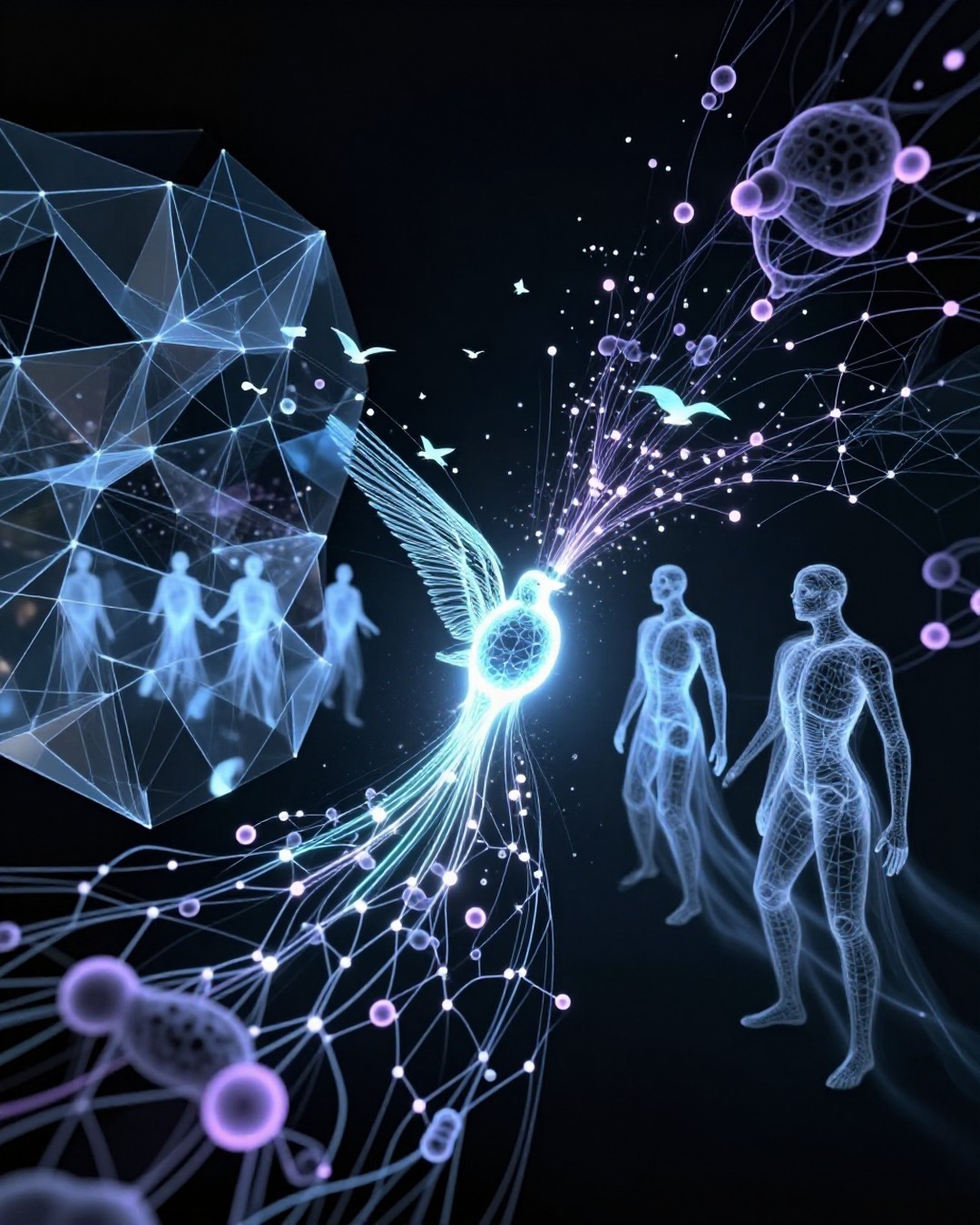
Imagem de Capa Gerada por IA

Physicists at the Würzburg–Dresden Cluster of Excellence ctd.qmat have developed a groundbreaking theoretical framework to describe and simulate non-reciprocal systems, such as bird flocks, bacterial swarms, and tissue cells. These systems appear to violate Newton's third law of motion because interactions flow in only one direction, meaning individuals respond to their environment without an equal and opposite reaction from their surroundings. The research team, led by Roderich Moessner and including Marín Bukov and Ricard Alert, addresses this challenge by introducing auxiliary degrees of freedom. By creating fictitious partner components for each real element in a system, the researchers can mathematically transform non-reciprocal interactions into reciprocal ones, allowing the use of established classical mechanics tools for precise simulation and analysis. This innovation bridges the gap between traditional theoretical mechanics and the complex, collective behaviors observed in biological and active matter systems. The methodology provides a robust foundation for future research into how these non-reciprocal interactions might give rise to novel quantum phenomena, such as magnetism or lossless current transport, in complex matter. The study, published on June 12, 2026, in Nature Physics, offers a versatile tool for scientists to model collective movement more accurately. This advancement not only simplifies the study of biological swarms but also opens new avenues for exploring quantum matter dynamics, potentially leading to discoveries in how non-reciprocal systems influence collective quantum behavior.

Pontos-chave

01

🔹 The Challenge of Non-Reciprocal Systems

Newton's third law (action equals reaction) is a cornerstone of classical mechanics. However, collective systems like bird flocks, bacterial swarms, and tissue cells exhibit non-reciprocal interactions. In these systems, individuals react to their environment (e.g., birds responding to neighbors ahead of them) without an equal and opposite reaction from the environment, making traditional simulation methods ineffective.

02

🔸 The Theoretical Solution: Auxiliary Degrees of Freedom

Researchers developed a theory that introduces 'fictitious partners' for each real component in a system. By assigning an artificial counterpart to every real bird or cell, the team can mathematically treat the non-reciprocal system as a reciprocal one. This allows the application of established many-body physics frameworks to describe and simulate these complex behaviors with high precision.

03

⭐ Research Significance and Methodology

The study, published in Nature Physics on June 12, 2026, provides a missing tool in theoretical mechanics. By extending the action-reaction framework, the team enables scientists to analyze systems that were previously difficult to simulate. This approach is essential for studying biological processes and collective movement in both macroscopic swarms and microscopic cellular groups.

04

📊 Future Implications for Quantum Matter

Principal Investigator Roderich Moessner highlights that the research opens doors to understanding quantum matter. The team is now investigating whether these exceptions to Newton's law lead to entirely new forms of collective quantum behavior, such as magnetism or lossless current transport, which could redefine our understanding of complex quantum systems.

05

💡 Key Contributors and Institutional Context

The research was conducted by a team at the Würzburg–Dresden Cluster of Excellence ctd.qmat (Complexity, Topology and Dynamics in Quantum Matter). Key contributors include physicist Roderich Moessner (Director of the Max Planck Institute for the Physics of Complex Systems), biophysicist Ricard Alert, and research group leader Marín Bukov, with the study titled 'Hamiltonian description of non-reciprocal interactions'.

Quer criar seu próprio mapa mental?

Faça login no Neumap AI e comece a criar seus próprios mapas mentais!

Começar