First Documented Feline Marfan Syndrome in Brothers Gary and Shaggy

marfan-syndrome cornell-university veterinary-genetics feline-research scientific-reports

Summary

Mind Map Cover Image
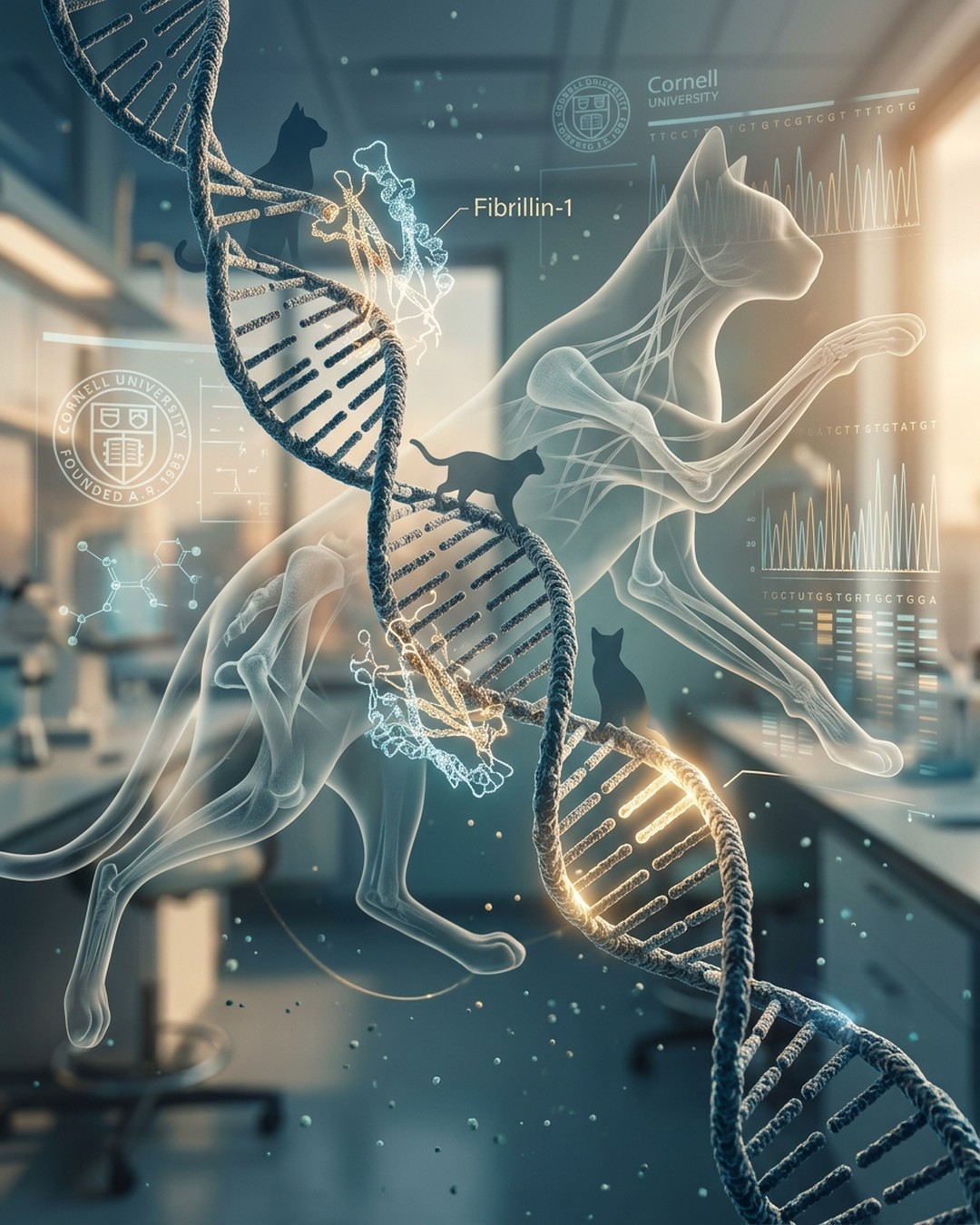
AI Generated Cover Image

Researchers at Cornell University have documented the first known feline cases of Marfan syndrome in two brothers named Gary and Shaggy, who reached adulthood despite inheriting two altered copies of the FBN1 gene. The study, published in Scientific Reports on September 19, 2026, provides the first molecular characterization of this rare connective tissue disorder in domestic cats. The authors emphasize that unlike humans, where a single altered FBN1 copy causes the condition and two copies are extremely rare, these cats carried two mutated copies that retained partial gene function. This hypomorphic splice region variant disrupted only part of the preparation process, leaving enough normal fibrillin-1 production to prevent severe early mortality. The essence of this discovery lies in understanding how partial hypomorphic function allows survival in rare homozygous mutations. The multidisciplinary team combined clinical evaluations, which showed long limbs, eye structural problems, and aortic enlargement, with genetic sequencing to confirm the exact mutation lineage. These findings establish a critical foundation for improved veterinary diagnostics and the future development of genetic tests to identify similar connective tissue disorders in pets. Practitioners can utilize these molecular insights to better recognize feline Marfan syndrome cases in clinical settings.

Key Points

01

🔹 First Documented Feline Marfan Syndrome

【📌 Key Finding】Two feline brothers named Gary and Shaggy are documented as the first domestic cats with Marfan syndrome. 【🔸 Impact Factors】The study published on September 19, 2026, in Scientific Reports provides the first molecular characterization of the rare inherited disorder in cats. 【⭐ Data Support】Marfan syndrome affects approximately 1 in 4,000 people and weakens connective tissues throughout the body.

02

🔸 Genetic Mechanism and Mutation Details

【📌 Key Finding】Both cats inherited two altered copies of the FBN1 gene, one from each parent. 【🔸 Impact Factors】The FBN1 gene provides instructions for making fibrillin-1, a crucial building block for connective tissues in blood vessels, bones, ligaments, skin, and eyes. 【⭐ Data Support】While a single altered copy causes the condition in humans, inheriting two copies is extremely rare and usually severe.

03

⭐ Partial Gene Function Explains Survival

【📌 Key Finding】The specific genetic alteration was a hypomorphic splice region variant that disrupted only part of the gene preparation process. 【🔸 Impact Factors】This mutation left some normal fibrillin-1 production intact rather than shutting the gene down completely. 【⭐ Data Support】This partial function explains why the brothers successfully survived into adulthood without experiencing more severe, fatal disease manifestations.

04

📊 Clinical Signs and Veterinary Diagnostics

【📌 Key Finding】Clinical evaluations revealed noticeably long limbs during kittenhood, structural eye problems, and aortic enlargement. 【🔸 Impact Factors】Senior author Dr. Jacquelyn Evans noted that these findings establish a foundation for improved veterinary diagnostics. 【⭐ Data Support】The research will help veterinarians recognize similar cases in the future and support the development of targeted genetic tests.

05

💡 Research Support and Collaborative Team

【📌 Key Finding】The multidisciplinary research team included experts from Cornell University's College of Veterinary Medicine and the Baker Institute for Animal Health. 【🔸 Impact Factors】The published study was supported in part by The Hartwell Foundation. 【⭐ Data Support】Co-authors include Shawna R. Cook, Jessica J. Hayward, Soon Hon Cheong, and corresponding principal investigators.

Want to create your own mindmap?

Login to Neumap AI and start creating your own mindmaps!

Get Started