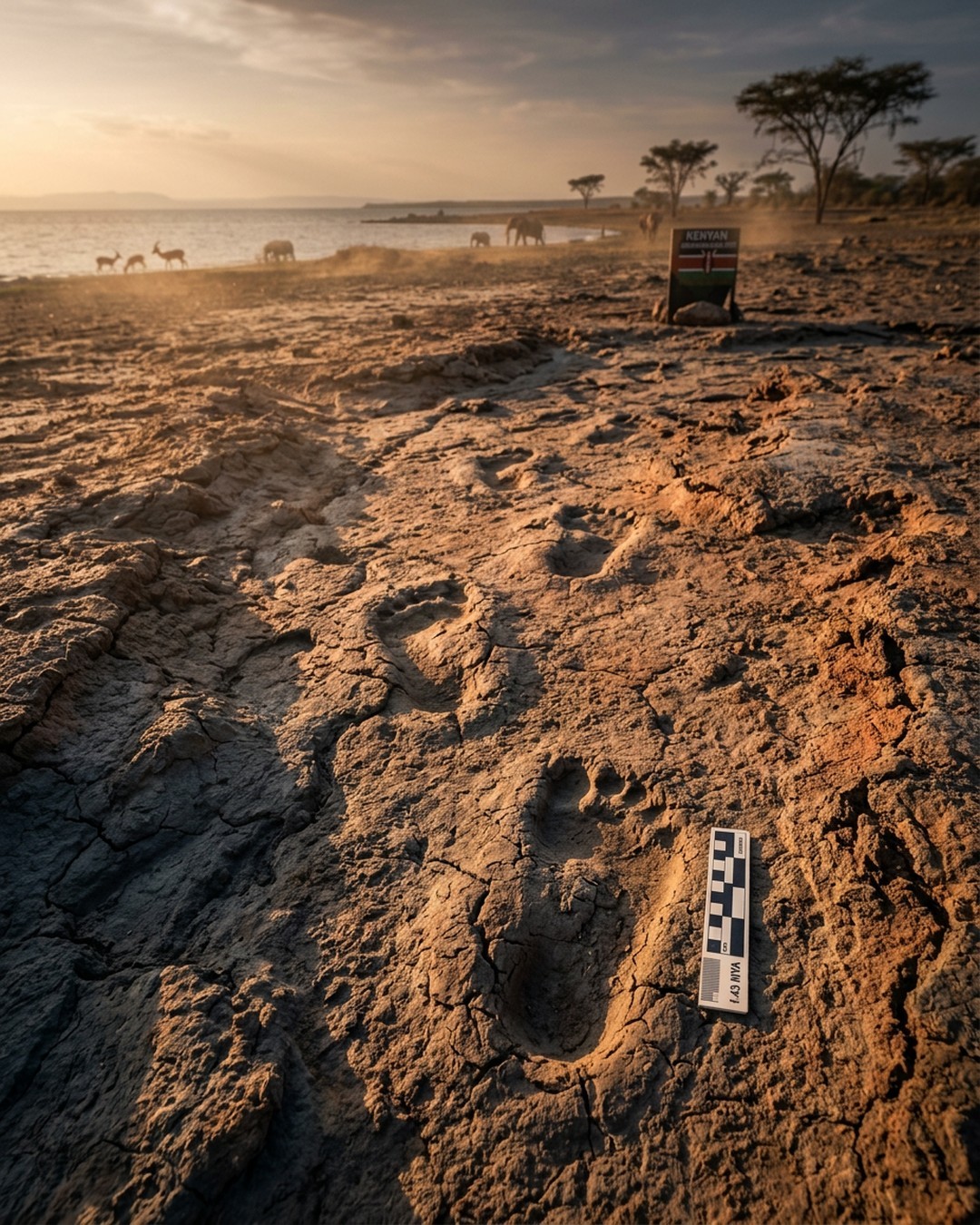
Mystery Hominin Footprints at Lake Turkana, Kenya

antiquity anthropology evolution kenya paleoanthropology

Summary

Mind Map Cover Image
AI Generated Cover Image

Researchers have analyzed 21 ancient hominin footprints discovered at the Lake Turkana site in Kenya, specifically known as GaJi10, dating back approximately 1.43 million years. The tracks were made in shallow mud by a group of eight individuals who co-existed alongside various African wildlife, including hippopotamuses, birds, and bovids. The primary mystery centers on the identity of the trackmakers, as the footprints exhibit anatomical features that do not neatly align with the two known hominin species inhabiting the region during that era, namely Homo erectus and Paranthropus boisei. The morphological characteristics strongly resemble Paranthropus boisei due to flatter arches and an angled big toe, yet their immense size suggests individuals stood over 180 centimetres tall, challenging previous scientific assumptions. Kevin Hatala and his research team outline three distinct possibilities regarding the footprints, evaluating whether they belong to exceptionally large Paranthropus boisei, Homo erectus with extreme morphological variation, or an entirely undiscovered hominin species. The height profile of the group further indicates that the traveling party likely consisted exclusively of males navigating a dangerous lakeshore environment. This discovery expands our understanding of early hominin physical diversity, locomotion, and ecological interactions during the Pleistocene epoch. Future paleoanthropological research will continue utilizing footprint analysis to reconstruct ancient hominin behavior and resolve long-standing debates regarding species distribution and body size limits in early human ancestors.

Key Points

01

🔹 Discovery of 1.43-Million-Year-Old Footprints at Lake Turkana

Researchers analyzed 21 ancient hominin footprints discovered at the GaJi10 site near Lake Turkana, Kenya, dating back approximately 1.43 million years. These tracks were formed in shallow mud measuring between 2 and 10 centimetres deep at the edge of an ancient lake, capturing a snapshot of a group of eight hominins traveling together alongside diverse wildlife such as hippopotamuses, bovids, birds, and equids.

02

🔸 Morphological Dilemma Between Homo erectus and Paranthropus boisei

Fossil evidence from the region indicates two co-existing hominin species: Homo erectus and Paranthropus boisei. However, the newly analyzed footprints present a scientific puzzle because their anatomical shape resembles Paranthropus boisei—featuring flatter arches and a big toe angled away from other digits—while their massive size significantly exceeds previous biological expectations for that species.

03

⭐ Challenging Previous Estimates of Body Size and Species Variation

Previous estimates suggested that the largest members of Paranthropus boisei reached just over 160 centimetres in height, but these footprints indicate a stature exceeding 180 centimetres if made by this species. Alternatively, if attributed to Homo erectus, the tracks imply a range of morphological variation in footprint structure that far exceeds anything observed in large sample sets of modern humans.

04

📊 Evaluation of Three Competing Hypotheses by Researchers

Lead researcher Kevin Hatala outlines three core hypotheses: first, that the tracks belong to Paranthropus boisei, vastly expanding upper body size limits; second, that they belong to Homo erectus with extreme morphological variation; or third, that they represent an entirely different, undiscovered hominin species, though fossil records make the third option unlikely.

05

💡 Ecological Context and Social Behavior of Ancient Hominins

The presence of numerous hippopotamus fossils alongside the hominin tracks indicates that the lakeshore environment posed genuine dangers, suggesting that whatever motivated the group to travel there—such as seeking water or food sources—was deemed worth the risk. Furthermore, the uniform height profile of the group suggests it likely consisted of males traveling together.

Want to create your own mindmap?

Login to Neumap AI and start creating your own mindmaps!

Get Started