New Compound LASSS Helps Aging Muscles Repair Themselves

scitechdaily biology muscle-aging kyushu-university health-breakthrough

Summary

Mind Map Cover Image
AI Generated Cover Image

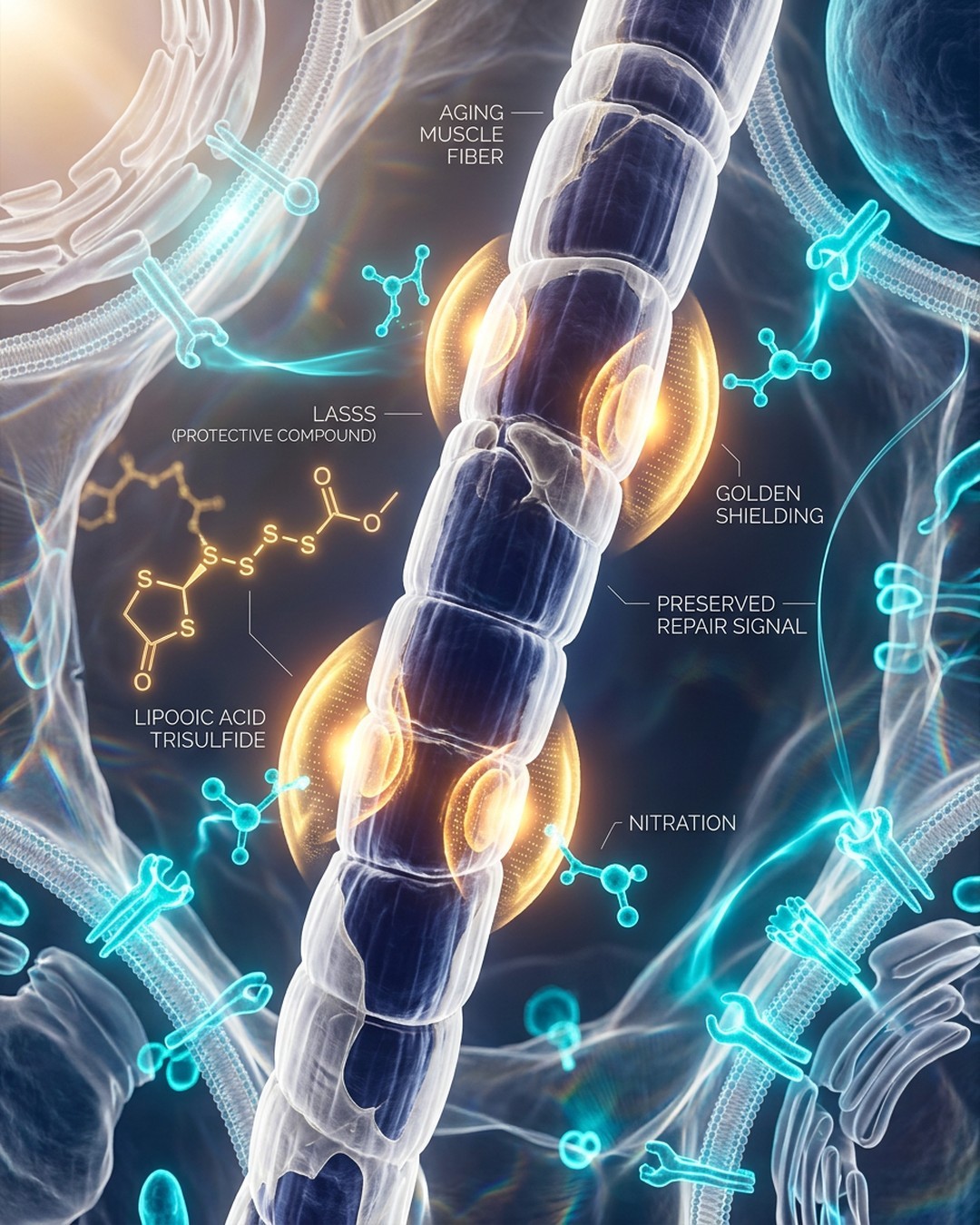
Researchers at Kyushu University published a study on July 24, 2026, in 'Scientific Reports' identifying a sulfur-containing compound, lipoic acid trisulfide (LASSS), that protects aging muscle repair signals from chemical damage. Skeletal muscle deterioration during aging is often caused by the chemical modification of hepatocyte growth factor (HGF) through nitration at specific sites Y198 and Y250, which prevents it from binding to c-met receptors on satellite cells. The research team demonstrated that treating HGF with LASSS at an increased molar ratio of 1:8000 converts the protein into an enhanced form termed 'Super HGF'. This modified factor exhibits more than twice the receptor-binding affinity of untreated HGF and displays increased resistance to nitration-induced dysfunction, outperforming another tested trisulfide compound, glutathione trisulfide (GSSSG). Animal experiments utilizing a tail suspension mouse model of muscle atrophy confirmed that pretreatment with LASSS significantly reduced HGF nitration compared to untreated subjects. This indicates that LASSS provides protection beyond simple antioxidant activity by directly interacting with HGF and inducing structural changes that preserve its regenerative capacity during periods of inactivity. These preliminary findings suggest a promising alternative therapeutic strategy for age-related muscle loss and inactivity-induced atrophy by safeguarding existing repair signals rather than replacing missing growth factors. While currently validated only in laboratory and animal models, this mechanism holds potential future applications for preserving mobility and independence in humans and companion animals.

Key Points

01

🔹 Core Discovery of Lipoic Acid Trisulfide (LASSS)

Researchers at Kyushu University identified that a sulfur-containing compound called lipoic acid trisulfide (LASSS) can shield vital muscle repair signals from chemical damage. Published on July 24, 2026, in 'Scientific Reports', the study reveals that LASSS converts hepatocyte growth factor (HGF) into 'Super HGF', which exhibits enhanced binding affinity to c-met receptors on satellite cells.

02

🔸 Mechanism of Age-Related Muscle Decline via Nitration

Aging skeletal muscle often retains repair signals like hepatocyte growth factor (HGF), but the protein becomes dysfunctional due to nitration. Reactive molecules add nitro groups to specific locations on the protein, specifically Y198 and Y250, weakening its connection to c-met receptors and disproportionately damaging fast-twitch muscle fibers responsible for explosive force.

03

⭐ Superiority of LASSS Over Traditional Antioxidants

When tested against glutathione trisulfide (GSSSG) and LASSS at a 1:8000 molar ratio, only LASSS successfully increased HGF receptor-binding affinity by more than two times while resisting nitration. This proves that LASSS functions through direct structural interaction with HGF rather than relying solely on general antioxidant activity.

04

📊 In Vivo Validation Using Mouse Atrophy Models

To test real-world application, researchers subjected mice to tail suspension, an established model for muscle atrophy caused by physical inactivity. Mice pretreated with LASSS developed significantly lower levels of HGF nitration compared to untreated control groups, confirming the protective efficacy of the compound in living biological systems.

05

💡 Therapeutic Implications for Humans and Pets

Instead of replacing missing growth factors, future treatments could utilize LASSS to protect existing repair signals from degradation during aging or extended bed rest. Because comparable HGF mechanisms exist across mammals, this discovery offers future therapeutic potential for preserving mobility in humans, cats, and dogs.

Want to create your own mindmap?

Login to Neumap AI and start creating your own mindmaps!

Get Started