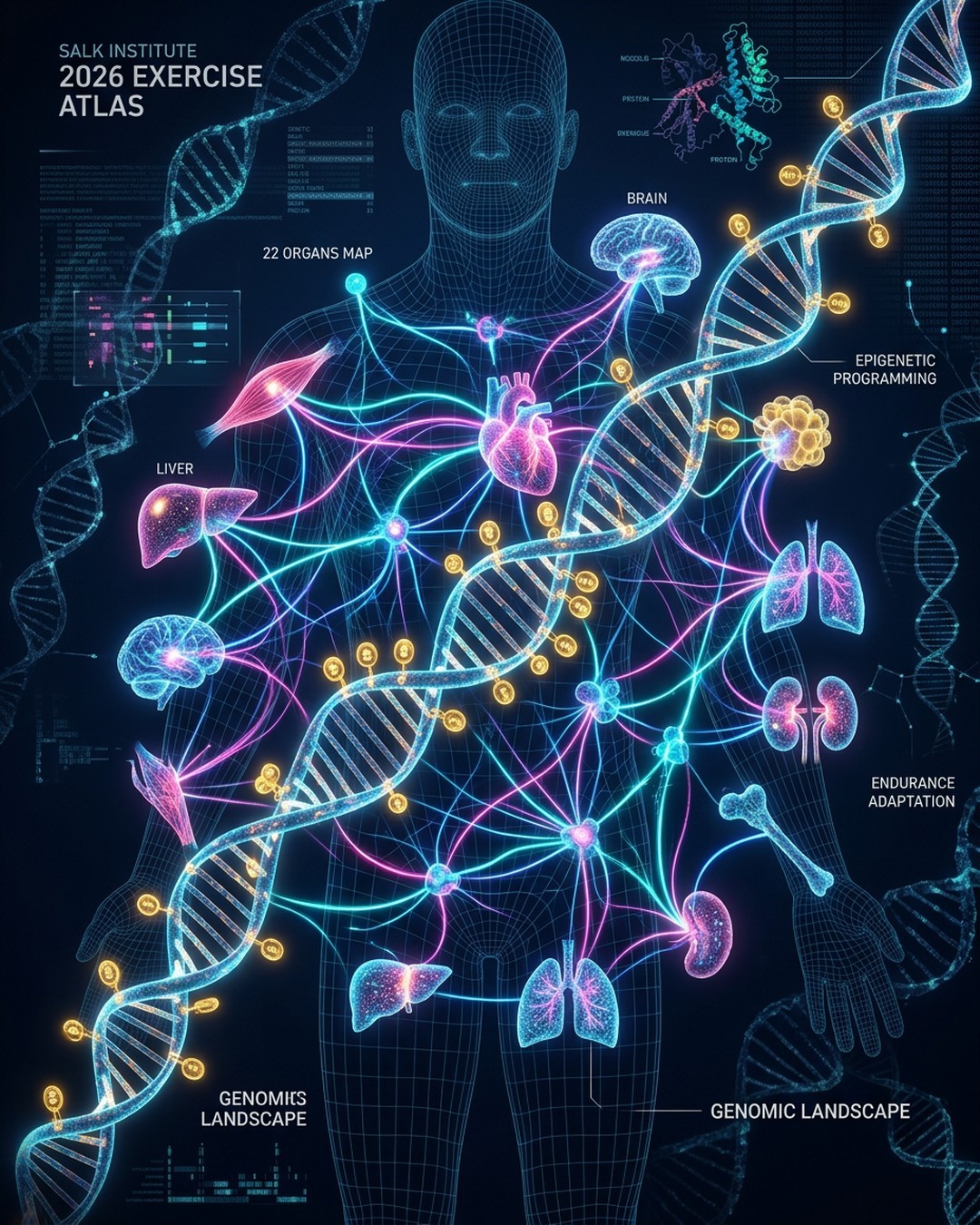
Published in October 2026 by researchers at the Salk Institute, this landmark study constructs the first comprehensive molecular atlas detailing systemic adaptations across 22 mouse tissues following eight weeks of voluntary endurance exercise. While clinical data demonstrates that regular physical exercise reduces all-cause mortality, cardiovascular disease, and cancer risk by more than 30 percent, scientific understanding has historically been constrained by reliance on accessible human blood and muscle biopsies. By evaluating voluntary wheel running across both sexes, the study captures organ-wide multi-omic modifications across whole tissues and individual cell nuclei.
The researchers emphasize that exercise is fundamentally an integrated, whole-body physiological phenomenon rather than a muscle-isolated process. Contrary to the common assumption of a universal exercise response pathway, bulk RNA sequencing revealed that no single gene altered its activity across all 22 surveyed tissues, proving that organs undergo highly divergent, tissue-specific adaptations. The authors assert that high-resolution single-cell and single-nucleus profiling is indispensable, as conventional bulk tissue analysis inevitably obscures critical cell-type-specific genomic and epigenetic programs.
The multi-omic framework systematically integrated bulk transcriptomics across 22 tissues, metabolomic profiling across eight organs and blood plasma, and proteomic quantification across four distinct leg muscles. Furthermore, the scientists applied single-nucleus RNA sequencing and the first post-exercise single-cell DNA methylation profiling across skeletal muscles, uncovering long-lasting epigenetic marks in specific cell lineages. The investigation also mapped significant sexual dimorphism, showing that female mice exhibited broader transcriptional and epigenetic reprogramming than males, alongside pronounced diurnal sensitivity where exercise-induced molecular signals peaked predominantly during the circadian active phase.
These molecular findings provide immediate translational utility through the establishment of a robust 51-gene exercise signature capable of distinguishing exercise-trained from sedentary muscle across both rodents and humans. This molecular fingerprint serves as an objective biomarker to evaluate muscle disuse, sarcopenia, and systemic physical fitness. Furthermore, recognizing circadian and sex-specific gene activation trajectories offers practical blueprints for optimizing training periodicity, personalizing athletic programming, and designing targeted therapeutics for individuals unable to perform sustained physical exercise.