New Gentoo Penguin Species Discovery and Genomic Taxonomy

ScitechDaily Biology PenguinSpecies GenomicResearch ClimateChange UCBerkeley

Summary

Mind Map Cover Image
AI Generated Cover Image

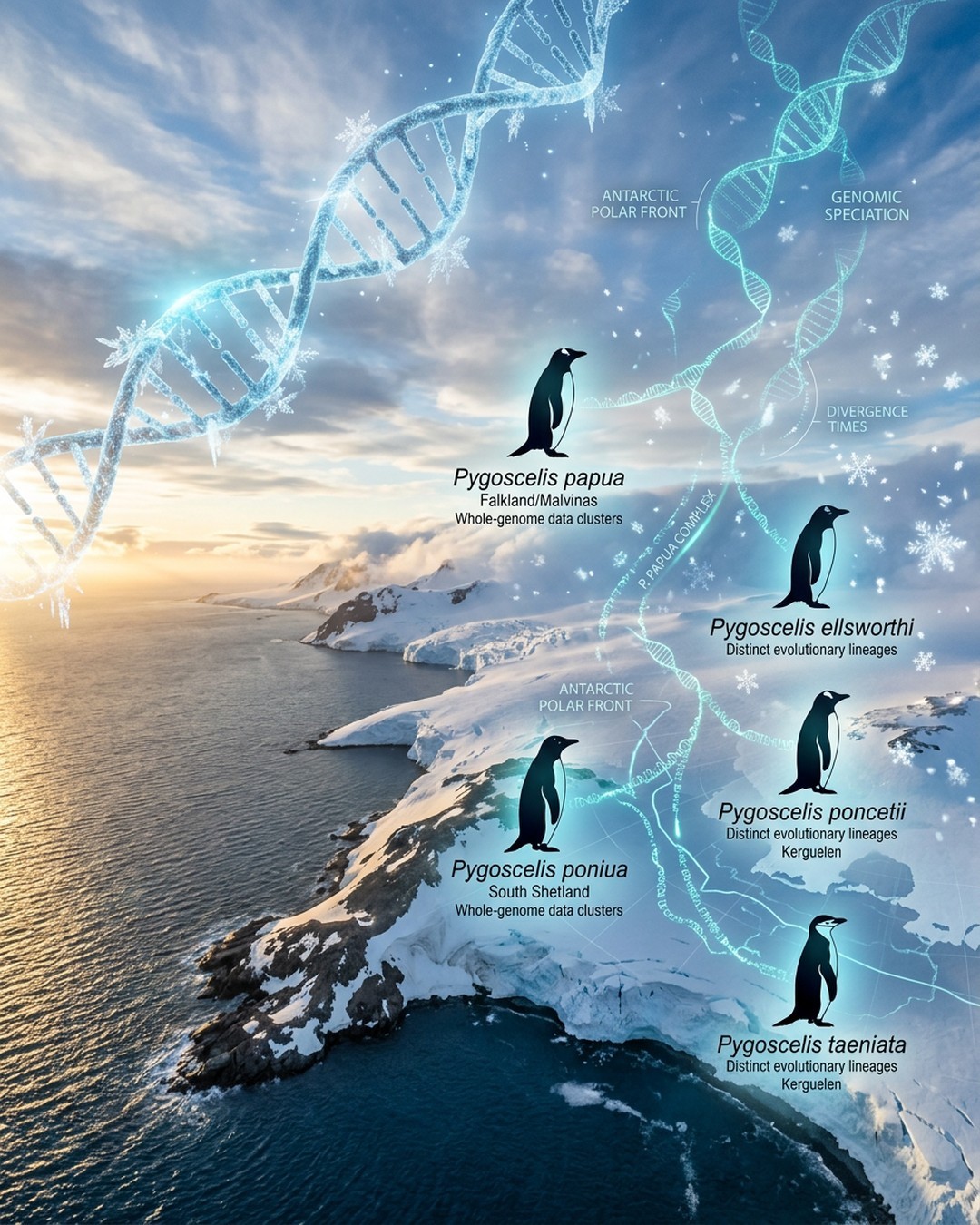
Genetic research published on September 3, 2026, in Communications Biology revealed that what scientists previously considered a single widespread gentoo penguin species is actually composed of four distinct species. An international research team led by scientists from Chile and the University of California, Berkeley identified a newly recognized species, Pygoscelis kerguelensis, on the remote Kerguelen Islands, marking the first newly named penguin species in over a century. The authors emphasize that despite major genetic separation, these cryptic species exhibit subtle physical similarities such as black backs and white undersides, which previously hid their diversity. The study utilized whole-genome sequences from 64 penguins across 10 breeding colonies to resolve a century-old taxonomy debate and analyze distinct genetic adaptations related to climate, metabolism, and diving capabilities. The research establishes that isolation over 300,000 to 500,000 years and the Antarctic Polar Front drove speciation among gentoo populations distributed across sub-Antarctic islands and Antarctica. While southern gentoo populations in Antarctica may benefit from shrinking sea ice, sub-Antarctic island species face severe habitat loss under moderate climate warming scenarios by 2050. Conservation institutions across nations governing sub-Antarctic islands must recognize these three newly elevated gentoo species and take targeted action to protect vulnerable populations. The comprehensive genomic dataset also provides vital resources for tracking health threats like avian influenza across global penguin colonies.

Key Points

01

🔹 Discovery of a New Gentoo Penguin Species

Published on September 3, 2026, in Communications Biology, genetic research led by scientists from UC Berkeley and Chile identified a new gentoo penguin species, Pygoscelis kerguelensis, on the Kerguelen Islands. This marks the first newly named penguin species in over 100 years, uncovered through whole-genome sequencing of 64 penguins across 10 colonies.

02

🔸 Resolution of a Century-Old Taxonomy Debate

Researchers determined that previous subspecies classifications were inadequate, establishing that gentoo penguins comprise four distinct species: Pygoscelis kerguelensis (southeastern lineage), Pygoscelis taeniata (eastern lineage), Pygoscelis papua (northern lineage), and Pygoscelis ellsworthi (southern lineage). Cryptic physical similarities had previously masked this major genetic separation.

03

⭐ Drivers of Speciation and Genetic Adaptations

Isolation over 300,000 to 500,000 years, reinforced by the Antarctic Polar Front and adaptable feeding behaviors, drove the evolution of separate species. Populations developed unique genetic traits: southern gentoo penguins possess genes for heat production and fat storage; eastern gentoos show carbohydrate metabolism and diving adaptations; northern gentoos exhibit digestive and heart function patterns.

04

📊 Climate Change Vulnerabilities and Habitat Projections

Climate models estimating habitat suitability by 2050 under moderate warming indicate that sub-Antarctic island species could lose all habitable conditions on their current islands with few alternatives. Conversely, the southern gentoo population, Pygoscelis ellsworthi, may expand its range in Antarctica as specialized penguin species decline due to shrinking sea ice and falling krill populations.

05

💡 Conservation Implications and Genomic Applications

Senior authors Juliana Vianna and Rauri Bowie emphasize that conservation institutions in Chile, South Africa, France, the Netherlands, Australia, and New Zealand must recognize the three sub-Antarctic gentoo species. Furthermore, the massive genomic dataset is actively utilized to identify populations vulnerable to global threats such as avian influenza.

Want to create your own mindmap?

Login to Neumap AI and start creating your own mindmaps!

Get Started