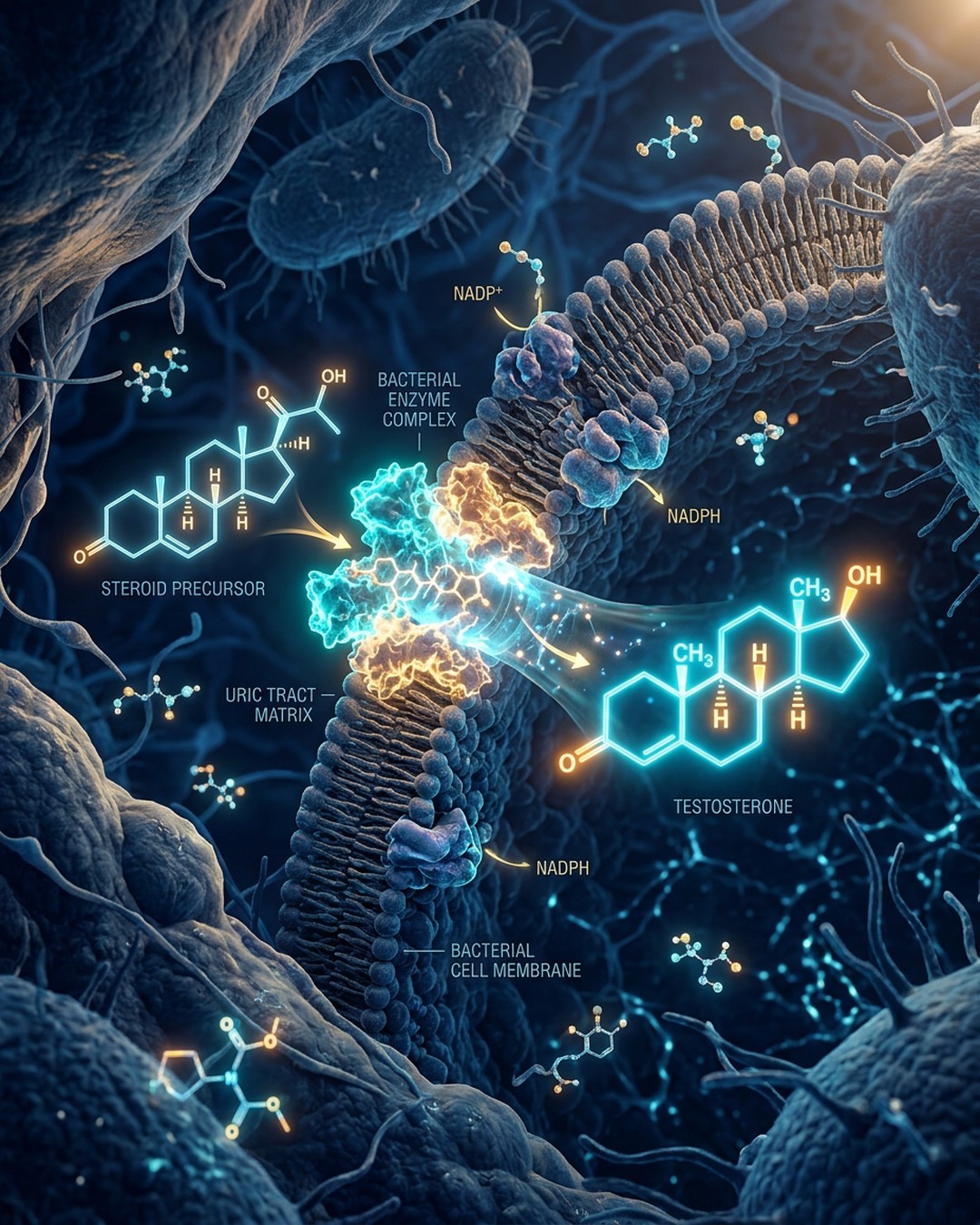
Bacterial Route to Testosterone Production in Urobiome

Nature-Communications Microbiome-Research Prostate-Cancer Androgen-Production Biophysics

Summary

Mind Map Cover Image
AI Generated Cover Image

Scientists have identified that Actinobaculum massiliense, a bacterium found in the human urinary tract, can convert the steroid precursor DHEA into testosterone under laboratory conditions. Published in Nature Communications in 2026, the study combined high-throughput screening, genomic sequencing, and atomic-level molecular simulations to understand this microbial pathway. The researchers discovered two genes responsible for this capability, named dirA and dirB for DHEA isomerase reductase. Through computational biophysics led by Auburn University, the team revealed that DirA features a broad, open pocket allowing versatile steroid transformations, whereas DirB possesses a narrow tunnel that restricts chemical reactions. While the finding does not prove that bacterial testosterone reaches prostate tumors or causes cancer, it introduces a novel microbial route for androgen production. This discovery raises important questions about whether urobiome metabolism shapes the chemical environment near the prostate and influences urinary steroid diagnostics. Researchers plan to move from molecular capability to physiological relevance by investigating how common the dirAB pathway is in human urinary microbiome datasets and determining its potential impact on prostate health and disease treatment responses.

Key Points

01

🔹 Bacterial Testosterone Production Discovery

Researchers discovered that Actinobaculum massiliense, a bacterium from the human urinary tract, can convert the steroid precursor DHEA into testosterone under laboratory conditions, revealing a previously unknown microbial route for androgen production as published in Nature Communications in 2026.

02

🔸 Identification of dirA and dirB Genes

Genome screening identified two key genes responsible for this steroid transformation, named dirA and dirB for DHEA isomerase reductase. Laboratory tests showed DirA is unusually versatile and can perform multiple steroid transformations, while DirB has much narrower chemical abilities.

03

⭐ Atomic-Level Molecular Simulations

Auburn University researchers used AI-based protein modeling and atom-by-atom simulations to discover that DirA has a wide open pocket giving steroids room to reposition, whereas DirB has a confined tunnel that frequently leaves the steroid misaligned.

04

📊 Implications for Prostate Cancer and Diagnostics

Although the study does not prove that bacteria-produced testosterone reaches tumors or causes cancer, it introduces a new factor for prostate research and urinary steroid profiling, prompting future investigations into whether this pathway is active in the human body.

05

💡 Next Steps in Physiological Research

Scientists aim to move from molecular capability to physiological relevance by searching human urinary microbiome datasets for the dirA and dirB genes to determine their prevalence and potential associations with prostate conditions and treatment responses.

Want to create your own mindmap?

Login to Neumap AI and start creating your own mindmaps!

Get Started