Horned Dinosaur Skull Combat Evolution

ScienceNews Paleontology Dinosaurs Biomechanics PeerJ

Summary

Mind Map Cover Image
AI Generated Cover Image

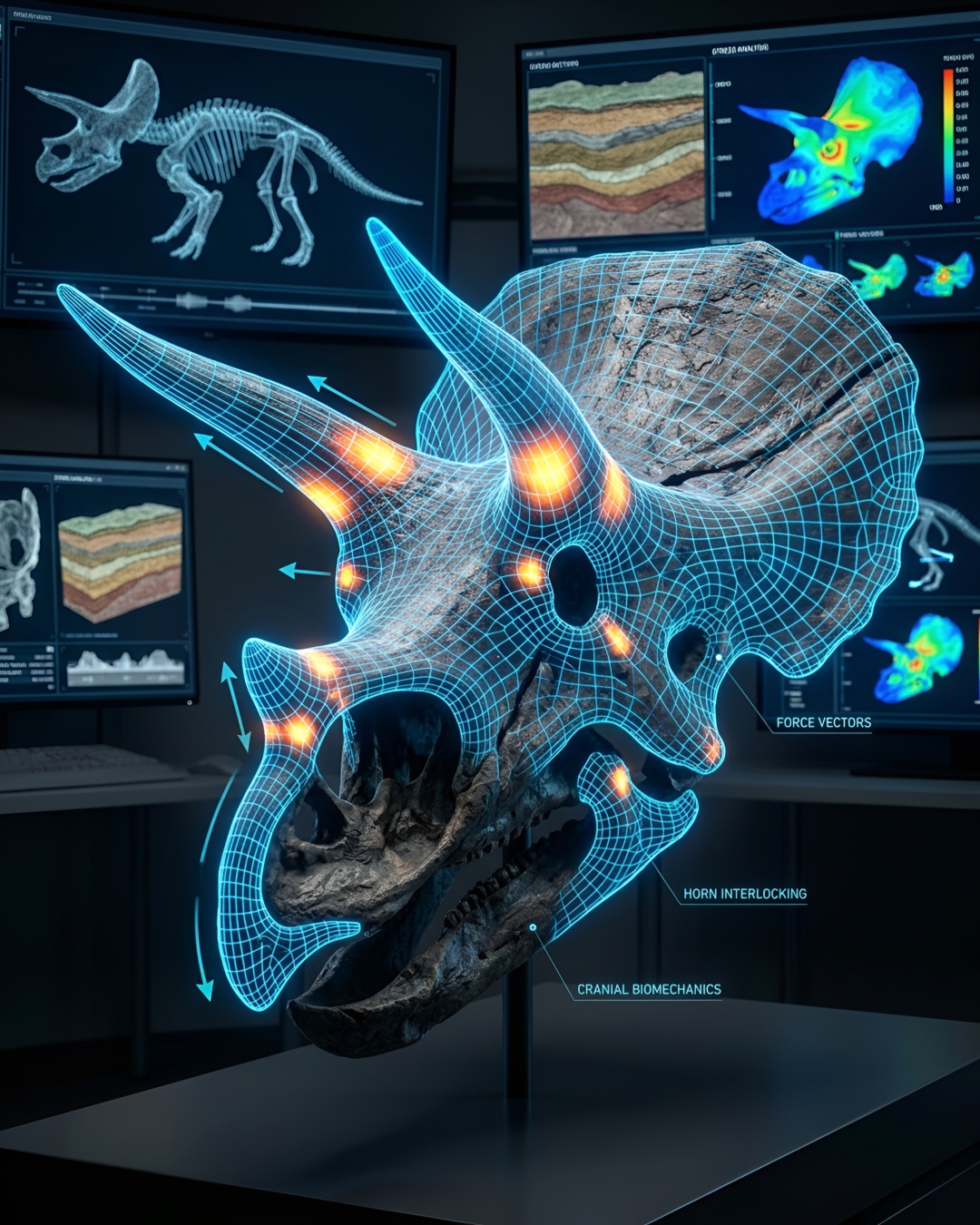
Recent biomechanical simulations utilizing 3-D models of five horned dinosaur species reveal how their facial armory evolved to withstand extreme combat forces. Published on September 24 in PeerJ by researcher Eric Austin Ames Jr. and colleagues at the University of Bristol, the study demonstrates that early ceratopsians like Psittacosaurus were ill-suited for combat, while later species such as Triceratops and Centrosaurus evolved specific skull mechanics to handle intense stabbing, ramming, and interlocking horn wrestling. The author highlights how ceratopsian skulls adapted over 125 million years of evolution, transitioning from basic social display features into multifunctional weapons capable of intraspecific combat and predator defense. Paleontologist Andrew Farke notes that fossilized facial injuries align with these simulated stress points, reinforcing the hypothesis that ceratopsian frills and horns functioned much like modern deer antlers. The research establishes a direct link between the diversification of ceratopsian headgear and distinct combat styles, explaining how mechanical stress limits dictated evolutionary pathways. Centrosaurus specialized in vertical stabbing motions, whereas Triceratops and Spiclypeus adapted to withstand severe torsional forces from interlocking horns during direct wrestling matches. Researchers recommend generating more detailed internal skull models from surface scans of fossilized specimens to further decode prehistoric combat behaviors. These findings provide a comprehensive framework for understanding how structural biomechanics dictate evolutionary success in both extinct and modern herbivorous species.

Key Points

01

🔹 3-D Simulation Study of Horned Dinosaurs

【📌 Research Findings】Published on September 24 in PeerJ by Eric Austin Ames Jr. and University of Bristol colleagues, digital 3-D simulations of six skulls across five ceratopsian species reveal how horned dinosaur skulls withstood combat forces. 【⭐ Data Support】Simulations varied attack directions and weapon usage to measure mechanical failure risks across the evolutionary tree.

02

🔸 Evolutionary Progression of Skull Combat Suitability

【📌 Developmental Stages】Early members like the husky-sized Psittacosaurus from 125 million years ago lacked skull adaptations for combat, while the pig-sized Protoceratops tolerated ramming. Larger later-diverging species like Centrosaurus, Triceratops, and Spiclypeus evolved specialized adaptations for diverse fighting styles.

03

⭐ Specialized Fighting Mechanics Across Species

【📌 Combat Styles】Centrosaurus functioned as a specialized stabber handling vertical forces exceptionally well but failing side-to-side tests. In contrast, Triceratops and Spiclypeus skulls successfully tolerated extreme forces generated by interlocking horns and wrestling.

04

📊 Dual Purpose of Horns and Frills

【📌 Functional Evolution】Horns and frills initially evolved for social and sexual display before transitioning to full-contact combat as diversity exploded. Andrew Farke notes that fossilized facial injuries on frills and cheeks correspond directly to these high-stress combat zones.

05

💡 Multifunctional Swiss Army Knife Defense

【📌 Ecological Implications】Much like modern deer, buffalo, or antelope antlers, ceratopsian weapons were easily turned against predators as versatile tools. Eric Austin Ames compares these anatomical adaptations to a Swiss Army knife capable of serving multiple survival functions.

Want to create your own mindmap?

Login to Neumap AI and start creating your own mindmaps!

Get Started