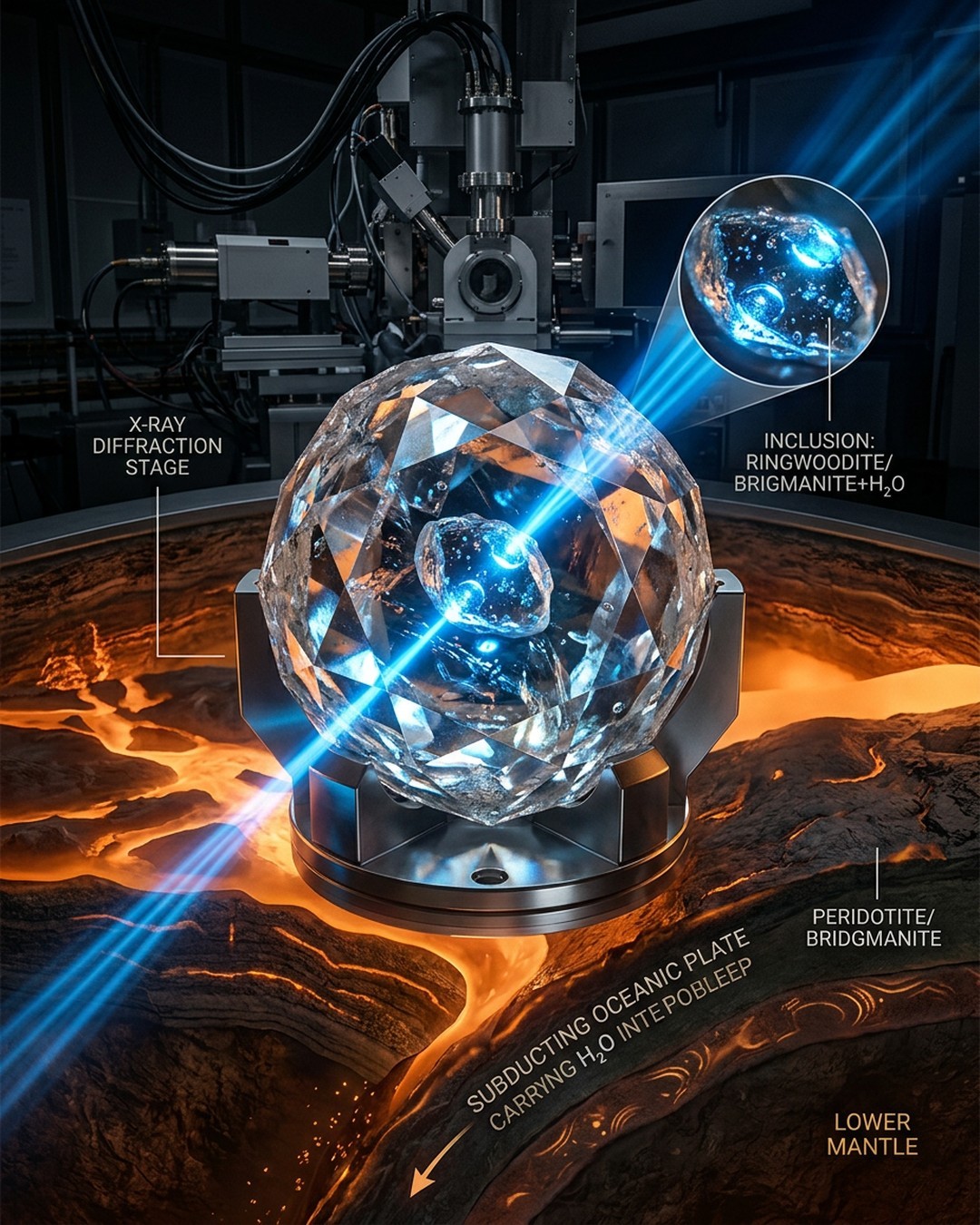
Super-Deep Diamond Reveals Water Transport to Earth's Lower Mantle

scitechdaily geology earth-science subduction-zones diamond-research sirius-accelerator

Summary

Mind Map Cover Image
AI Generated Cover Image

A microscopic mineral pocket sealed inside a 3-millimeter diamond from Juina, Brazil, provides the first direct evidence that the mineral goethite can transport water into the Earth's lower mantle. Researchers analyzed the super-deep diamond using advanced synchrotron light techniques at the Sirius particle accelerator facility operated by the Brazilian Synchrotron Light Laboratory. The research team demonstrated that goethite, an iron oxyhydroxide typically found in soils and ocean floors, can survive extreme temperatures ranging from 877 to 1,827 degrees Celsius and pressures between 35 and 57 gigapascals. These findings challenge the traditional view that goethite decomposes near the surface and cannot endure subduction processes into the deep mantle. By remaining protected within deep fractures of cool oceanic plates, goethite can descend beyond 400 kilometers before transforming into hematite, magnetite, and water. This mechanism reveals a viable pathway for surface water to reach deep interior regions of the Earth previously thought incapable of storing significant moisture. Scientists can leverage these insights to better understand planetary water cycles and mantle dynamics. The study highlights the efficacy of using non-destructive synchrotron X-ray microtomography and diffraction to unlock geological secrets preserved inside natural diamond inclusions.

Key Points

01

🔹 Discovery of Goethite in Super-Deep Diamond

A Brazilian research team discovered goethite (FeOOH) along with hematite (Fe2O3) and magnetite (Fe3O4) trapped inside a 3-millimeter super-deep diamond sourced from a gold miners' cooperative in Juina, Mato Grosso state, Brazil. The diamond served as a protective shield, preserving these mineral inclusions from external alteration over hundreds of millions of years.

02

🔸 Role of Sirius Particle Accelerator in Analysis

The research was conducted entirely using Brazilian instruments at the Sirius particle accelerator facility, part of the Brazilian Center for Research in Energy and Materials (CNPEM). High-resolution X-ray microtomography at the Mogno beamline mapped about 100 inclusions, while X-ray diffraction at the Ema beamline identified the mineral assemblage within the sealed pocket.

03

⭐ Survival Under Extreme Mantle Conditions

The findings contradict the traditional belief that goethite quickly converts into hematite and water at temperatures above 200 degrees Celsius during subduction. The enclosed goethite proved capable of withstanding extreme pressures of 35 to 57 gigapascals and temperatures ranging from 877 to 1,827 degrees Celsius found in the lower mantle.

04

📊 Implications for Earth's Deep Water Cycle

The research proposes that goethite survives subduction by being protected inside deep fractures within relatively cool oceanic plates, descending beyond 400 kilometers. As it transforms into hematite or magnetite, it releases water into the lower mantle, providing a mechanism for surface water to penetrate deep planetary regions.

05

💡 Supporting Mineral Evidence and Context

Another inclusion in the same diamond contained ferropericlase ((Mg, Fe)O), a mineral abundant in the lower mantle, confirming the diamond's deep formation origin. This discovery complements previous findings of ringwoodite in Juina diamonds, further establishing that substantial quantities of water participate in Earth's deep interior cycle.

Want to create your own mindmap?

Login to Neumap AI and start creating your own mindmaps!

Get Started