Magnetic Nanoparticles for Ectopic Pregnancy

ScitechDaily Nanomedicine EctopicPregnancy MedicalResearch OregonStateUniversity

Summary

Mind Map Cover Image
AI Generated Cover Image

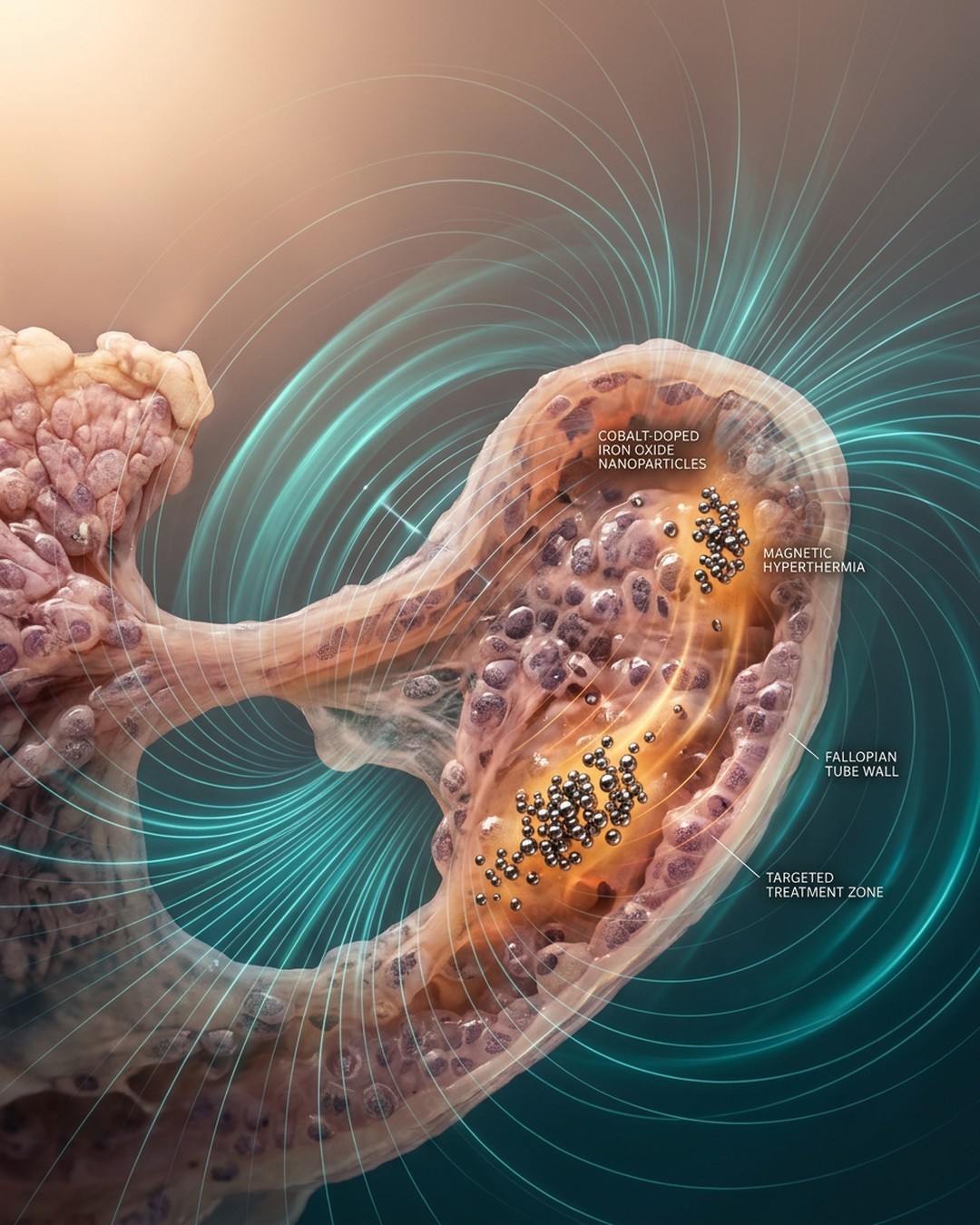
Researchers at Oregon State University have successfully developed an innovative nanomedicine approach using cobalt-doped soft ferromagnetic iron oxide nanoparticles to detect and treat dangerous ectopic pregnancies in mice. Approximately 98 percent of ectopic pregnancies occur in the fallopian tubes, representing about 2 percent of all pregnancies in the United States, roughly 100000 cases annually, and remaining a leading cause of first-trimester maternal mortality. The research team, led by Olena Taratula and Karthickraja Duraisamy, aims to address the significant limitations and high misdiagnosis or failure rates associated with traditional diagnostic tools like transvaginal ultrasound and treatments such as methotrexate. By intravenously administering engineered nanoparticles that selectively accumulate in the placenta, the technology enables precise visualization via magnetic resonance imaging without crossing the placental barrier into the embryo. When these nanoparticles concentrate in improperly located gestational sacs, such as inside a fallopian tube, exposure to an alternating magnetic field induces controlled local hyperthermia of up to 45 degrees Celsius. This magnetic heating mechanism successfully disrupts placental function and destroys targeted gestational sacs while preserving surrounding uterine tissue and fertility in pregnant mice, avoiding invasive surgery. Published on September 17, 2026, in the journal Biomaterials, this breakthrough remains at the animal-testing stage, requiring extensive validation in other animal models before human clinical translation. Financial support for the study was provided by Oregon State University College of Pharmacy, the National Institutes of Health, and Oregon Health and Science University.

Key Points

01

🔹 Ectopic Pregnancy Statistics and Risks

【📌 Core Statistics】Ectopic pregnancies account for about 2 percent of pregnancies in the United States and between 1 and 2 percent worldwide, translating to roughly 100000 cases annually in the US. 【🔸 Mortality and Complications】About 98 percent of these abnormal implantations occur in the fallopian tubes, making it a leading cause of maternal mortality during the first trimester. 【⭐ Traditional Limitations】Standard transvaginal ultrasound carries a misdiagnosis rate of about 10 percent, while the primary drug methotrexate has an even higher failure rate and causes severe side effects like nausea, vomiting, and organ damage.

02

🔸 Nanoparticle Design and Targeting Mechanism

【📌 Engineering Approach】Researchers developed specially engineered cobalt-doped soft ferromagnetic iron oxide nanoparticles administered intravenously to target pregnancy-associated tissue. 【🔸 Placental Accumulation】Due to their microscopic scale, these nanoparticles circulate through the body and selectively accumulate within the placenta, the organ nourishing the fetus. 【⭐ Safety Feature】The nanoparticles do not cross the placental barrier, ensuring that correctly positioned intrauterine embryos remain entirely unaffected by the circulating particles.

03

⭐ Magnetic Resonance Imaging Detection

【📌 Diagnostic Enhancement】Effective detection of the growing placenta significantly improves the accuracy and timeliness of ectopic pregnancy identification. 【🔸 Visualization Capability】Once sufficient nanoparticles concentrate in the placenta, medical professionals can visualize the organ using magnetic resonance imaging (MRI). 【⭐ Clinical Application】In human patients, this technique can definitively reveal whether the placenta is developing correctly inside the uterus or in an abnormal location.

04

📊 Magnetic Hyperthermia Treatment

【📌 Therapeutic Mechanism】When nanoparticles locate an incorrectly positioned placenta in a fallopian tube, exposure to an alternating magnetic field causes them to heat up. 【🔸 Controlled Heating】The MRI-guided magnetic nanoplatform achieves localized hyperthermia of less than or equal to 45 degrees Celsius (113 degrees Fahrenheit). 【⭐ Tissue Preservation】In pregnant mice experiments, this controlled heating successfully disrupted gestational sacs while completely preserving surrounding uterine tissue and future fertility.

05

💡 Future Research and Funding Sources

【📌 Current Development Stage】The technology remains in the animal-testing stage, and researchers emphasize that additional validation studies in other animal models are required. 【🔸 Research Leadership】Key investigators include Olena Taratula, Karthickraja Duraisamy, and collaborators from Oregon State University and Oregon Health and Science University. 【⭐ Financial Support】Funding was provided by the Oregon State University College of Pharmacy, National Institutes of Health National Cancer Institute, Eunice Kennedy Shriver National Institute of Child Health and Human Development, and OHSU School of Medicine.

Want to create your own mindmap?

Login to Neumap AI and start creating your own mindmaps!

Get Started