Universe Expansion Remains Accelerating

astronomy cosmology dark-energy supernova royal-astronomical-society

Summary

Mind Map Cover Image
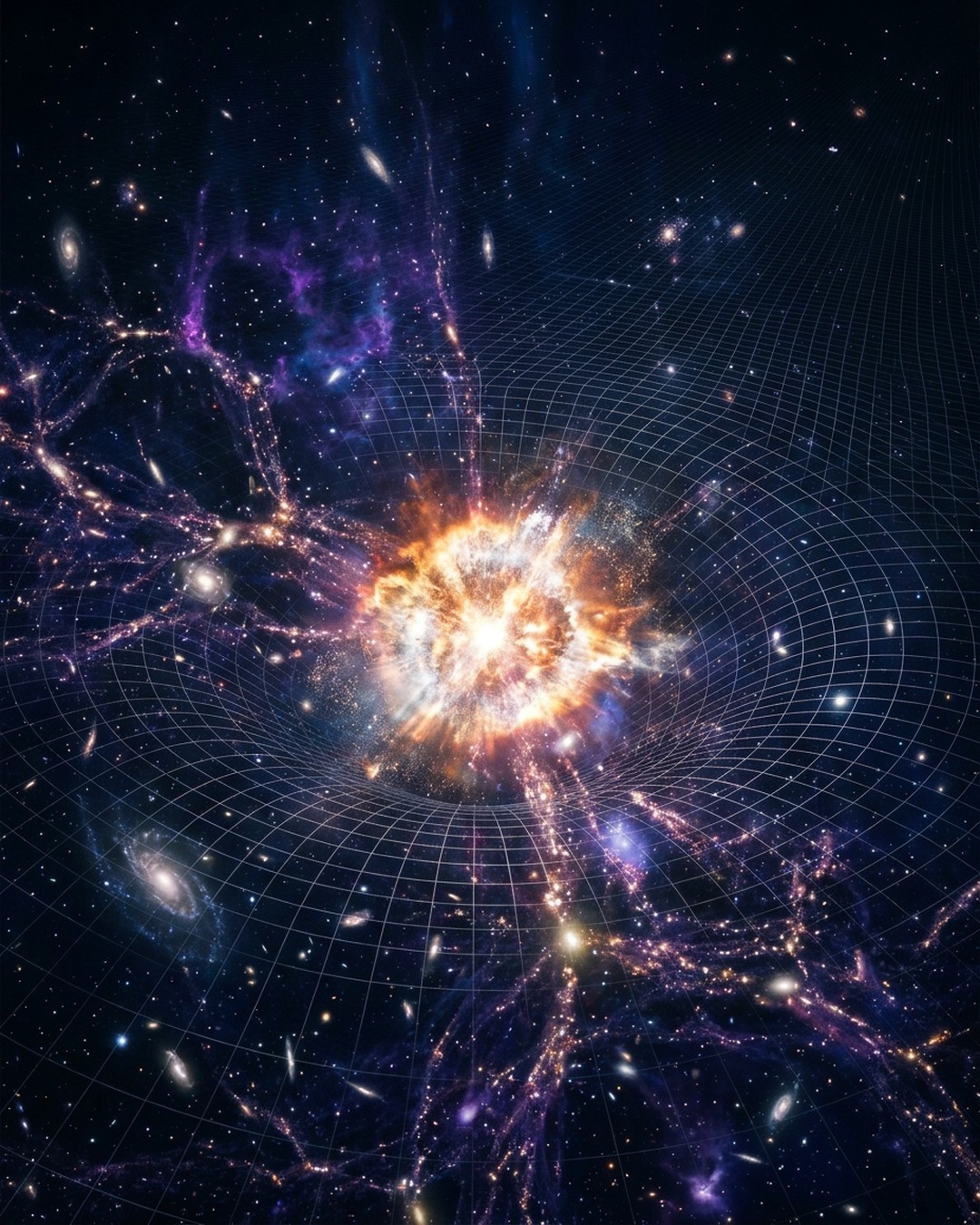
AI Generated Cover Image

An international team of astrophysicists published a study on June 10, 2026, in the Monthly Notices of the Royal Astronomical Society, rejecting claims from a previous South Korean study that suggested the universe's expansion was slowing down. The researchers confirmed that the universe is still expanding at an accelerating rate, maintaining the standard cosmological model involving dark energy. The controversy arose from a scientific misunderstanding regarding the aging of exploding stars rather than a breakdown in modern cosmology. The earlier study incorrectly treated the age of a host galaxy as the age of the individual exploding star and failed to properly account for host galaxy mass variations across cosmic history. Led by Dr. Phil Wiseman from the University of Southampton alongside notable Nobel Laureates including Professor Adam Riess and Professor Brian Schmidt, the team re-calibrated Type Ia supernova measurements. They proved that after properly accounting for host environments, the evidence for cosmic acceleration remains remarkably robust and consistent. This validation allows astronomers to move past false alarms about cosmic deceleration and refocus efforts on uncovering the true physical nature of dark energy. The scientific community views this debate as a healthy test of established models that ultimately drives more precise measurement techniques in modern astrophysics.

Key Points

01

🔹 Confirmation of Accelerating Universe Expansion

An international team of astrophysicists published research on June 10, 2026, in the Monthly Notices of the Royal Astronomical Society confirming that the universe is still expanding at an accelerating rate. This finding firmly rejects a previous South Korean study that suggested cosmic expansion had entered a period of deceleration due to weakening dark energy.

02

🔸 Identification of Flaws in Previous Deceleration Claims

The controversy stemmed from a misunderstanding in the earlier study regarding Type Ia supernovae. The previous research incorrectly assumed that the age of a host galaxy matched the age of the individual exploding star and failed to account for host galaxy mass variations and different host environments across cosmic history.

03

⭐ Re-calibration and Consistency of Type Ia Supernovae

Led by Dr. Phil Wiseman from the University of Southampton and including Nobel Laureates Professor Adam Riess and Professor Brian Schmidt, the research team re-calibrated supernovae data. They demonstrated that when properly accounting for host populations and environments, the evidence for cosmic acceleration remains remarkably consistent.

04

📊 Preservation of the Standard Cosmology Model

By validating previous measurements, the study preserves the standard cosmological framework. Researchers emphasized that dark energy, which acts as a mysterious anti-gravity force driving cosmic expansion, remains the leading explanation, allowing scientists to focus on determining what dark energy actually is rather than questioning its existence.

05

💡 Positive Impact on Scientific Progress and Methodology

Co-author Professor Mark Sullivan noted that questioning established theories is essential for scientific progress. Although the deceleration hypothesis proved incorrect, it opened up new ways of thinking about how white dwarf star explosions occur and how astronomers can measure dark energy with greater accuracy in future studies.

Want to create your own mindmap?

Login to Neumap AI and start creating your own mindmaps!

Get Started