Mount Vesuvius Calibration Enhances Geological Dating Accuracy

scitechdaily geology earth-science uc-berkeley archaeology volcano

Summary

Mind Map Cover Image
AI Generated Cover Image

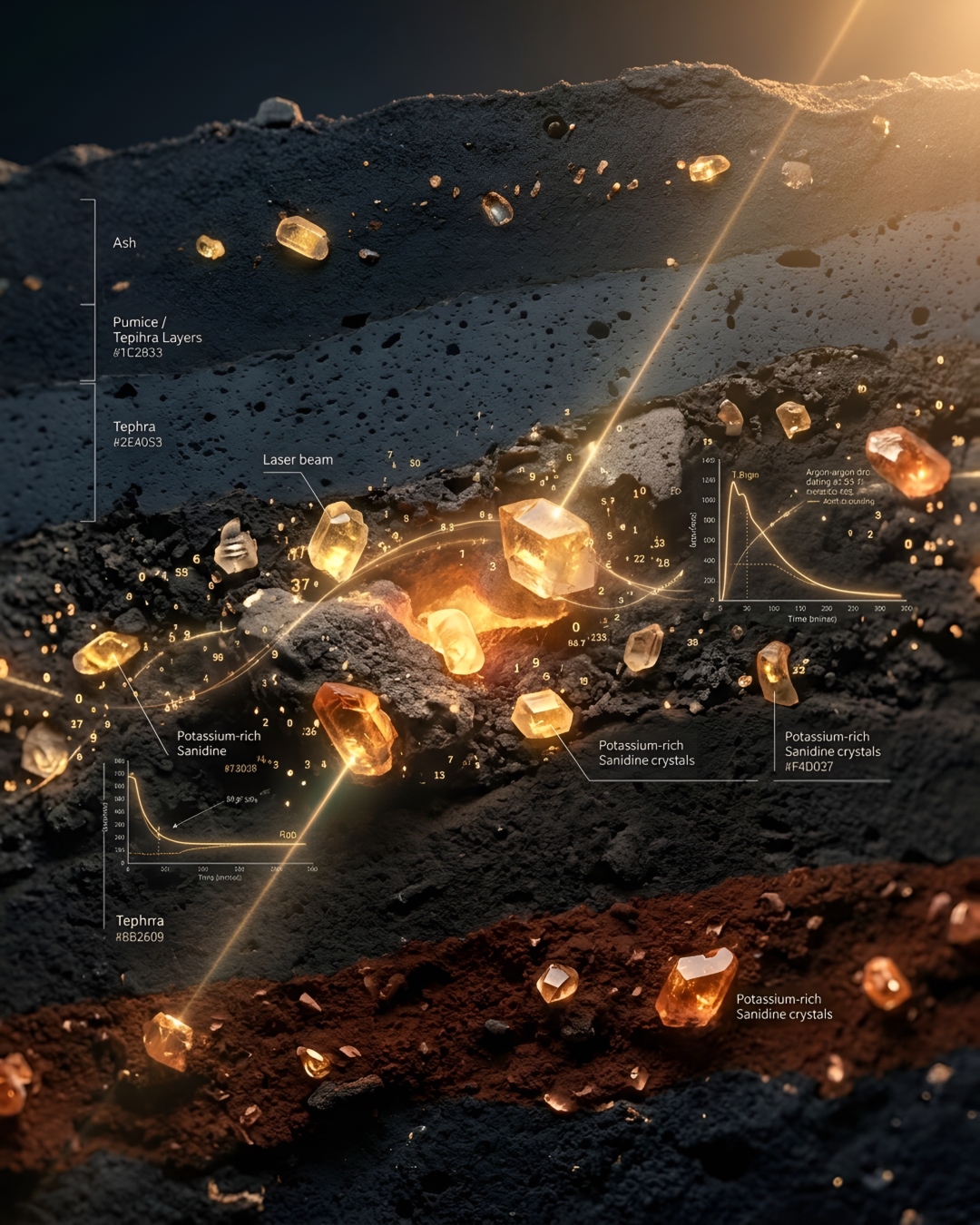
Researchers from the Berkeley Geochronology Center, UC Berkeley, and the University of Padua utilized the historical 79 CE eruption of Mount Vesuvius, which buried Pompeii, to significantly refine and calibrate argon-argon geochronological dating techniques. By analyzing potassium-rich sanidine mineral samples from lower ash deposits at Oplontis, the research team achieved an exceptional analytical precision of 0.7 percent and an accuracy of 0.4 percent compared to the historical benchmark. The study leader Paul Renne and graduate student Caroline Hasler spearheaded efforts that reconciled argon-argon dating with other radiometric systems like uranium-lead dating through a Bayesian statistical framework published in 2025. This methodological refinement successfully calculated a more precise half-life for potassium-40 decaying into argon-40 at 12.044 billion years with an uncertainty of 0.088 billion years, doubling the precision of previous nuclear physics estimates. By establishing Mount Vesuvius as a robust historical calibration standard, scientists can now resolve geological and volcanic events within the historical period down to uncertainties on the scale of decades. This advancement strengthens cross-dating systems, improves radiocarbon dating reliability, and enhances timelines for major prehistoric catastrophes such as asteroid impacts and mass extinctions. Earth scientists, archaeologists, and geochronologists can apply these calibrated methods to reconstruct eruptive histories of active volcanoes near densely populated metropolitan regions like Naples, Mexico City, and Yogyakarta. The unified mathematical framework also helps researchers untangle complex causal relationships between closely spaced geological events across deep Earth history.

Key Points

01

🔹 Historical Benchmark Calibration Using Mount Vesuvius

Researchers utilized the well-documented 79 CE eruption of Mount Vesuvius, which destroyed Pompeii, as an absolute historical calibration point for argon-argon dating. Analysis of eight sanidine volcanic mineral samples yielded an age of 1,938 ±13 years before measurement in 2025, matching the known historical age of 1,946 years with 0.7 percent precision and 0.4 percent accuracy.

02

🔸 Refined Potassium-40 Half-Life Determination

By leveraging the historical age constraint of the Vesuvius eruption, the scientific team calculated a potassium-40 half-life of 12.044 billion years with a 0.088 billion year uncertainty. This new value is approximately twice as precise as previous estimates derived directly from traditional nuclear physics methods.

03

⭐ Superior Sample Collection and Analytical Techniques

The breakthrough relied on specialized potassium-rich sanidine crystals obtained in 1998 from lower ash and pumice deposits at Oplontis, which formed early during the eruption before magma reservoirs became chemically depleted. Combined with modern mass spectrometry and updated neutron irradiation, these superior samples enabled sub-one-percent precision.

04

📊 Unifying Independent Geochronological Dating Systems

The Vesuvius recalibration supports a broader 2025 Bayesian statistical framework designed to intercalibrate argon-argon dating with uranium-lead dating and radiocarbon dating. This mathematical unification resolves long-standing discrepancies between independent radiometric systems, enabling consistent timelines for Earth history.

05

💡 Applications in Volcanology and Historical Chronology

The refined dating technique allows scientists to resolve historical volcanic events with decadal-scale uncertainties, improving risk assessments for active volcanoes near Naples, Mexico City, and Yogyakarta. It also helps researchers accurately sequence closely spaced events such as dinosaur extinction triggers and ancient global cooling phases.

Want to create your own mindmap?

Login to Neumap AI and start creating your own mindmaps!

Get Started