AI vs Primate Brain Visual Processing Mismatch

ArtificialIntelligence Neuroscience YorkUniversity ComputerVision ResearchAnalysis

Summary

Mind Map Cover Image
AI Generated Cover Image

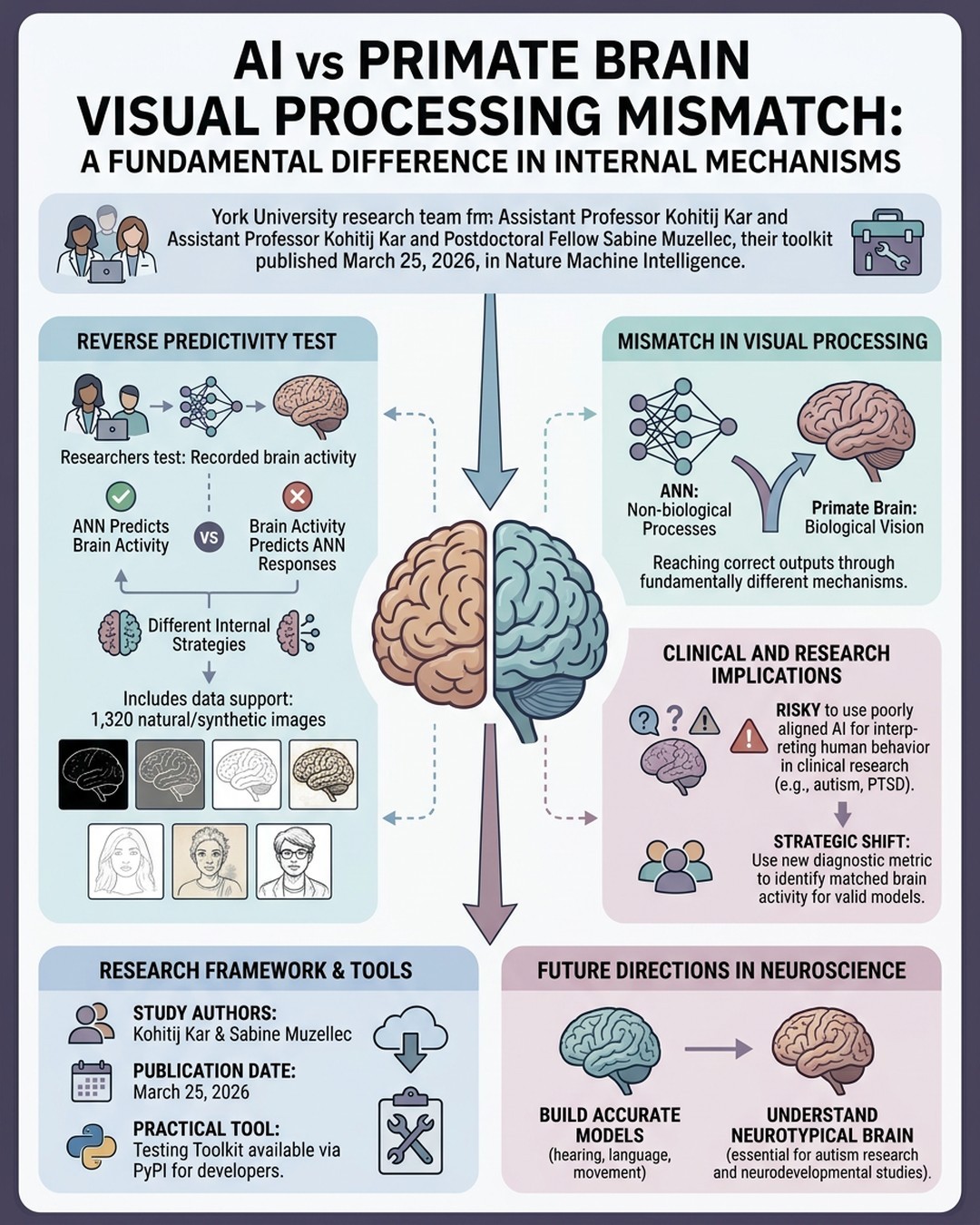
Researchers at York University have identified a significant discrepancy between artificial neural networks (ANNs) and primate brains regarding visual information processing. While AI models are frequently cited as brain-like due to their ability to predict neural activity during object recognition, this study reveals that the internal mechanisms of these models do not mirror biological processes. The findings suggest that AI often achieves correct visual outputs through strategies fundamentally different from those employed by the human brain. The research team, led by Assistant Professor Kohitij Kar, utilized a novel reverse predictivity test to evaluate the alignment between AI internal features and recorded brain activity. By testing 1,320 natural and synthetic images, they demonstrated that while AI can predict brain activity, the reverse is not true: brain activity cannot reliably predict the internal features of AI models. This indicates a lack of structural and functional equivalence between the two systems. This study provides a critical diagnostic metric for the field of neuroscience and AI development. The authors emphasize that relying on poorly aligned models to interpret human behavior, particularly in clinical research for conditions like autism or PTSD, carries significant risks. They have released a testing toolkit to help developers improve the biological accuracy of their models. For practitioners and researchers, this work serves as a cautionary note against assuming functional similarity between AI and biological systems. Future research should prioritize building models that not only predict outcomes but also replicate the underlying neural mechanisms of human vision to ensure reliability in clinical and behavioral applications.

Key Points

01

🔹 The Reverse Predictivity Test

【📌 Methodology】Researchers developed a reverse predictivity test to determine if AI internal responses can be predicted by recorded brain activity. 【🔸 Core Finding】While AI models can predict brain activity, the reverse is not true, indicating that AI and primate brains use different internal strategies to solve visual tasks. 【⭐ Data Support】The study utilized 1,320 natural and synthetic images, including 300 images with altered visual styles like outlines and drawings.

02

🔸 Mismatch in Visual Processing

【📌 The Problem】Artificial neural networks (ANNs) are often labeled as brain-like, but this study proves they reach correct visual answers through processes that do not align with biological vision. 【🔸 Impact Factors】The mismatch suggests that current AI models may not provide a reliable explanation of how the brain works, despite their predictive capabilities in specific tasks.

03

⭐ Clinical and Research Implications

【📌 Risk Warning】Using poorly aligned AI systems to interpret human behavior in clinical research (e.g., autism, PTSD) is risky. 【💡 Strategic Shift】The authors advocate for using their new diagnostic metric to identify which parts of an ANN truly match brain activity, ensuring that models used for behavioral research are scientifically valid.

04

📊 Research Framework and Tools

【📌 Study Authors】Led by Assistant Professor Kohitij Kar and Postdoctoral Fellow Sabine Muzellec at York University. 【📅 Publication Date】March 25, 2026, in Nature Machine Intelligence. 【🛠️ Practical Tool】The team released a testing toolkit (available via PyPI) for developers to evaluate and improve the biological alignment of their AI models.

05

💡 Future Directions in Neuroscience

【📌 Goal】Building more accurate, brain-like models to support research in hearing, language, and movement. 【🎯 Application】The research program specifically aims to use these validated models as a baseline for understanding the neurotypical brain, which is essential for advancing autism research and other neurodevelopmental studies.

Want to create your own mindmap?

Login to Neumap AI and start creating your own mindmaps!

Get Started