Could Advanced Aliens Be Living Nearby? Scientists Say It Is Unlikely

SciTechDaily Astrobiology Exoplanets Space

Summary

Mind Map Cover Image
AI Generated Cover Image

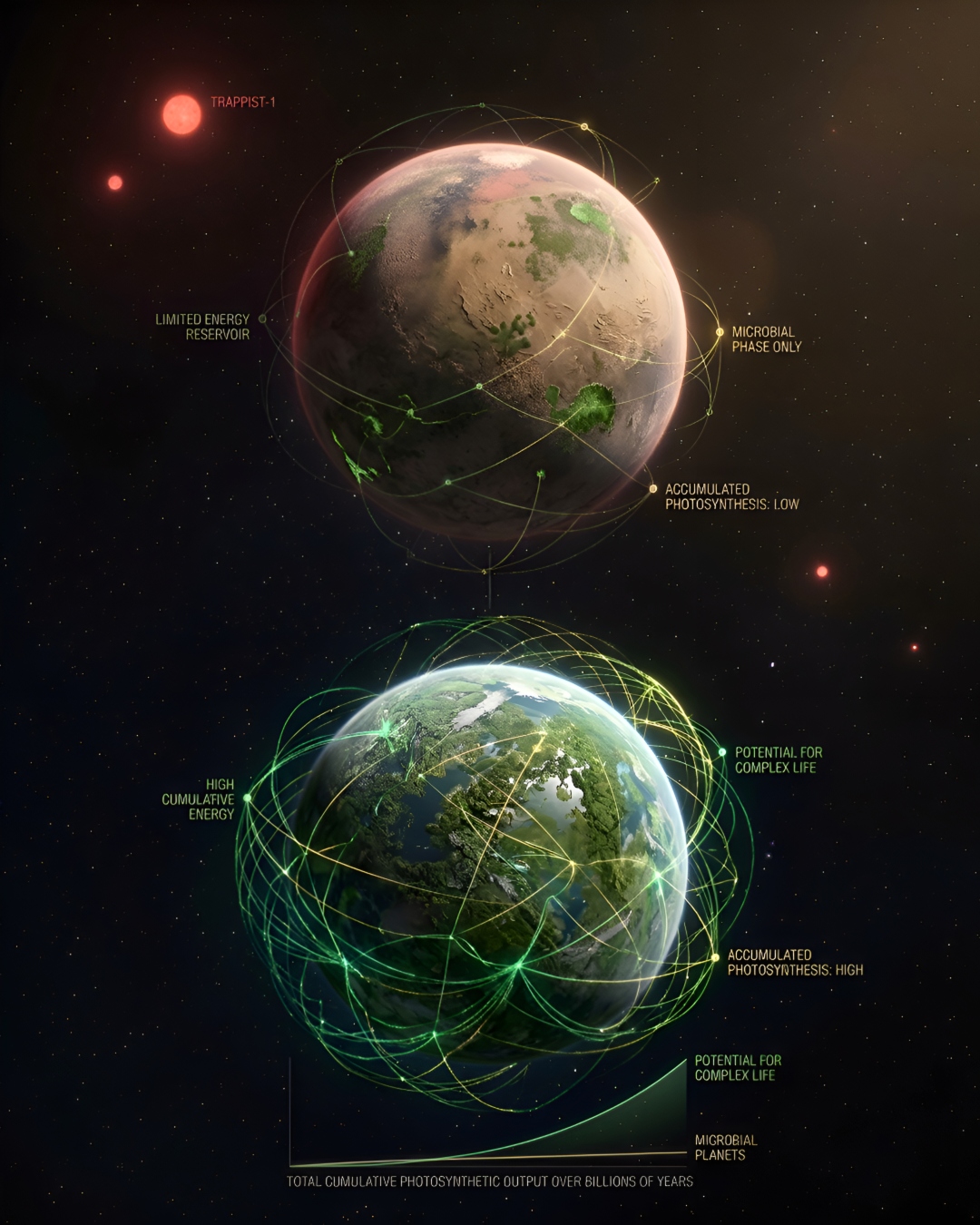
Advanced extraterrestrial civilizations are unlikely to inhabit Earth's galactic neighborhood, according to a September 30, 2026 study published in the International Journal of Astrobiology by researchers at Northern Arizona University, led by Professor Chris Doughty. The research proposes that the evolution of complex life on exoplanets depends heavily on cumulative photosynthetic energy over billions of years, rather than the sheer passage of time, explaining why nearby older planets may still host only simple microbial life. By analyzing climate simulations for 29 nearby habitable exoplanets, the team found that most worlds, such as TRAPPIST-1e which has only 21 percent of Earth's lifetime carbon fixation, suffer from limited light, temperature, or precipitation that severely restricts plant growth. Only two planets, GJ 1061c and K2-3d, were identified as potentially having life progressed beyond Earth's evolutionary stage, suggesting that Fermi's paradox is resolved because most neighboring Earth-like planets remain stuck at the microbial stage.

Key Points

01

🔹 Study Overview and Publication

Published on September 30, 2026, in the International Journal of Astrobiology, a study led by Professor Chris Doughty from Northern Arizona University suggests that advanced extraterrestrial civilizations are unlikely to exist in Earth's immediate galactic neighborhood.

02

🔸 Photosynthesis as an Evolutionary Clock

The evolution of complex life depends on cumulative photosynthetic energy over a planet's entire history rather than just time. On Earth, photosynthesis fixed 2.4 × 10²⁵ grams of carbon before vascular plants emerged and another 7 × 10²⁵ grams before humans evolved.

03

⭐ Exoplanet Analysis Findings

Among 29 nearby habitable exoplanets, researchers identified only two worlds, GJ 1061c and K2-3d, where life might have progressed beyond Earth's current evolutionary stage, while three others could have reached a Mesozoic Era stage.

04

📊 TRAPPIST-1e Energy Limitations

TRAPPIST-1e, located 40 light-years away, has a potential lifetime carbon fixation of just 21 percent of Earth's total, placing it securely at the microbial stage of evolution despite being several billion years older than Earth.

05

💡 Climate Constraints and Fermi Paradox Resolution

Scarce rainfall and dimmer stars limit plant growth on many red dwarf planets, meaning ecosystems may resemble deserts rather than tropical forests, resolving Enrico Fermi's famous question 'Where are they?' by indicating neighboring planets are still filled with microbes.

Want to create your own mindmap?

Login to Neumap AI and start creating your own mindmaps!

Get Started