AI Memory Revolution: HBM, SSD, and CMX Architecture

AI Memory NVIDIA SSD HBM NAND Semiconductor Infrastructure

Summary

Mind Map Cover Image
AI Generated Cover Image

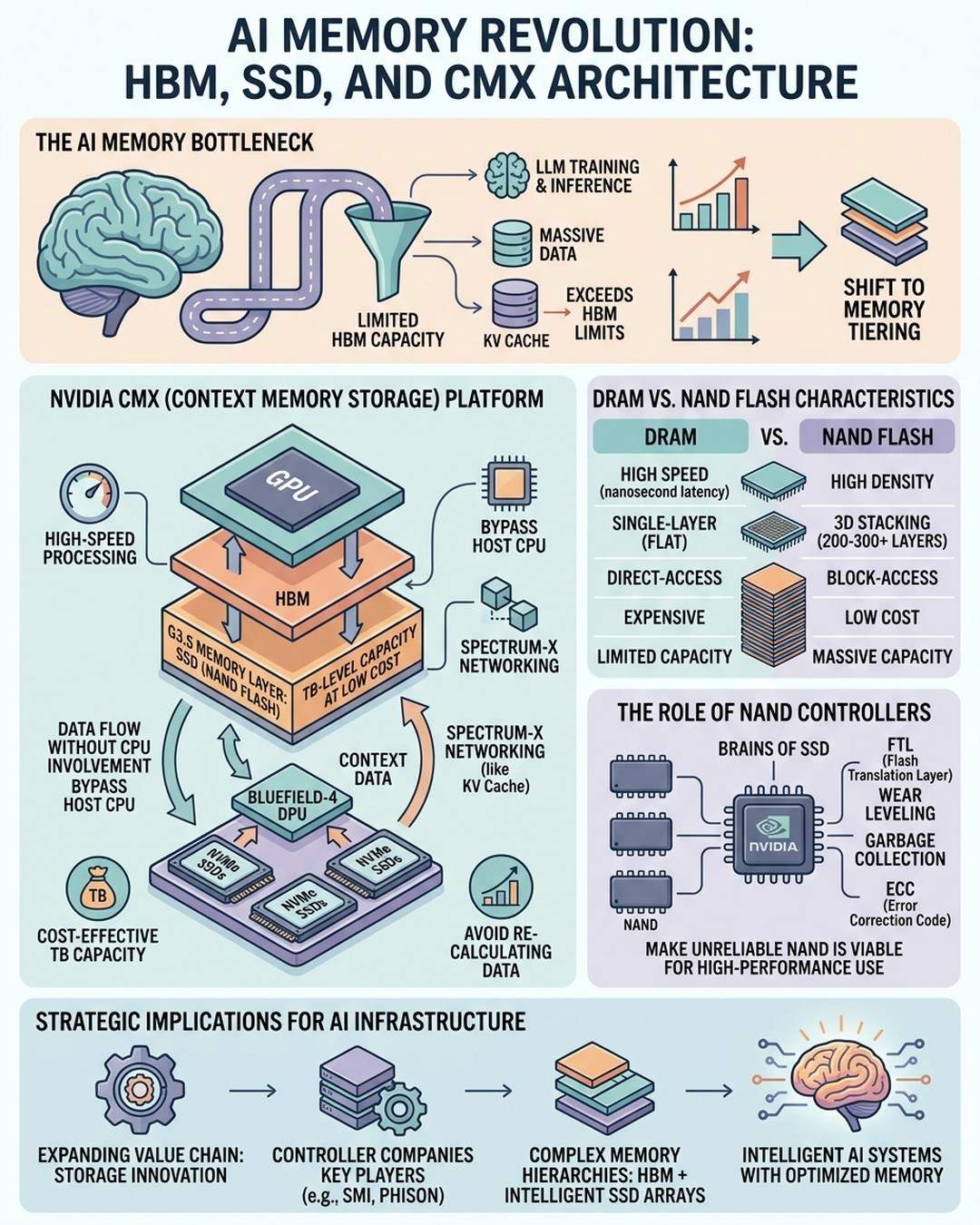
The AI industry is facing a critical bottleneck where high-bandwidth memory (HBM) and DRAM capacity cannot keep pace with the massive memory requirements of large language models. As AI transitions from simple tasks to complex reasoning, the need for storing KV Cache (key-value cache) has exploded, leading to severe HBM shortages and rising costs. The industry is shifting toward a memory tiering strategy that utilizes high-capacity, cost-effective SSDs (NAND Flash) as a secondary memory layer to supplement expensive DRAM. The author highlights that NVIDIA is leading this architectural revolution with its CMX (Context Memory Storage) platform, which introduces a G3.5 memory layer between DRAM and traditional storage. By leveraging specialized hardware like BlueField-4 DPUs and Spectrum-X networking, this architecture allows AI systems to offload non-immediate memory tasks to SSD-based arrays without sacrificing performance. This approach effectively treats SSDs as an extension of system memory rather than just a passive storage device. The core of this transition relies on the sophisticated role of NAND Flash controllers and the Flash Translation Layer (FTL). Unlike DRAM, which is a high-speed, direct-access medium, NAND Flash is inherently flawed, requiring controllers to manage wear leveling, garbage collection, and error correction. These controllers act as essential translators that transform unreliable raw NAND into stable, high-performance storage capable of meeting the rigorous demands of modern AI workloads. For users and investors, this shift signifies a fundamental change in hardware value distribution. The focus is moving from pure compute power to memory efficiency and intelligent data orchestration. Companies specializing in advanced NAND controllers and memory-tiering software are becoming increasingly vital to the AI infrastructure ecosystem, as they provide the necessary bridge to overcome the physical and economic limitations of traditional memory hierarchies.

Key Points

01

🔹 The AI Memory Bottleneck

AI performance is currently constrained by memory capacity rather than just compute power. The KV Cache (Key-Value Cache), which stores intermediate reasoning steps for LLMs, consumes massive amounts of HBM. Because HBM is expensive and production-limited, the industry is forced to adopt memory tiering to avoid re-calculating data, which is computationally more expensive than retrieving it from storage.

02

🔸 NVIDIA CMX and Memory Tiering

NVIDIA's CMX (Context Memory Storage) platform introduces a G3.5 memory layer using high-speed NVMe SSDs. This architecture uses BlueField-4 DPUs (Data Processing Units) and Spectrum-X networking to move data between storage and GPU memory without involving the host CPU. This allows for TB-level memory capacity at a fraction of the cost of HBM.

03

⭐ DRAM vs. NAND Flash Characteristics

DRAM is optimized for speed (nanosecond latency) but is limited to single-layer 'flat' structures, making it expensive. NAND Flash is optimized for density, using 3D stacking (200-300+ layers) to achieve massive capacity at low cost. The fundamental trade-off is that DRAM is a high-speed, direct-access medium, while NAND is a high-capacity, block-access medium that requires management.

04

📊 The Role of NAND Controllers

Raw NAND Flash is inherently unreliable, suffering from wear, inability to perform direct overwrites, and bit errors. SSD controllers and the FTL (Flash Translation Layer) act as 'translators' that perform wear leveling, garbage collection, and ECC (Error Correction Code). These controllers are the 'brains' that make SSDs viable for high-performance AI memory tiering.

05

💡 Strategic Implications for AI Infrastructure

The shift toward memory tiering means that the value chain is expanding to include storage-side innovation. Companies like Silicon Motion (SMI) and Phison are critical in developing the controllers necessary to manage these complex memory hierarchies. Future AI systems will rely on a combination of HBM for core processing and intelligent SSD arrays for context-heavy memory tasks.

Want to create your own mindmap?

Login to Neumap AI and start creating your own mindmaps!

Get Started