SuperAgers Memory Resilience and Genetics Study

scitechdaily health aging alzheimers-disease genetics memory university-of-chicago

Summary

Mind Map Cover Image
AI Generated Cover Image

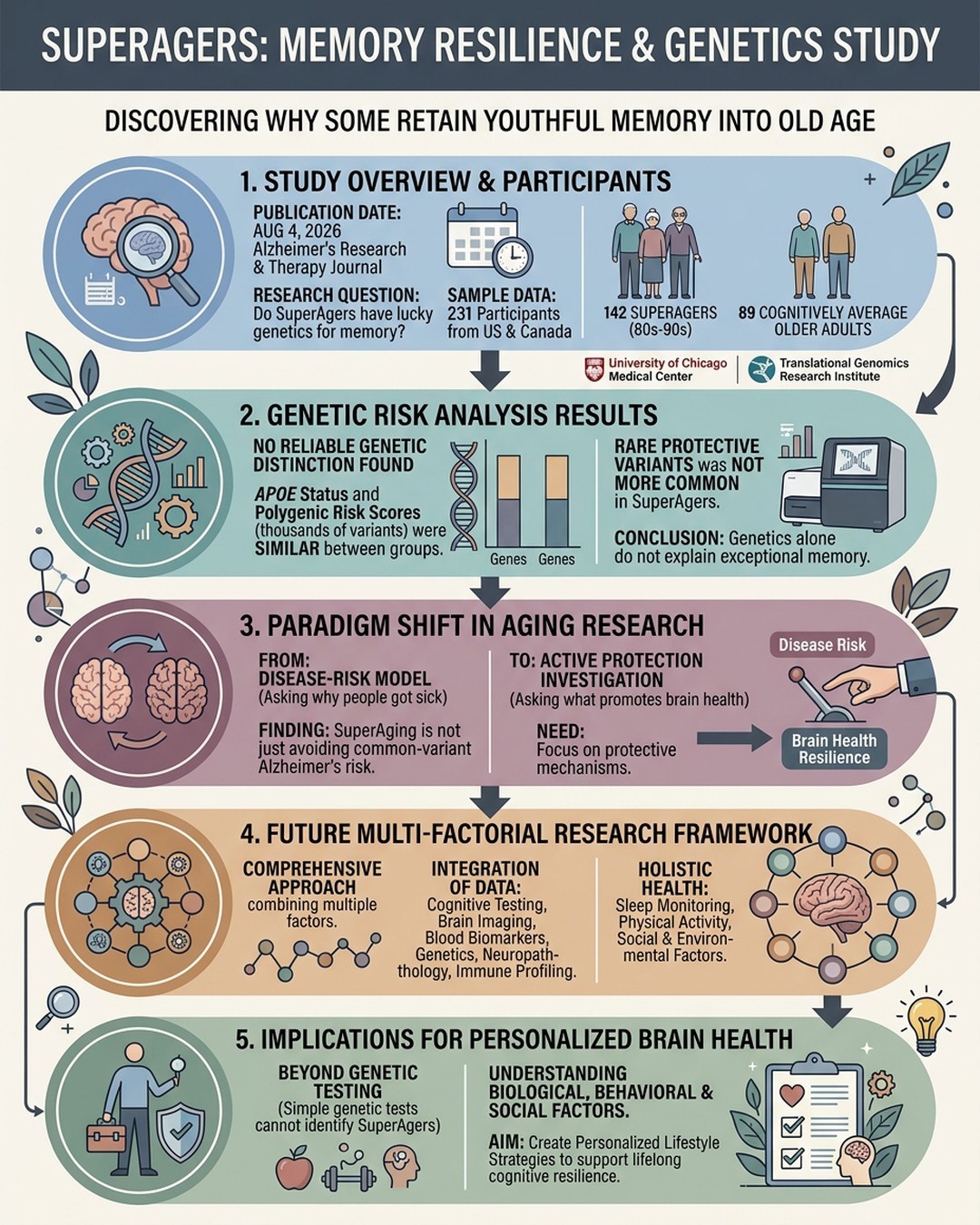
A major study published on August 4, 2026, in Alzheimer's Research & Therapy reveals that SuperAgers individuals in their 80s and 90s with memory abilities rivalling younger adults do not maintain their sharpness simply by dodging Alzheimer's genes. Researchers from the University of Chicago Medical Center and the Translational Genomics Research Institute studied 142 SuperAgers and 89 cognitively average older adults, discovering that APOE status and polygenic risk scores cannot reliably distinguish the two groups. The author's main viewpoint emphasizes that exceptional cognitive aging is not merely the inverse of inherited Alzheimer's risk. Instead of assuming SuperAgers simply inherited low-risk genetics, the scientific community must investigate active protective mechanisms, lifestyle factors, brain structure, and environmental influences that preserve youthful memory across the lifespan. The essence of this research establishes a definitive boundary for Alzheimer's disease genetics, proving that common genetic risk factors captured by current models fail to explain the SuperAging phenotype. This shifts the paradigm from focusing strictly on disease avoidance to identifying proactive biological and experiential pathways that promote superior brain health. Practical application of these findings suggests that future longevity and cognitive health strategies should look beyond genetic testing and focus on holistic, whole-person health measurements, combining biomarkers, brain imaging, physical activity, and social engagement to support long-term cognitive resilience.

Key Points

01

🔹 Study Overview and Publication Date

【📌 Core Finding】Published on August 4, 2026, in Alzheimer's Research & Therapy, a major study investigated whether SuperAgers retain youthful memory due to lucky genetics. 【⭐ Sample Data】Researchers examined 142 SuperAgers and 89 cognitively average older adults recruited across five sites in the U.S. and Canada by the Healthy Aging & Alzheimer's Research Care Center and the Translational Genomics Research Institute.

02

🔸 Genetic Risk Analysis Results

【📌 APOE & Polygenic Scores】DNA analysis focusing on APOE and three polygenic risk scores combining thousands of genetic variants revealed no reliable distinction between SuperAgers and average older adults. 【⭐ Rare Variants】Rare genetic variants previously linked to Alzheimer's protection were no more common in SuperAgers than in the comparison group, proving genetics alone does not explain exceptional memory.

03

⭐ Paradigm Shift in Aging Research

【📌 Shifting Focus】The findings establish that SuperAging is not simply the inverse of common-variant Alzheimer's risk. 【💡 Active Protection】Scientists must now move beyond disease-risk models to investigate active protective mechanisms, shifting from asking why individuals avoided disease to discovering what promotes exceptional brain health.

04

📊 Future Multi-Factorial Research Framework

【📌 Comprehensive Approach】Future research will combine cognitive testing with brain imaging, blood biomarkers, genetics, neuropathology, and immune profiling. 【📈 Holistic Health】Studies will also incorporate sleep monitoring, physical activity, and detailed measurements of social and environmental health influences.

05

💡 Implications for Personalized Brain Health

【📌 Beyond Genetic Testing】Identifying SuperAgers cannot be achieved through simple genetic testing as originally theorized by Emily Rogalski in 2008. 【🎯 Personalized Strategies】Understanding biological, behavioral, and social factors will inform personalized lifestyle strategies to support lifelong brain health.

Want to create your own mindmap?

Login to Neumap AI and start creating your own mindmaps!

Get Started