5-Million-Year-Old Indian Ocean Whale Graveyard

Oceanography Paleontology MarineBiology DeepSeaResearch WhaleEvolution

Summary

Mind Map Cover Image
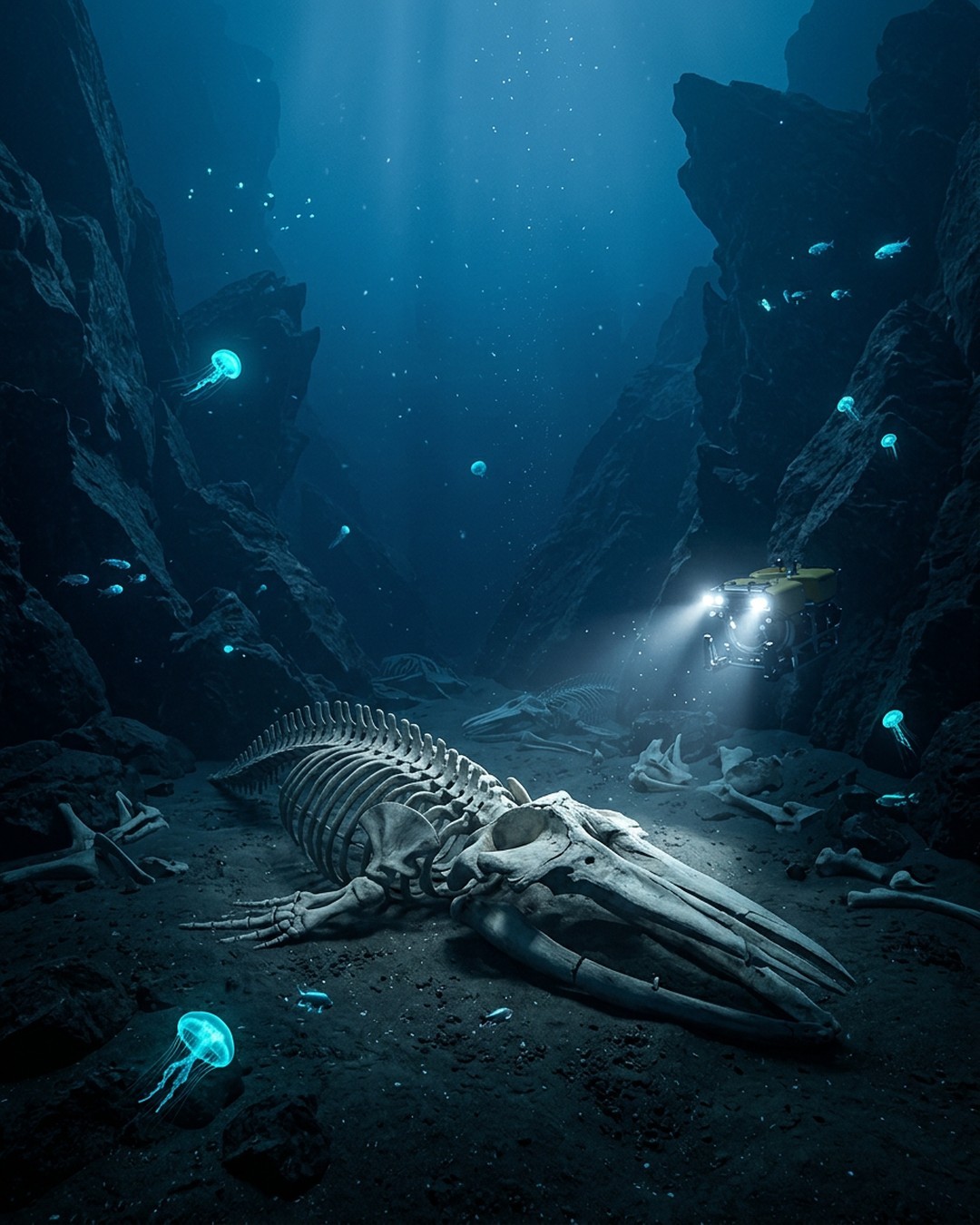
AI Generated Cover Image

A research team led by Xiaotong Peng from the Chinese Academy of Sciences has discovered a massive, 5.3-million-year-old whale graveyard in the Diamantina Zone of the southeastern Indian Ocean. Published in Nature on June 10, 2026, the study reveals a 1,200-kilometer-long site containing 476 whale fossils and five active whale fall ecosystems, providing unprecedented insights into deep-sea biodiversity and whale evolution. The researchers utilized the submersible Fendouzhe to conduct 33 dives between February and March 2023, mapping the seafloor at depths ranging from 4,200 to 7,000 meters. The findings include multiple beaked-whale species, a baleen sei whale, and a newly identified extinct species named Pterocetus diamantinae, all preserved in a unique geological setting. The formation of this necropolis is attributed to the V-shaped topography of the Diamantina Zone, which acts as a natural trap for sinking carcasses, combined with the high density of deep-diving beaked whales in the region. This site serves as a critical evolutionary window, linking Pliocene-era marine life to modern deep-sea ecosystems. This discovery highlights the vast, unexplored nature of the deep ocean and offers a rare opportunity to study the long-term ecological impact of whale falls. Researchers suggest that such sites are essential for understanding how marine life adapts to the nutrient-rich remains of large vertebrates over geological timescales.

Key Points

01

🔹 Discovery Overview and Location

【📌 Key Finding】A vast whale graveyard was identified in the Diamantina Zone of the southeastern Indian Ocean. 【⭐ Data Support】The site spans approximately 1,200 kilometers at depths between 4,200 and 7,000 meters. 【🔸 Impact Factors】The discovery was made by a team led by Xiaotong Peng using the Fendouzhe submersible in February 2023.

02

🔸 Fossil and Ecosystem Composition

【📌 Key Finding】The site contains 476 whale fossils and five active whale fall ecosystems. 【⭐ Data Support】Recovered fossils include five beaked-whale species, such as Andrews’ beaked whale (Mesoplodon bowdoini) and the strap-toothed whale (Mesoplodon layardii), alongside the sei whale (Balaenoptera borealis) and the newly discovered extinct species Pterocetus diamantinae.

03

⭐ Geological and Evolutionary Significance

【📌 Key Finding】Isotopic dating confirms the oldest fossils are 5.3 million years old, dating back to the Pliocene epoch. 【🔸 Impact Factors】The V-shaped topography of the Diamantina Zone is the primary cause for the accumulation of carcasses, effectively funneling them into a concentrated area on the seafloor.

04

📊 Research Methodology

【📌 Key Finding】The team conducted 33 total dives to map the necropolis. 【⭐ Data Support】Researchers utilized genetic analysis and ear bone morphology to identify species, including a 5-meter-long Antarctic minke whale. 【🔸 Impact Factors】The study provides a rare evolutionary window into the history of beaked whales, which are typically difficult to study due to their deep-diving nature.

05

💡 Ecological Implications

【📌 Key Finding】Active whale falls at the site support diverse, strange-looking deep-sea organisms, including jellyfish, brittle stars, and bone-boring worms. 【🔸 Impact Factors】Many of these organisms may be new to science, highlighting how whale carcasses serve as vital nutrient sources for deep-sea biodiversity.

Want to create your own mindmap?

Login to Neumap AI and start creating your own mindmaps!

Get Started