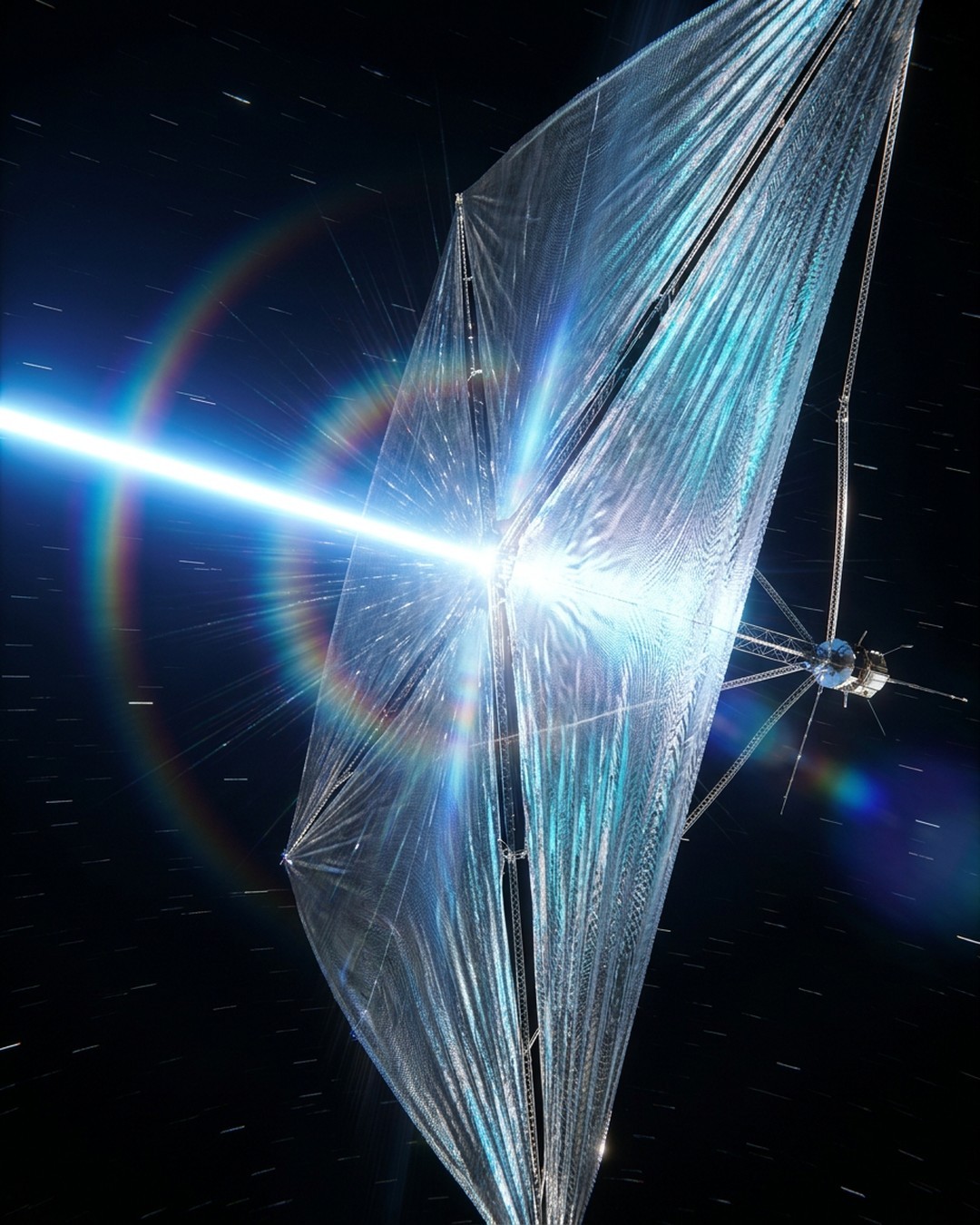
Dynamics of Interstellar Solar Sails at Relativistic Speeds

SpaceExploration SolarSail Relativity Astrophysics InterstellarTravel

Summary

Mind Map Cover Image
AI Generated Cover Image

Interstellar solar sails, designed to reach distant stars using light-based propulsion, face a significant physical challenge as they approach relativistic speeds. Research by Chao Shen and Jiaze Li from the Harbin Institute of Technology, published on June 2, 2026, identifies that light itself can act as a drag force once a spacecraft reaches 75% of the speed of light. This phenomenon occurs due to relativistic light aberration, where scattered photons begin to exert force in the direction of the sail's motion, effectively opposing its acceleration. The authors emphasize that while traditional propulsion methods like chemical rockets are insufficient for interstellar travel, light-driven sails are a promising alternative. However, the efficiency of these sails decreases as they accelerate because the Doppler effect reduces the frequency of incoming light, thereby diminishing the thrust generated by incident light, specular reflection, and diffuse scattering. Understanding these radiative dynamics is crucial for future mission planning and spacecraft design. The study highlights that at 75% of the speed of light, the diffuse scattering of photons creates a drag effect that complicates continued acceleration. Although the net force remains positive, the significant drop in efficiency necessitates advanced engineering solutions. The research treats the sail as an idealized mirror, acknowledging that real-world applications will require more complex modeling of non-radiative factors like interstellar gas and thermal limitations. Practical application of these findings suggests that future aerospace engineering must focus on developing advanced metamaterials and photonic crystals. These materials could potentially be tuned to leverage relativistic effects, allowing for self-correction and stabilization of the sail within the laser beam. This research serves as a foundational step in overcoming the complex physics of high-speed interstellar transit.

Key Points

01

🔹 Relativistic Drag Phenomenon

【📌 Key Finding】At 75% of the speed of light, solar sails experience a drag force caused by light itself. 【🔸 Impact Factors】Relativistic light aberration causes diffusely scattered photons to be directed forward, creating an opposing force. 【⭐ Data Support】The study by Chao Shen and Jiaze Li (June 2, 2026) confirms that while the net force remains positive, the efficiency of acceleration drops significantly at these extreme velocities.

02

🔸 Photon-Sail Interaction Mechanisms

【📌 Three Modes of Force】1. Incident light (direct momentum transfer from photons striking the sail). 2. Specular reflection (momentum transfer from photons bouncing off the surface). 3. Diffuse scattering (momentum transfer from absorbed and reemitted photons). 【⭐ Causal Relationship】As the sail accelerates, the Doppler effect reduces the frequency of incoming light, which directly lowers the thrust generated by these three mechanisms.

03

⭐ Engineering and Material Solutions

【📌 Future Design】Engineers are exploring advanced metamaterials and photonic crystals tuned to specific laser wavelengths. 【💡 Application】These materials could potentially use the aberration effects to stabilize the sail's flight path, ensuring it remains centered in the laser beam during high-speed transit.

04

📊 Research Scope and Limitations

【📌 Study Focus】The paper 'Relativistic Lightsail Propulsion Dynamics' focuses exclusively on radiative dynamics using an idealized mirror model. 【⚠️ Exclusions】The current model does not account for non-radiative factors such as drag from interstellar gas and dust, thermal limitations (potential melting), or the curvature of spacetime.

05

💡 Strategic Importance for Interstellar Travel

【📌 Goal】Achieving interstellar travel requires speeds far beyond chemical propulsion capabilities. 【🎯 Conclusion】Understanding the flight dynamics and efficiency drop-offs at relativistic speeds is essential for the eventual development of probes capable of reaching other star systems.

Want to create your own mindmap?

Login to Neumap AI and start creating your own mindmaps!

Get Started