Rewriting the Mathematics of Thermodynamics

Physics Thermodynamics GaugeTheory QuantumMechanics ScientificResearch

Summary

Mind Map Cover Image
AI Generated Cover Image

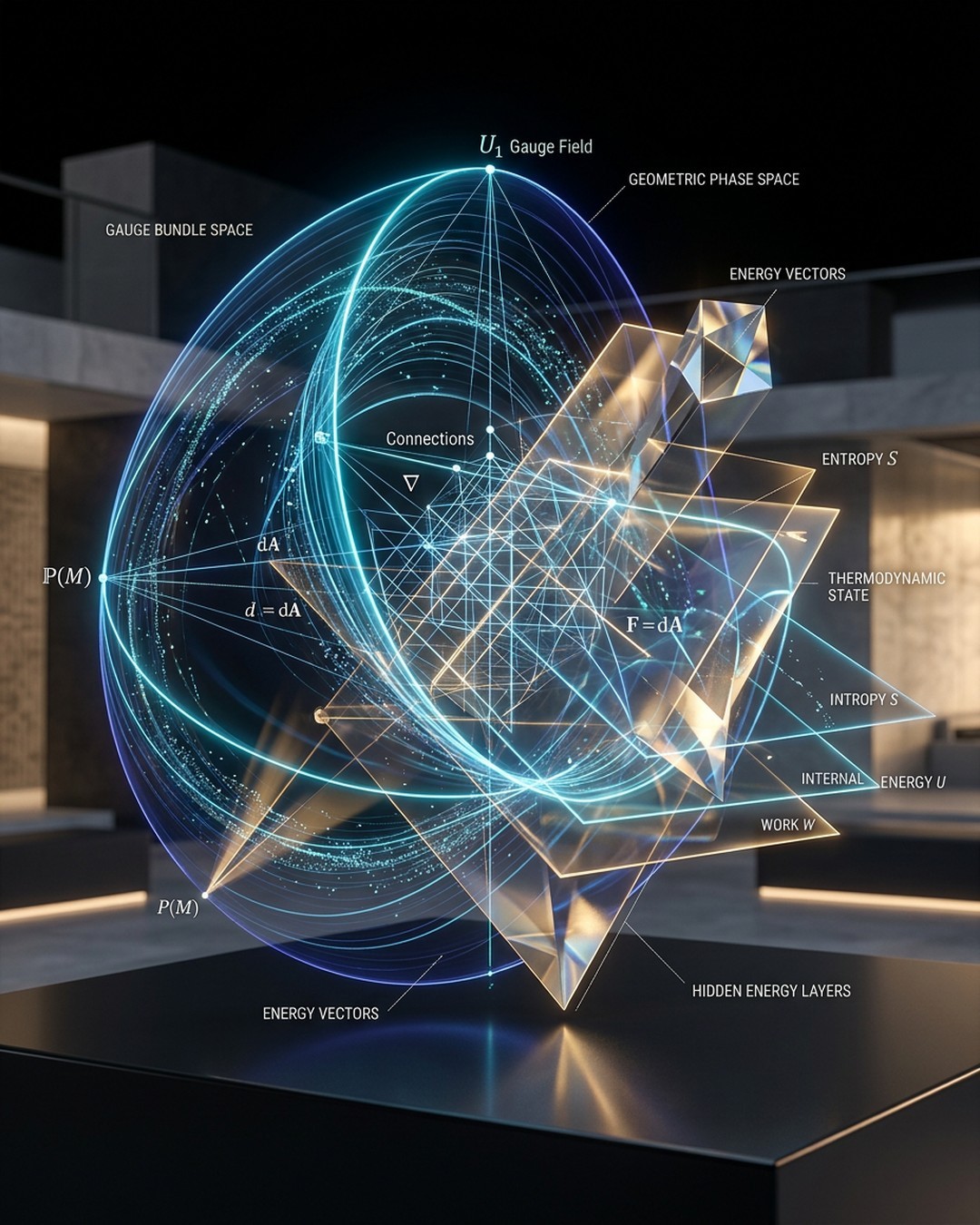
Researchers are currently restructuring the 200-year-old mathematical foundations of thermodynamics by applying gauge theory, a framework typically reserved for quantum field physics. Bryan Roberts of the London School of Economics and Political Science argues that traditional thermodynamics lacks sufficient mathematical rigor, particularly in distinguishing between accessible work and hidden heat energy. By mapping thermodynamic systems onto geometric bundle spaces, this new approach provides a more precise, consistent, and universal definition of entropy and temperature. The author posits that thermodynamics should be viewed through the lens of gauge theory, where observable quantities are projections of unobservable internal states. This methodology treats heat as a hidden contribution to energy, mirroring how gauge theory handles non-observable properties in quantum physics. This shift aims to unify disparate definitions of heat and work, potentially resolving long-standing inconsistencies in both classical and quantum thermodynamic models. This theoretical advancement offers a robust mathematical architecture that simplifies the study of complex systems, ranging from mechanical engines to black holes. By leveraging the geometric properties of gauge theory, scientists can now define entropy more rigorously, facilitating easier application across diverse physical scales and potentially bridging the gap between thermodynamics and special relativity. For the scientific community, this research provides a pathway to standardize thermodynamic definitions, which is critical for future quantum technology development. Researchers can utilize these geometric insights to predict experimental outcomes, such as thermodynamic versions of the Aharonov-Bohm effect, and to create more consistent models for energy efficiency in emerging quantum devices.

Key Points

01

🔹 Mathematical Restructuring of Thermodynamics

Bryan Roberts is rebuilding the foundations of thermodynamics using gauge theory (a mathematical framework for objects with non-observable properties). This approach addresses the historical lack of mathematical rigor in the field, which has relied on imprecise definitions for over two centuries.

02

🔸 The Gauge Theory Analogy: Marbles and Shadows

The theory utilizes a 'bundle space' (a mathematical space containing hidden internal information) and an 'observable space' (the projection of that information). Similar to how a shadow reveals properties of an object that cannot be seen directly, gauge theory allows physicists to study hidden energy components like heat by observing their projections in accessible space.

03

⭐ Redefining Work and Heat

Traditional thermodynamics treats work and heat as equal components of total energy. Roberts proposes that heat is a 'hidden contribution' to energy, mapping it into the bundle space. This distinction provides a more precise geometric definition of entropy and temperature, applicable to systems from car engines to black holes.

04

📊 Experimental Implications and Quantum Connections

The gauge theory approach suggests a thermodynamic version of the Aharonov-Bohm effect (a quantum phenomenon where a particle is affected by a hidden magnetic field). Preliminary experiments with molecular junctions support this, indicating that gauge structure can be observed in thermodynamic systems.

05

💡 Future Integration with Relativity

Lucas Céleri of the Federal University of Goiás notes that this rigorous mathematical framework may solve the long-standing challenge of combining thermodynamics with Albert Einstein's theory of special relativity. It provides a consistent, unique understanding of heat and work that is currently lacking in quantum thermodynamics.

Want to create your own mindmap?

Login to Neumap AI and start creating your own mindmaps!

Get Started