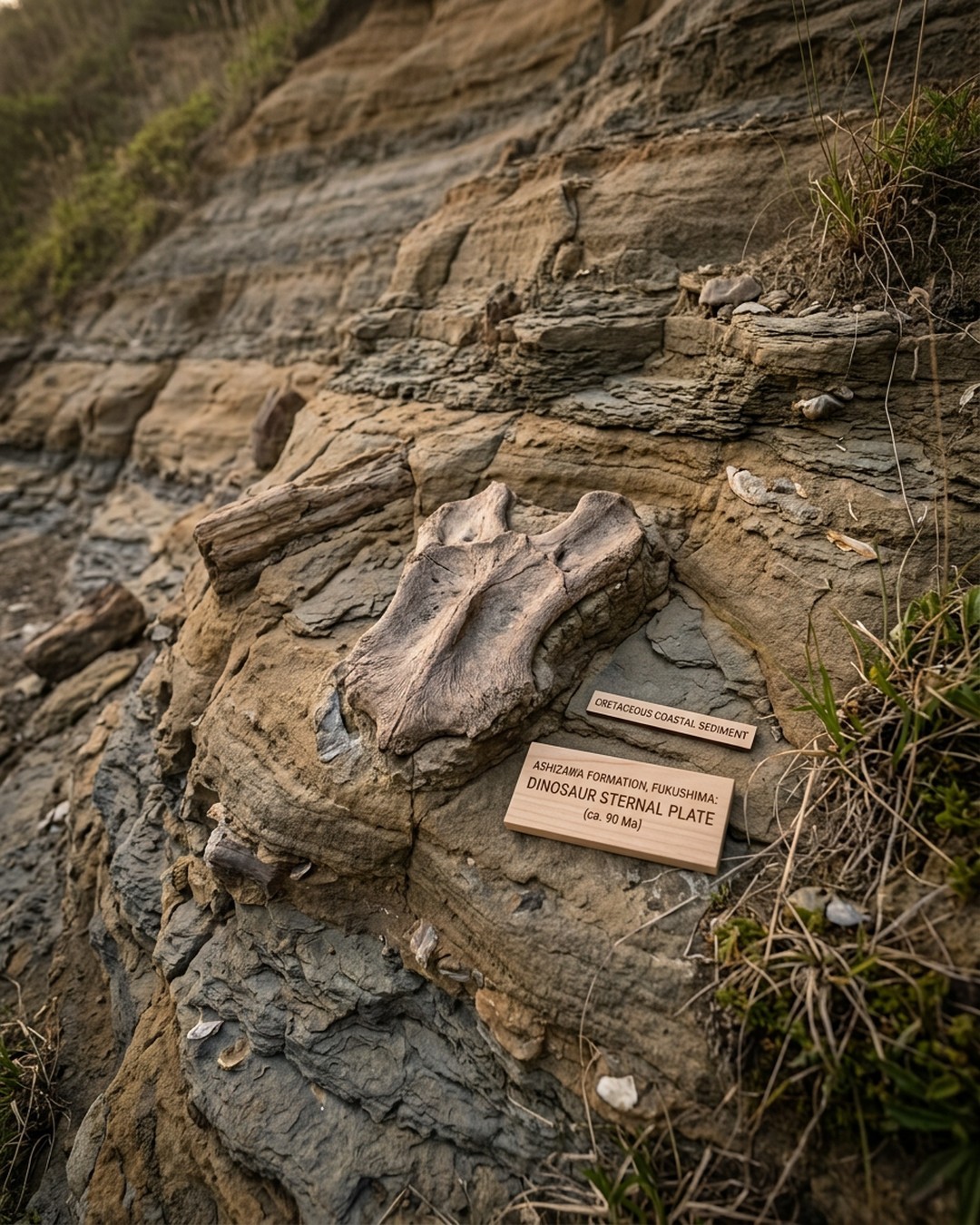
90-Million-Year-Old Fossil Discovery in Japan

scitechdaily paleontology dinosaurs fossil-discovery cretaceous-period

Summary

Mind Map Cover Image
AI Generated Cover Image

Researchers have identified a 90-million-year-old fossil from Fukushima Prefecture, Japan, as the right sternal plate of a small iguanodontian dinosaur belonging to the styracosternan group. The fossil, which remained unstudied for over twenty years after its discovery in 1999 at the Iwaki City Ammonite Center, indicates that the dinosaur was approximately 3 meters long. This discovery provides critical evidence that Late Cretaceous coastal ecosystems in East Asia supported herbivorous dinosaurs with a wide variety of body sizes, contrasting with larger species previously found. Scientists emphasize that finding smaller species alongside larger taxa enhances our understanding of ancient coastal biodiversity and ecological niche distribution during the Cretaceous period.

Key Points

01

🔹 Discovery and Background of the Fossil

【📌 Key Finding】A forgotten fossil discovered in 1999 at the Iwaki City Ammonite Center in Fukushima Prefecture, Japan, has been officially identified after remaining unstudied for more than two decades. 【🔸 Geological Context】The specimen was retrieved from the Obisagawa Member of the Ashizawa Formation, dating back approximately 90 to 88 million years within the lower Upper Cretaceous Futaba Group. 【⭐ Depositional Environment】The fossil sediments were originally deposited in a shallow-marine coastal environment, offering unique insights into ancient ecosystems along eastern Asia.

02

🔸 Anatomical Identification and Classification

【📌 Morphological Analysis】Detailed examination revealed the isolated bone is the right sternal plate (breastbone) of an indeterminate styracosternan, which is a derived group of iguanodontians. 【🔸 Previous Misidentification】The specimen was initially and tentatively categorized as a sternal plate belonging to a larger hadrosauroid dinosaur before being reevaluated. 【⭐ Taxonomic Significance】This classification places the specimen securely within the broader lineage of plant-eating iguanodontians that thrived across the Northern Hemisphere.

03

⭐ Body Size and Ecological Implications

【📌 Size Estimation】Comparative morphological analysis with related species suggests that the dinosaur measured approximately 3 meters in length. 【🔸 Diversity in Ecosystems】This 3-meter animal is substantially smaller than other known iguanodontians from the same geological formation, which reached lengths of around 8 meters. 【⭐ Coastal Biodiversity】The coexistence of large and small iguanodontians demonstrates that Late Cretaceous coastal environments in East Asia supported a diverse range of dinosaur body sizes.

04

📊 Research Significance and Publication Details

【📌 Collaborative Study】The findings were authored by researchers including Masami Kondo, Kohei Tanaka, Fumiaki Utagawa, Junki Yoshida, and Darla K. Zelenitsky. 【🔸 Academic Reference】The comprehensive study was published in 2026 within the academic journal Paleontological Research under DOI 10.2517/prpsj.250042. 【⭐ Advancing Paleontology】The research bridges gaps in the incomplete Japanese fossil record, helping paleontologists better understand how herbivorous dinosaurs evolved and distributed across Laurasia.

05

💡 Broader Evolutionary and Geographic Context

【📌 Geographic Distribution】Iguanodontians were widespread plant-eating dinosaurs that lived from the Late Jurassic through the Late Cretaceous across Asia, North America, and Europe. 【🔸 Migration Pathways】The movement and adaptation of these dinosaurs across Laurasia played a major role in shaping their global diversification. 【⭐ Regional Contribution】Fossils recovered from Japanese coastal strata serve as essential data points for reconstructing regional faunal turnover and environmental adaptations.

Want to create your own mindmap?

Login to Neumap AI and start creating your own mindmaps!

Get Started