Yellowstone Wolves Reality Check

yellowstone-wolves ecology-myth wildlife-conservation trophic-cascades scitechdaily

Summary

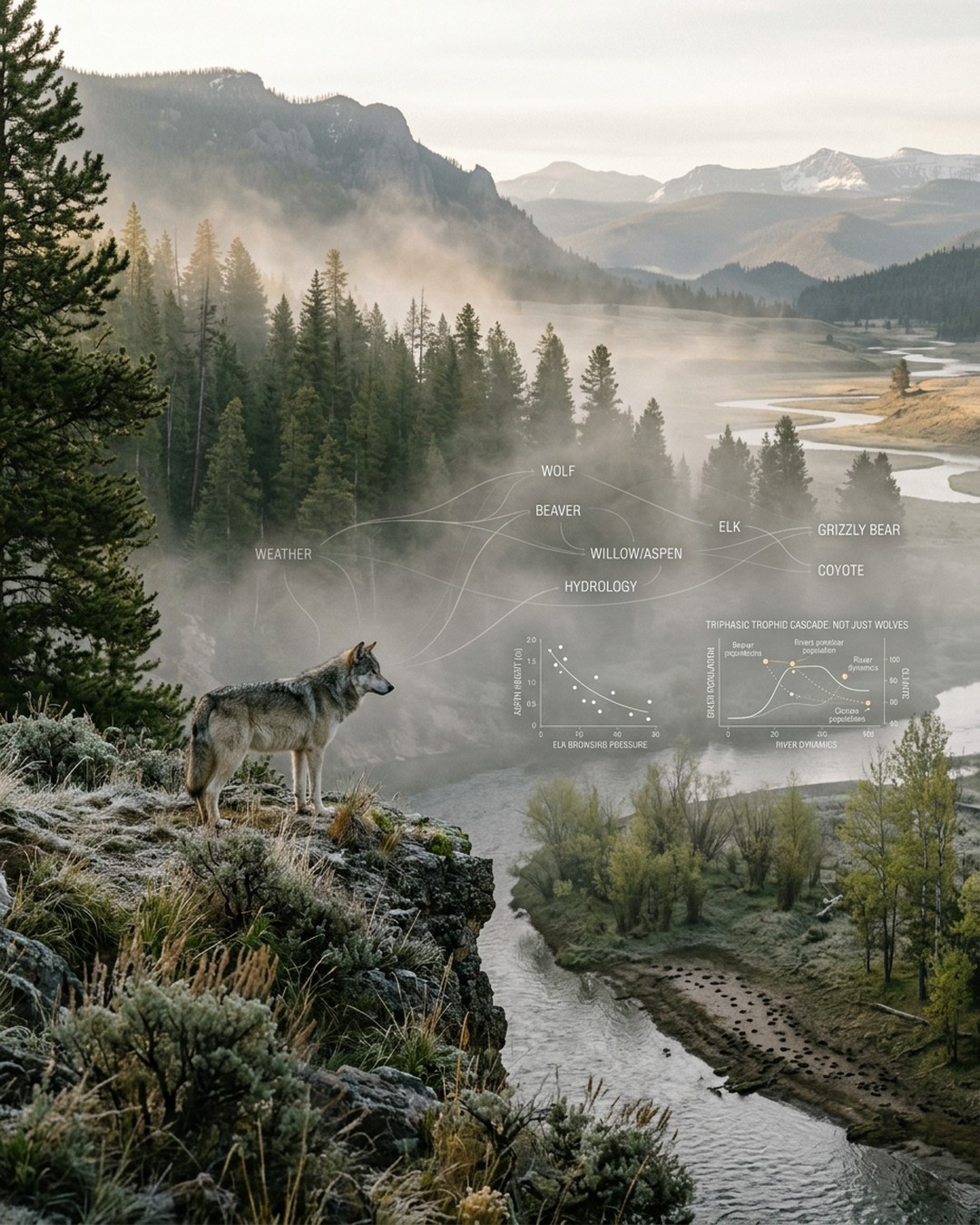
Mind Map Cover Image
AI Generated Cover Image

Published on October 13, 2026, by Rogelio Luque-Lora from the University of Edinburgh, the article examines the popular narrative surrounding wolf reintroduction in Yellowstone National Park starting in 1995. While viral videos and media accounts claim that restoring wolves completely revitalized the park's ecosystem via trophic cascades, modern scientific research reveals a much more complex and nuanced reality. The author argues that the linear causal chain where wolves reduce elk, which in turn allows vegetation and beavers to recover, is an oversimplification. Multiple carnivores like bears and mountain lions hunt elk, elk behavior prioritizes feeding over fear of predators, and landscape-wide tree recovery falls short of popular claims. Consequently, biologists describe the ecological impact as a trophic trickle rather than a cascade. Furthermore, the article explores why humans are so eager to believe the simplistic narrative, attributing it to desires for viewing nature as a balanced machine, romanticizing an unpeopled wilderness, and seeking a restorative nature cure. The author concludes that wolves are worth saving for their own sake, independent of whether they single-handedly fix damaged ecosystems. Practically, readers and conservationists are encouraged to embrace the true complexity of ecological science rather than relying on romanticized myths. Wildlife management must rely on rigorous data and account for broader socioeconomic realities involving local stakeholders rather than oversimplified environmental fairy tales.

Key Points

01

🔹 Origin and Popular Narrative of Yellowstone Wolves

【📌 Key Finding】Wolves were eradicated from Yellowstone in the 1920s and successfully reintroduced in 1995 across 3,500 square miles.【🔸 Impact Factors】Without wolves, elk overgrew and overgrazed riverbanks, destroying willow, aspen groves, and beaver ponds.【⭐ Data Support】A viral video viewed by 46 million people popularized the claim that wolves single-handedly restored the park ecosystem by driving elk away from valleys.

02

🔸 Scientific Reality: Trophic Trickle vs. Cascade

【📌 Key Finding】Decades of subsequent data show that the linear trophic cascade is an oversimplification.【🔸 Impact Factors】Elk are preyed upon by multiple carnivores including humans, bears, and mountain lions, not just wolves.【⭐ Data Support】Lead wolf biologists describe the actual recovery as a trophic trickle, where tree recovery falls far short of landscape-wide reversal.

03

⭐ Behavioral Dynamics: Feeding Over Fear

【📌 Key Finding】Elk do not flee or avoid grazing areas as intensely as the popular narrative suggests.【🔸 Impact Factors】Hungry animals prioritize feeding over predator avoidance regardless of wolf presence.【⭐ Data Support】Research demonstrates that grazing needs dictate elk movement behavior more than the landscape of fear.

04

📊 Psychological Craving for Wilderness Myths

【📌 Key Finding】The persistence of the wolf restoration myth satisfies deep human psychological desires.【🔸 Impact Factors】It reinforces the flawed belief that nature is a balanced machine, that human intervention is purely destructive, and that wilderness heals itself.【⭐ Data Support】Viral media accounts systematically omit human interventions such as flying wolves from Canada and releasing beavers.

05

💡 Intrinsic Value of Wildlife Conservation

【📌 Key Finding】Ecologists should advocate for wolf conservation based on intrinsic value rather than exaggerated ecosystem fixes.【🔸 Impact Factors】Relying on fickle arguments about the balance of nature undermines rigorous scientific foundations.【⭐ Data Support】Love and sorrow for wildlife are solid and beyond dispute, providing a stable foundation for conservation without needing overstated cascade theories.

Want to create your own mindmap?

Login to Neumap AI and start creating your own mindmaps!

Get Started