Bio-metal Material in Ragworm Jaws

biomaterials ragworm material-science bio-metal engineering-innovation

Summary

Mind Map Cover Image
AI Generated Cover Image

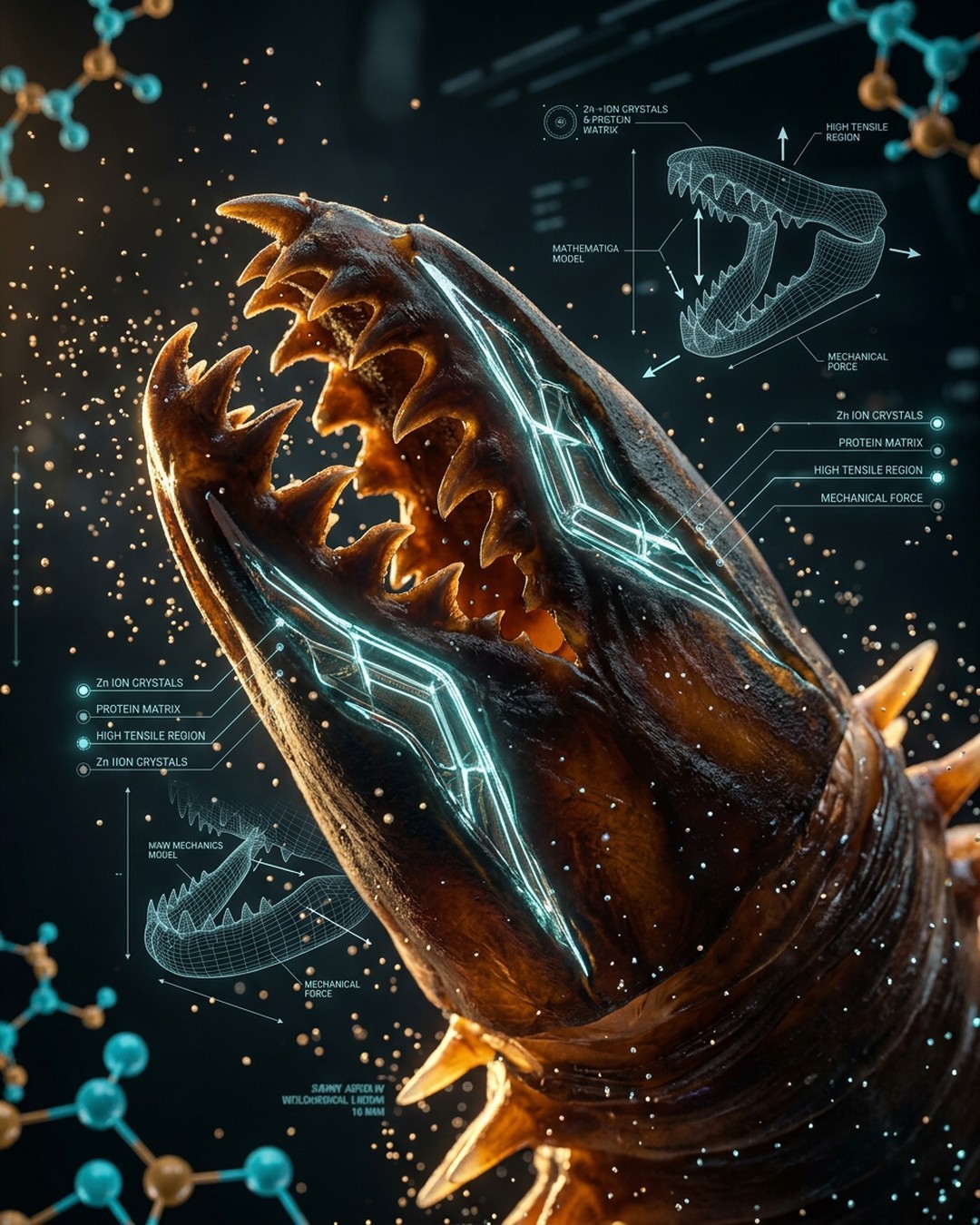
Researchers have identified a novel bio-metal material within the jaws of the marine ragworm Perinereis cultrifera, which combines protein-based structures with metal ions like zinc. This unique composition grants the jaws exceptional hardness and lightweight properties, bridging the gap between biological tissues and traditional metallic materials. The research team, led by Christian Hellmich at TU Wien, conducted over 3300 indentation experiments to analyze the mechanical behavior of these jaws. They discovered that the material exhibits metal-like hardness patterns while retaining biological elasticity, a combination that defies conventional material classification. By developing a mathematical model, the scientists demonstrated that microscopic forces arise from metal ions arranging into crystal-like defect lines. This structural configuration allows the material to respond to strain in ways previously unseen in synthetic engineering materials. The discovery offers significant potential for industries such as aeronautics and automotive manufacturing, where the demand for high-strength, low-weight materials is constant. Future research aims to genetically program these materials to grow within biological systems, potentially revolutionizing sustainable material production.

Key Points

01

🔹 Discovery of Bio-metal in Ragworm Jaws

The marine ragworm Perinereis cultrifera possesses jaws composed of a unique bio-metal material. This substance integrates proteins with metal ions, specifically zinc, to achieve a hardness-to-weight ratio that surpasses many synthetic alternatives, providing a natural blueprint for advanced engineering applications.

02

🔸 Mechanical Properties and Experimental Data

The research team performed over 3300 indentation tests on millimetre-sized jaws. The results showed that the material hardness follows patterns characteristic of metals like copper and silver, yet it maintains a level of elasticity that pure metals lack, confirming its status as a hybrid material.

03

⭐ Mathematical Modeling of Microscopic Forces

A mathematical model developed by the researchers reveals that the material's strength stems from metal ions arranging into lines similar to crystal defects. These microscopic configurations allow the jaw to manage strain effectively, providing a structural mechanism that explains its durability.

04

📊 Industrial and Evolutionary Implications

Experts like Matthew Lehnert (Kent State University) highlight that industries such as aeronautics and automotive manufacturing are actively seeking such hard, lightweight materials. Evolution has successfully coaxed metal-like mechanical fingerprints from protein-based ingredients, offering a roadmap for future material development.

05

💡 Future Research and Genetic Programming

The long-term goal of the research, led by Christian Hellmich and a team including geneticists, is to genetically program materials to grow within biological systems. By knocking out specific genes, researchers aim to understand the exact biological triggers that create these high-performance bio-metal structures.

Want to create your own mindmap?

Login to Neumap AI and start creating your own mindmaps!

Get Started