Salish Sea Sea Spiders Discovery

scitechdaily marine-biology zoology biodiversity scientific-discovery

Summary

Mind Map Cover Image
AI Generated Cover Image

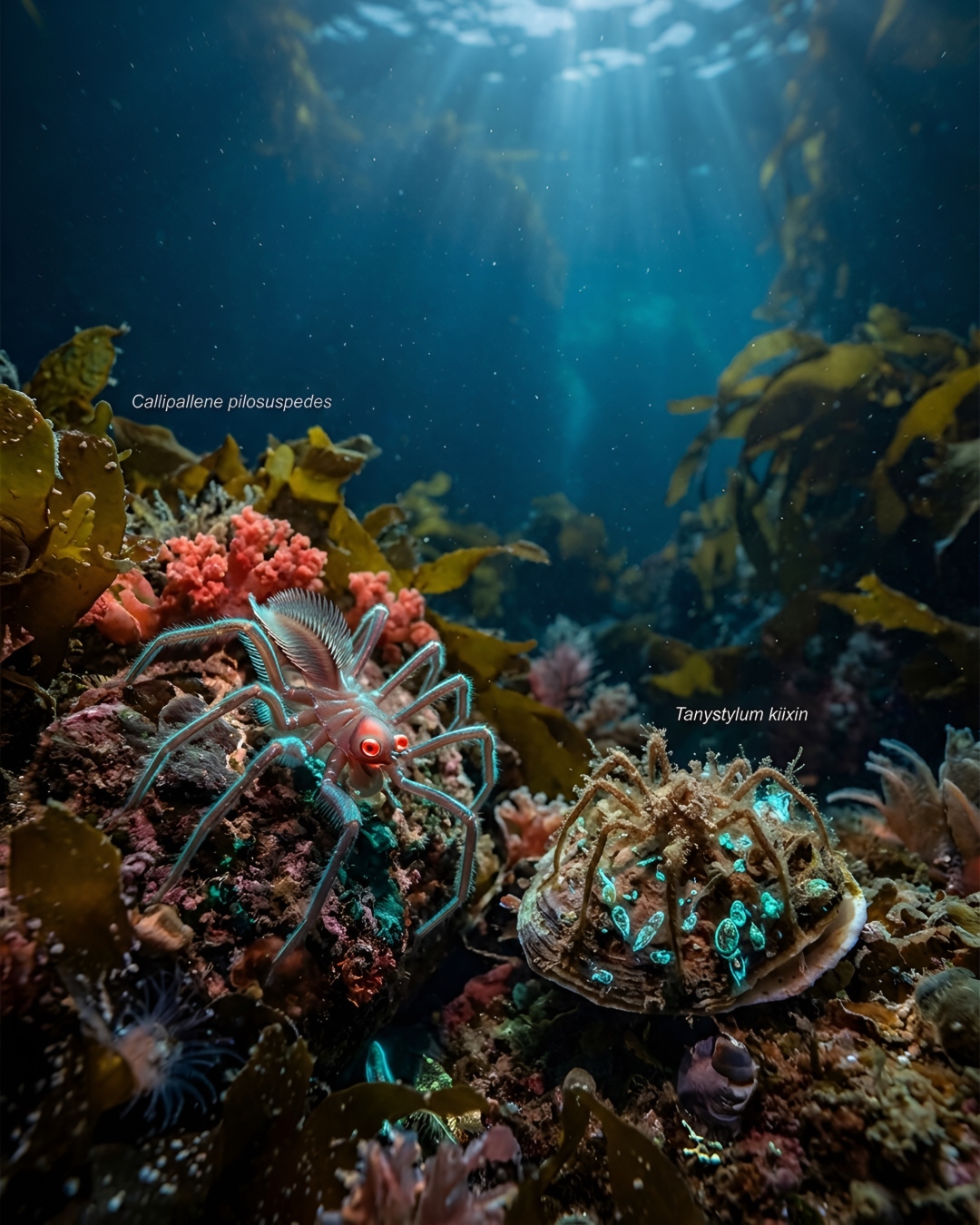
Researchers at the University of British Columbia have discovered two new species of sea spiders in the Salish Sea, marking the first new species described in the region in nearly a century. Published on August 26, 2026, in the journal Organisms Diversity & Evolution, the study highlights how little is known about local marine invertebrates amid growing environmental threats like climate change. The research expedition, led by master's student Cormac Toler-Scott between September 2023 and August 2024, utilized diving depths of up to 18 meters around Quadra Island, Vancouver, Bamfield, and Victoria. The team combined morphological examination with DNA sequencing and detailed microscopic imaging to document Callipallene pilosuspedes and Tanystylum kiixin. Callipallene pilosuspedes features bright red eyes, long curved comb-like spines on its lower legs used for precise grooming, and a three-lipped mouth surrounded by sensory tendrils. In contrast, Tanystylum kiixin possesses smaller egg-carrying limbs and accumulates debris, hosting tiny protist parasites that create a complex nested ecosystem on the spider's body. These findings bridge a century-long biodiversity gap in the Pacific Northwest and emphasize the urgent need for comprehensive species cataloging and conservation efforts. By establishing a reliable genetic database and identification guide, the study equips marine biologists to better monitor and protect vulnerable coastal ecosystems against ongoing human and climate disturbances.

Key Points

01

🔹 Discovery of New Sea Spider Species

Researchers at the University of British Columbia discovered two new sea spider species, Callipallene pilosuspedes and Tanystylum kiixin, in the Salish Sea, representing the first new sea spider species described in the region in almost a century (published August 26, 2026).

02

🔸 Fieldwork and Methodology

Led by Cormac Toler-Scott between September 2023 and August 2024, the study involved diving up to 18 meters (59 feet) deep around Quadra Island, Vancouver, Bamfield, and Victoria, utilizing both morphological analysis and DNA sequencing.

03

⭐ Morphology of Callipallene pilosuspedes

Callipallene pilosuspedes features bright red eyes, hairy feet, a short proboscis with grasping claws, a three-lipped mouth resembling a miniature Sarlacc pit, and specialized comb-like spines on its egg-carrying limbs used for precise self-grooming.

04

📊 Characteristics of Tanystylum kiixin

Named after an Indigenous village site near where specimens were collected, Tanystylum kiixin has smaller, less dexterous limbs that accumulate dirt and debris, serving as a host for tiny protist parasites that form a complex nested ecosystem.

05

💡 Conservation and Biodiversity Implications

The study successfully closes a century-long regional marine biodiversity gap by creating a genetic database and identification guide, providing essential baseline data to help marine biologists understand and protect invertebrates vulnerable to climate change.

Want to create your own mindmap?

Login to Neumap AI and start creating your own mindmaps!

Get Started