Ancient Egyptian Retainer Sacrifice at Abydos

scitechdaily archaeology anthropology egyptology history

摘要

心智图封面图片
AI 生成的封面图片

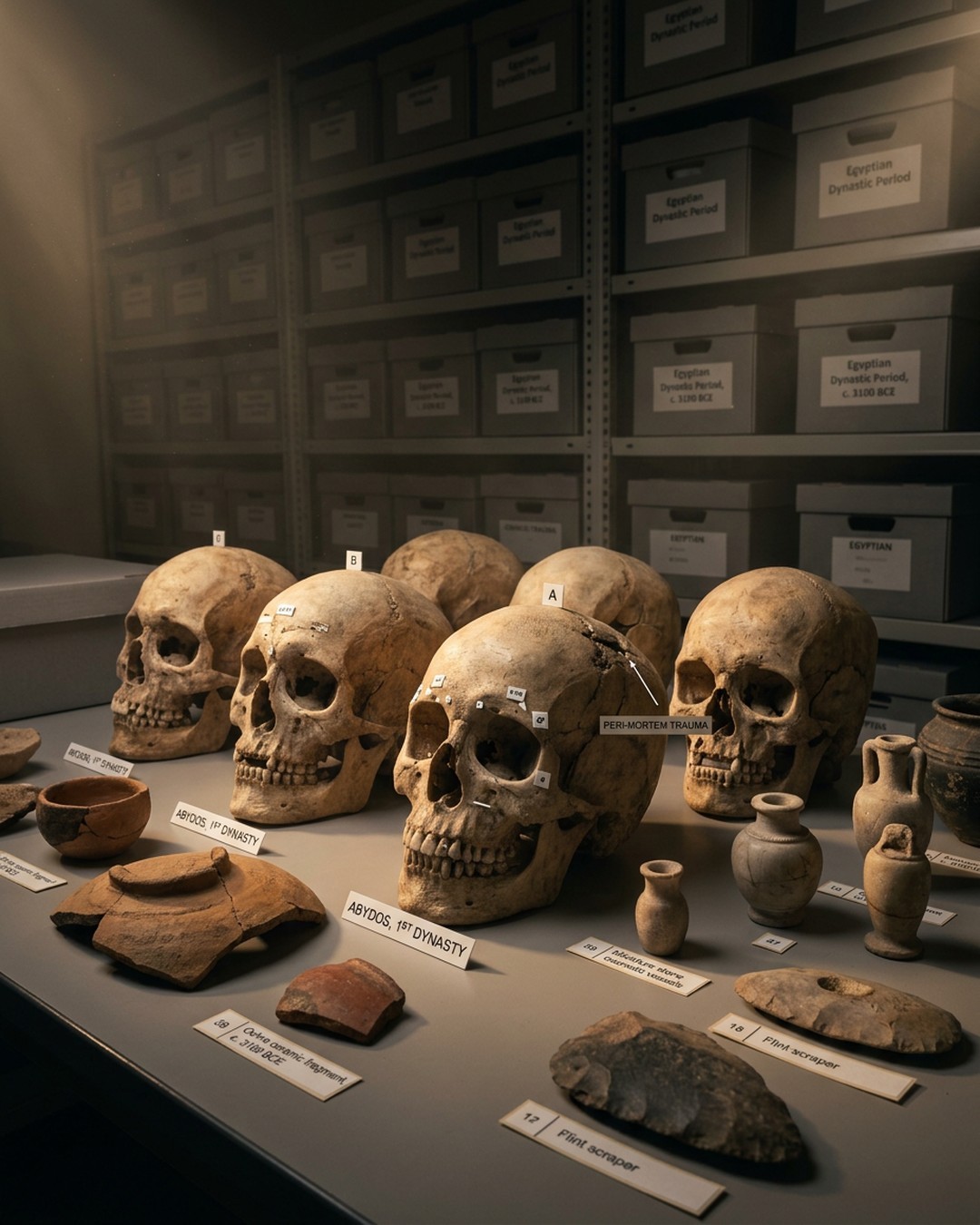
Recent bioarchaeological research published on October 17, 2026, by Dr. Roselyn Campbell reveals compelling evidence of retainer sacrifice in ancient Egypt around 3000 BCE. By examining 46 skulls from subsidiary graves surrounding the royal tombs at Abydos, the study identified significant cranial trauma in 18 specimens, indicating that approximately 39% of the individuals suffered violent deaths. The author highlights how historical excavators like Flinders Petrie initially suspected mass killings associated with First Dynasty royal burials but misidentified the perimortem linear fractures and sharp-force trauma as natural damage or excavation artifacts. This reassessment utilizes modern forensic techniques to uncover systemic state-sanctioned violence. The investigation establishes that lower-to-mid-level officials, artisans, and household members buried near Egypt's earliest kings were likely subjected to ritual killing. This practice served both religious functions regarding afterlife service and served as a powerful physical manifestation of absolute royal authority during the unification period. This study demonstrates the immense value of revisiting legacy museum collections with modern scientific methodologies. Researchers and historians gain deeper insights into the social hierarchy, funerary customs, and power dynamics of early dynastic civilizations through re-evaluating incomplete historical datasets.

关键点

01

🔹 Discovery of Cranial Trauma in 5,000-Year-Old Skulls

Dr. Roselyn Campbell examined 46 skulls from subsidiary graves at Abydos housed in the Duckworth Collection at Cambridge University. The analysis identified significant cranial trauma in 18 skulls, proving that roughly 39% of the individuals experienced perimortem injuries consistent with violent blows to the head around 3000 BCE during the First Dynasty.

02

🔸 Reassessment of Flinders Petrie's Excavation Records

During the 1920s, excavator Flinders Petrie suspected retainer sacrifice at the royal burial grounds of Egypt's earliest kings due to the sheer volume of subsidiary graves. However, he failed to identify fatal wounds, incorrectly attributing skull damage to natural causes. Modern forensic knowledge allowed researchers to reclassify these marks as linear fractures and sharp-force trauma.

03

⭐ Mechanics and Implications of Retainer Sacrifice

Retainer sacrifice involved killing individuals close to a ruler upon their death to ensure continued service in the afterlife and to vividly display absolute royal power. While some retainers may have volunteered, others were likely forced. The skeletal trauma identified includes linear fractures causing rapid unconsciousness and internal bleeding, alongside a chopping injury to an eye.

04

📊 Social Status of the Sacrificed Individuals

The subsidiary burials surrounding the monumental royal complexes at Abydos contained lower-to-mid-level officials and artisans. Grave goods associated with these chamber tombs included simple coffins, ceramic vessels, copper tools, projectile points, and small ivory figurines, highlighting the stratification of early dynastic Egyptian society.

05

💡 Methodological Significance of Re-evaluating Legacy Data

Published in Frontiers in Environmental Archaeology on October 4, 2026, this study titled New data from old bones emphasizes how modern bioarchaeology and forensic science can extract groundbreaking historical insights from incomplete, imperfect legacy datasets preserved in museum collections globally.

想要创建自己的思维导图?

登录Neumap AI,开始创建专属于你的思维导图!

立即开始