AI Memory Energy Reduction via Optimal Control Magnetic Switching

scitechdaily artificial-intelligence computer-science energy university-of-edinburgh

摘要

心智图封面图片
AI 生成的封面图片

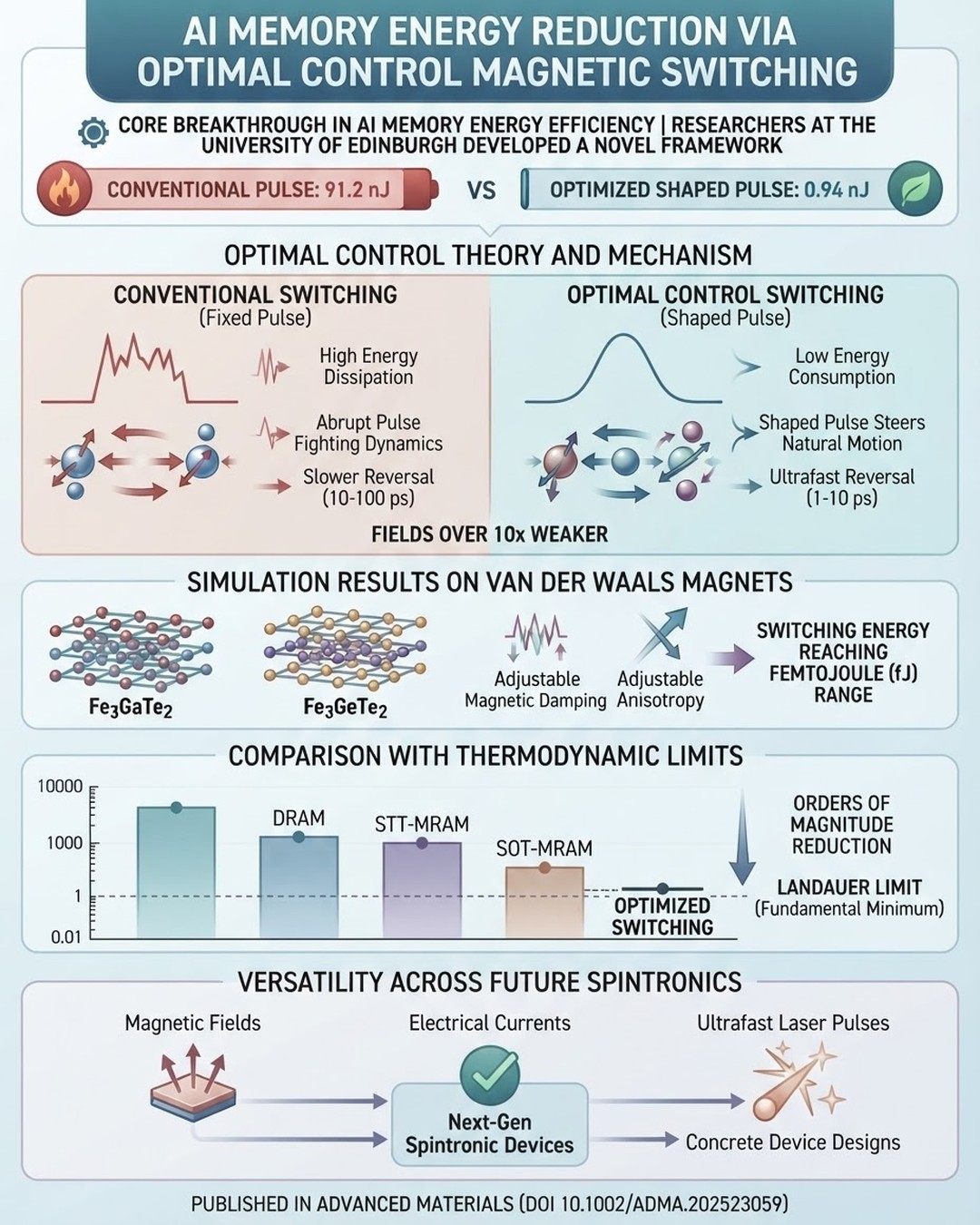
Researchers at the University of Edinburgh have developed a novel mathematical framework utilizing optimal control theory to dramatically reduce the energy required to write digital information in magnetic memory. Published on August 21, 2026, in Advanced Materials, the study demonstrates that carefully shaping magnetic field pulses can reverse magnetization in 1 to 10 picoseconds while consuming as little as 0.94 nanojoules compared to 91.2 nanojoules for conventional pulses. The author highlights that as artificial intelligence and large-scale data processing continue to expand exponentially, memory energy consumption has become a critical bottleneck. Traditional field pulses are inefficient and difficult to scale, driving industry interest toward spin-transfer torque and spin-orbit torque magnetic random access memory. The new optimal control method steers magnetization smoothly by leveraging natural material dynamics rather than fighting them. Through computer simulations of three ultrathin van der Waals magnets namely Fe3GaTe2, Fe3GeTe2, and CrSBr, the research team proved that optimized pulses achieve ultrafast switching with magnetic fields over 10 times weaker than standard methods. Furthermore, by tuning properties like magnetic damping and anisotropy, energy consumption could eventually enter the femtojoule range, closely approaching the fundamental thermodynamic Landauer limit. This versatile mathematical framework is not limited to magnetic fields and can be adapted to electrical currents and ultrafast laser pulses used in future spintronics. Engineers can potentially combine multiple switching mechanisms to create highly energy-efficient hardware architectures, offering a vital pathway to curb the massive power footprint of future artificial intelligence systems and data centers.

关键点

01

🔹 Core Breakthrough in AI Memory Energy Efficiency

【📌 Key Finding】Researchers at the University of Edinburgh published a study on August 21, 2026, in Advanced Materials detailing a mathematical framework that slashes AI memory energy use by thousands of times. 【🔸 Impact Factors】AI workloads, large language models, and data centers repeatedly store, transfer, and retrieve data at massive scales, creating unsustainable energy footprints. 【⭐ Data Support】The optimized switching technique reduced energy consumption to as little as 0.94 nanojoules compared with 91.2 nanojoules for conventional field pulses.

02

🔸 Optimal Control Theory and Mechanism

【📌 Key Finding】The research applies optimal control theory to calculate precise, moment-to-moment changes in magnetic fields for writing digital bits. 【🔸 Impact Factors】Instead of applying fixed-shape pulses that fight material dynamics, shaped pulses steer magnetization smoothly using natural motion. 【⭐ Data Support】Simulations showed magnetization reversal occurring in 1 to 10 picoseconds using fields over 10 times weaker than standard methods.

03

⭐ Simulation Results on Van Der Waals Magnets

【📌 Key Finding】The technique was successfully tested via computer simulations on three ultrathin van der Waals magnets: Fe3GaTe2, Fe3GeTe2, and CrSBr. 【🔸 Impact Factors】These materials feature weakly bonded atomic layers suitable for compact, high-speed electronics. 【⭐ Data Support】By adjusting magnetic damping and anisotropy, switching energy could eventually reach the femtojoule range, competing with STT-MRAM and SOT-MRAM technologies.

04

📊 Comparison with Thermodynamic Limits

【📌 Key Finding】The modeling indicates optimized switching brings magnetic memory significantly closer to the Landauer limit. 【🔸 Impact Factors】The Landauer limit defines the fundamental thermodynamic minimum energy dissipated when information is irreversibly erased. 【⭐ Data Support】Reductions spanning several orders of magnitude outperform leading memory technologies including DRAM, STT-MRAM, and SOT-MRAM.

05

💡 Versatility Across Future Spintronics Technologies

【📌 Key Finding】Led by Dr. Elton Santos, the research team confirmed the mathematical framework extends beyond magnetic fields to electrical currents and ultrafast laser pulses. 【🔸 Impact Factors】Engineers can combine fields, currents, and light rather than relying on a single switching mechanism. 【⭐ Data Support】Published under DOI 10.1002/adma.202523059, the findings provide concrete device designs for future experimental testing.

想要创建自己的思维导图?

登录Neumap AI,开始创建专属于你的思维导图!

立即开始