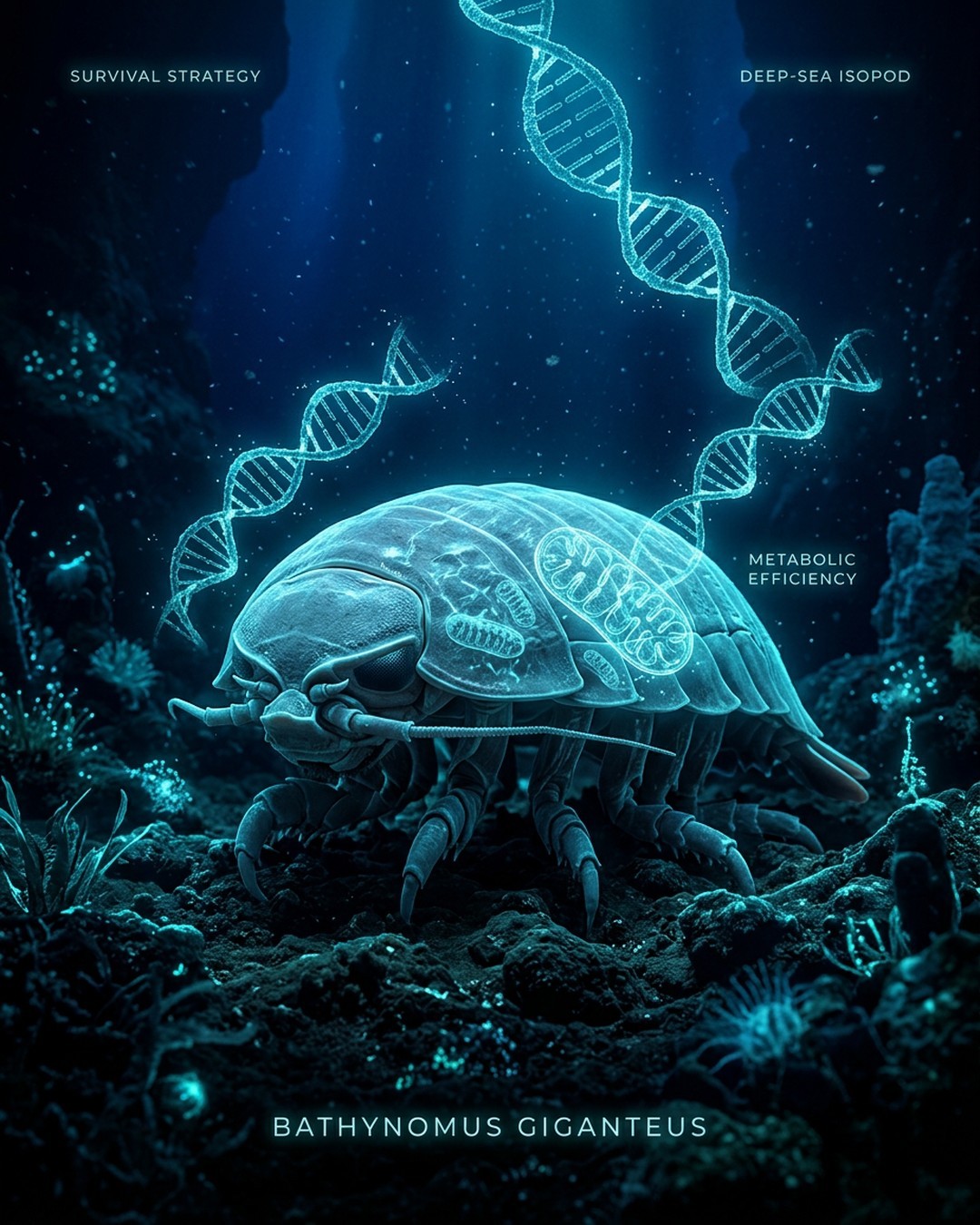
Survival Strategy of Supergiant Deep-Sea Isopods

MarineBiology EvolutionaryBiology DeepSeaResearch Metabolism Genetics

摘要

心智图封面图片
AI 生成的封面图片

Researchers from the Institute of Oceanology of the Chinese Academy of Sciences have identified the biological mechanisms enabling supergiant deep-sea isopods to survive up to five years without food. Published in the journal Cell on June 5, 2026, the study reveals that these creatures utilize a combination of anatomical adaptations and horizontal gene transfer to thrive in nutrient-scarce deep-sea environments. The authors emphasize that survival is achieved through a strategy of 'increasing revenue and reducing expenditure.' By maintaining an exceptionally large stomach and a low basal metabolic rate, these isopods can store and slowly process energy over extended periods, effectively balancing the high energy demands of gigantism with the limitations of their habitat. The core discovery involves the horizontal transfer of the ND1 gene from symbiotic bacteria into the isopod genome. This gene, regulated by histone acetylation, acts as a metabolic switch that suppresses mitochondrial activity in cold, deep-sea conditions, thereby significantly increasing starvation tolerance compared to related species in shallower waters. This research provides a new paradigm for understanding how megafauna adapt to extreme environments. The findings offer practical insights into metabolic regulation and evolutionary biology, demonstrating how organisms co-opt microbial genes to reshape energy allocation for long-term survival.

关键点

01

🔹 Survival Mechanism: The 'Revenue and Expenditure' Strategy

【📌 Core Strategy】Deep-sea isopods (Bathynomus jamesi and Bathynomus doederleini) survive by maximizing energy storage and minimizing consumption. 【🔸 Anatomical Adaptation】Their stomachs occupy approximately two-thirds of their body volume, allowing for massive food intake when available. 【⭐ Metabolic Control】They maintain an exceptionally low basal metabolic rate (BMR), enabling them to digest stored reserves slowly over periods lasting up to five years.

02

🔸 Genetic Innovation: The Role of the ND1 Gene

【📌 Horizontal Gene Transfer】The ND1 gene was acquired from symbiotic bacteria and integrated into the isopod genome. 【🔸 Functional Impact】ND1 is a component of Complex I in the electron transport chain. 【⭐ Regulatory Mechanism】The gene is highly expressed and controlled by histone acetylation, which allows the organism to fine-tune its mitochondrial metabolic network in response to environmental temperatures.

03

⭐ Experimental Validation of Starvation Tolerance

【📌 Cross-Species Testing】Researchers inserted the ND1 gene into zebrafish, nematodes, and human 293T cells. 【🔸 Temperature Dependency】At normal temperatures, ND1 increased energy metabolism. However, in low-temperature conditions simulating the deep sea, ND1 suppressed mitochondrial activity. 【⭐ Quantitative Result】In zebrafish, this genetic modification increased starvation tolerance by 37%.

04

📊 Comparative Anatomy and Microbiome

【📌 Stomach Capacity】Deep-sea species possess significantly larger stomachs than their shallow-water or intertidal counterparts. 【🔸 Microbiome Composition】The stomach contents are characterized by a low density of digestive bacteria (e.g., Firmicutes) but are rich in Chlamydiae, which are associated with lipid storage, supporting the hypothesis of long-term energy conservation.

05

💡 Evolutionary Significance

【📌 Balancing Trade-offs】The study resolves the conflict between the high energy requirements of gigantism and the scarcity of food in deep-sea ecosystems. 【🔸 Scientific Paradigm】This is the first study to demonstrate how deep-sea megafauna reshape energy allocation through a combination of horizontal gene transfer and epigenetic optimization.

想要创建自己的思维导图?

登录Neumap AI,开始创建专属于你的思维导图!

立即开始