AI in Science: Augmentation and Productivity

ArtificialIntelligence ScientificDiscovery EconomicsOfScience KnowledgeProduction MetaScience HumanAugmentation

摘要

心智图封面图片
AI 生成的封面图片

This article explores the transformative impact of artificial intelligence on the scientific knowledge production function, characterizing AI as a powerful tool for augmenting human scientists rather than fully automating the discovery process. The authors argue that the central challenge of frontier science involves navigating vast combinatorial search spaces, where AI prediction machines significantly enhance productivity by aiding in question, idea, design, and test generation. The authors maintain that human judgment remains indispensable for tasks requiring abductive inference, contextual nuance, and ethical deliberation, particularly in data-sparse environments. They propose a multi-stage model of scientific productivity that accounts for both the Jones view of AI-driven growth acceleration and the Acemoglu view of human-centric bottlenecks, emphasizing that AI functions as a general purpose meta-technology (GPMT) that requires significant upstream and downstream complementary investments. The essence of the authors' strategic framework lies in the 'jagged frontier' of AI capabilities, where productivity gains are uneven across domains and workflow stages. They highlight that the productive application of AI depends heavily on the share of the scientific workforce equipped with AI expertise, suggesting that policy should focus on fostering human-AI complementarity rather than purely defensive automation strategies. The authors warn of potential 'knowledge collapse' if AI tools substitute for human learning effort, potentially depleting the collective information base necessary for future scientific breakthroughs. Practical value for users lies in the recognition that AI adoption is not a one-size-fits-all solution. Scientists and research organizations are encouraged to treat AI as a tool for augmenting judgment, focusing on training researchers to navigate the jagged frontier while maintaining the critical human capacity for hypothesis generation and causal validation. The authors suggest that future scientific progress will be driven by the interplay between algorithmic scaling, architectural innovation, and the strategic reorganization of scientific workflows to overcome persistent bottlenecks.

关键点

01

🔹 AI as a Tool for Combinatorial Search

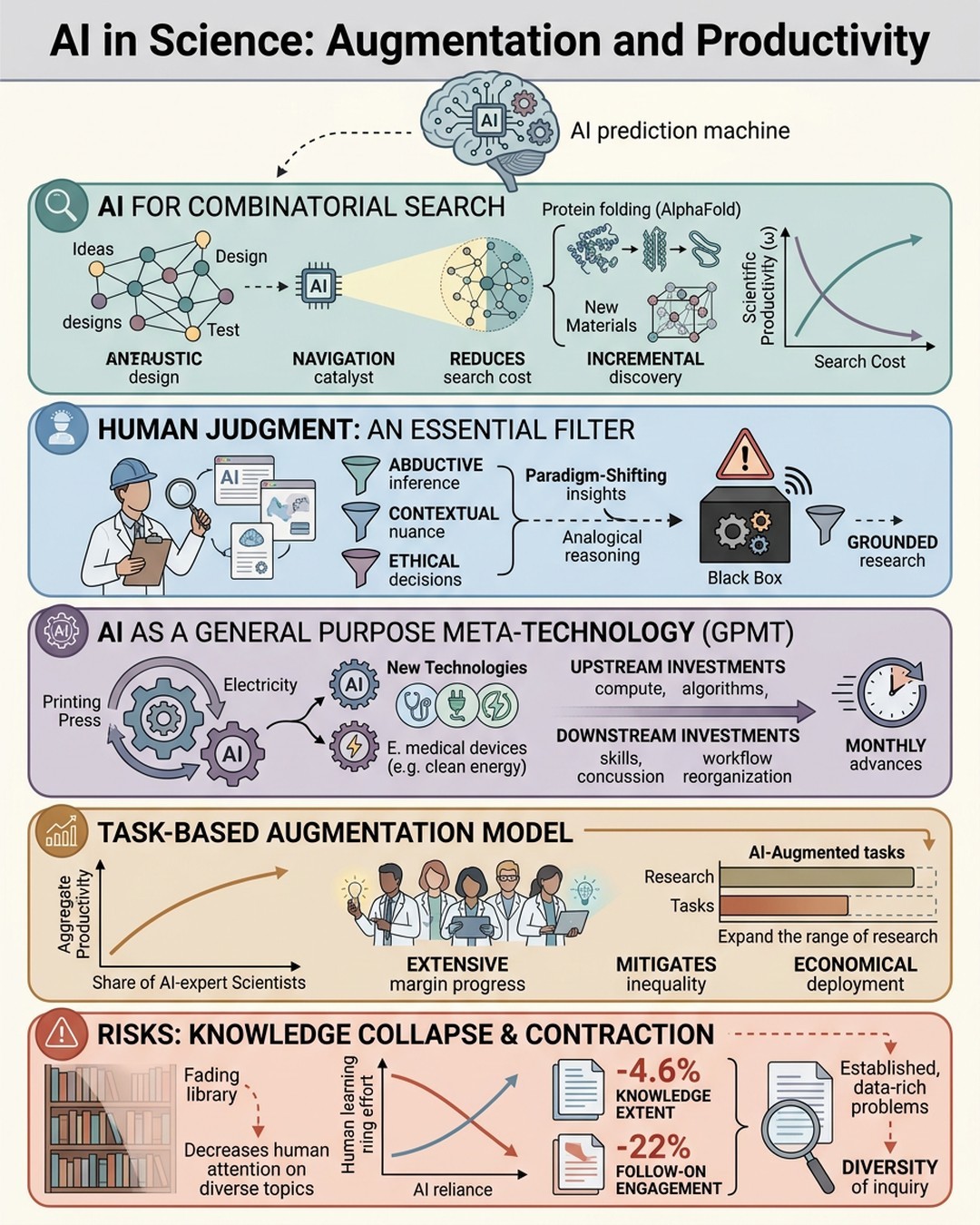
【📌 Core Finding】AI functions as a prediction machine that revolutionizes search over vast combinatorial spaces of ideas, designs, and tests. 【🔸 Impact Factors】By reducing the search cost in complex domains like drug discovery (e.g., AlphaFold) and materials science, AI significantly increases scientific productivity (ω). 【⭐ Data Support】The authors model scientific productivity as a product of four stages: question generation (α), idea generation (β), design generation (γ), and testing (δ), where AI acts as a catalyst for navigating spaces too large for human exhaustive search.

02

🔸 The Indispensability of Human Judgment

【📌 Key Finding】Human judgment remains essential for abductive inference, contextual nuance, and ethical decision-making. 【🔸 Impact Factors】AI models excel at interpolation in data-rich environments but struggle with 'paradigm-shifting' insights that require analogical reasoning and first-principles understanding. 【⭐ Causal Relationship】Human judgment acts as a necessary filter for AI-generated hypotheses, ensuring that research remains grounded in physical reality and societal values, preventing the 'black box' nature of AI from leading to scientific errors.

03

⭐ AI as a General Purpose Meta-Technology (GPMT)

【📌 Definition】AI is a technology for developing new technologies, sharing characteristics with historical GPTs like the printing press or electricity. 【🔸 Impact Factors】The 'jagged frontier' of AI requires upstream investments (e.g., scaling compute, algorithmic improvements) and downstream investments (e.g., skills training, workflow reorganization). 【⭐ Comparison】Unlike previous GPTs, AI exhibits extreme dynamism, with capabilities advancing on a monthly basis, necessitating continuous experimentation to identify optimal use cases.

04

📊 Task-Based Augmentation Model

【📌 Key Finding】Productivity gains from AI are amplified by the share of the scientific workforce that are 'AI-experts'. 【🔸 Impact Factors】Technological progress in AI expands the range of tasks that can be performed using AI (the extensive margin). 【⭐ Causal Relationship】A larger supply of AI-expert scientists mitigates wage inequality and enhances aggregate productivity by making AI expertise more economical to deploy across a broader range of scientific tasks.

05

💡 Risks of Knowledge Collapse and Contraction

【📌 Key Finding】Over-reliance on AI tools may lead to a 'knowledge collapse' where human learning effort is substituted by AI, depleting the public signals necessary for collective knowledge. 【🔸 Impact Factors】Hao et al. (2026) document a 4.6% contraction in 'knowledge extent' and a 22% reduction in follow-on scientific engagement among AI-augmented researchers. 【⭐ Warning】There is a risk that AI concentrates scientific attention on established, data-rich problems, potentially stifling the diversity of scientific inquiry.

想要创建自己的思维导图?

登录Neumap AI,开始创建专属于你的思维导图!

立即开始