The US-China AI Arms Race Evolution

AI-Arms-Race US-China-Relations Open-Source-AI Tech-Geopolitics LLM-Development

摘要

心智图封面图片
AI 生成的封面图片

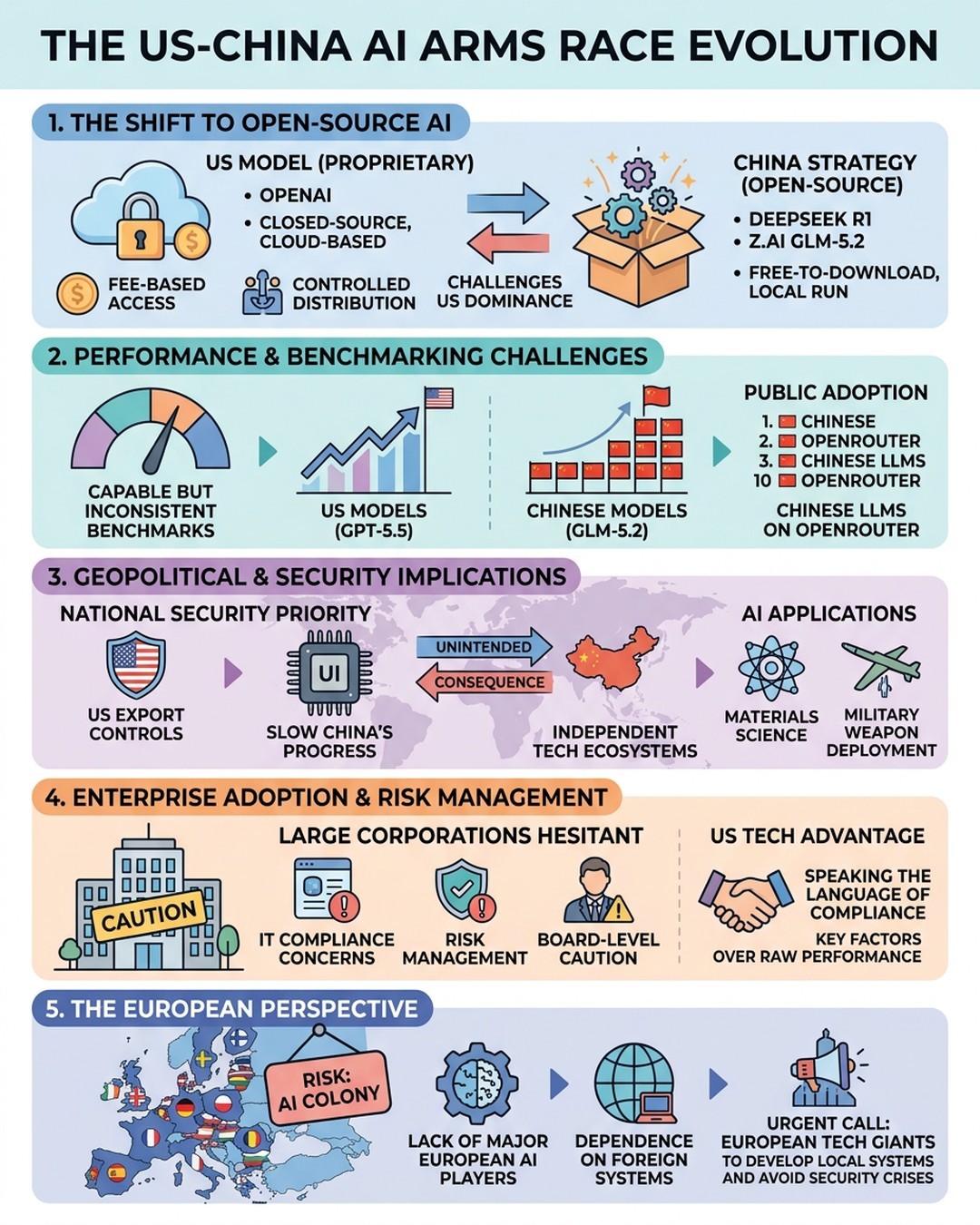
The global AI landscape is undergoing a significant shift as Chinese firms increasingly adopt an aggressive open-source strategy, challenging the closed-model, cloud-based dominance of US technology companies. While US firms like OpenAI prioritize proprietary, fee-based access, Chinese companies such as DeepSeek and Z.ai are releasing highly capable models that can be run locally for free, effectively narrowing the performance gap and pressuring Western frontier labs. The author highlights that while US lawmakers initially reacted with panic to Chinese breakthroughs, the market is rapidly adapting to China's emergence as a formidable AI competitor. This shift mirrors historical patterns where China transitioned from a fast follower to a major innovator in sectors like smartphones and electric vehicles, utilizing open-source models to bypass Western export controls and build independent technological ecosystems. Strategic competition is intensifying, with AI now viewed as a critical matter of national security, influencing everything from drug discovery to military target selection. US efforts to restrict access to advanced chips and models may inadvertently accelerate China's drive toward self-sufficiency, similar to the historical trajectory of Huawei developing its own ecosystem after being cut off from Google services. For businesses, the choice between US and Chinese models involves a trade-off between cost-efficiency and compliance. While open-source Chinese models offer accessibility and stability, large enterprises remain cautious, favoring established US tech giants that provide the necessary infrastructure, risk management, and regulatory compliance required for corporate environments.

关键点

01

🔹 The Shift to Open-Source AI

Chinese firms are aggressively releasing open-source Large Language Models (LLMs) like DeepSeek R1 and Z.ai GLM-5.2. Unlike US counterparts that host models in the cloud for a fee, these Chinese models are free to download and run locally. This strategy challenges the closed-model approach of Western labs and forces a re-evaluation of AI market dominance.

02

🔸 Performance and Benchmarking Challenges

While Chinese models like GLM-5.2 are highly capable, benchmarking remains inconsistent across the industry. Artificial Analysis found that while GLM-5.2 performs competitively, it still trails slightly behind OpenAI's GPT-5.5 in intelligence tests. Despite this, seven of the top 10 LLMs on OpenRouter are currently built by Chinese companies, indicating strong public adoption.

03

⭐ Geopolitical and Security Implications

AI has become a national security priority, with applications ranging from materials science to military weapon deployment. US export controls on chips and restricted access to models are intended to slow China, but experts warn this may backfire by forcing China to build its own independent technological ecosystems, similar to the Huawei-Android precedent.

04

📊 Enterprise Adoption and Risk Management

Large corporations remain hesitant to adopt Chinese open-source models due to concerns over IT compliance, risk management, and board-level caution. Established US tech firms (e.g., Microsoft) maintain a competitive advantage by speaking the language of corporate compliance, which is often more important to enterprise clients than raw model performance.

05

💡 The European Perspective

Experts like Philip Torr argue that Europe is sleepwalking into a national security crisis by lacking its own major AI players. The region faces the risk of becoming an AI colony, dependent on foreign systems, and there is an urgent call for the development of European-based tech giants that operate under local legislation and contribute to the regional economy.

想要创建自己的思维导图?

登录Neumap AI,开始创建专属于你的思维导图!

立即开始