XRISM Reveals Galaxy-Shaping Winds From Supermassive Black Holes

astronomy black-holes xrism university-of-michigan space-research

摘要

心智图封面图片
AI 生成的封面图片

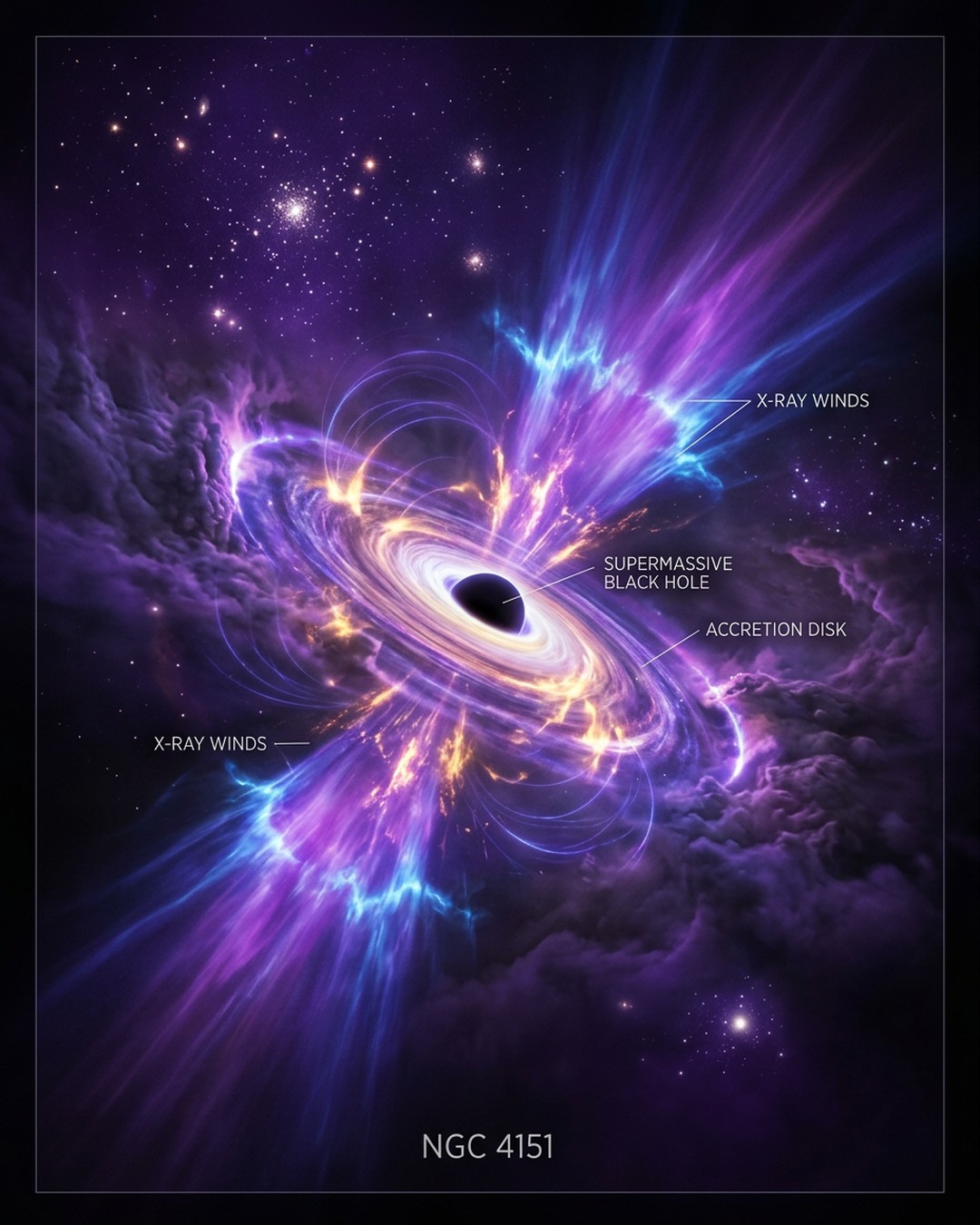
On July 8, 2026, researchers at the University of Michigan utilized data from the X-Ray Imaging and Spectroscopy Mission (XRISM) to reveal that powerful winds erupting from supermassive black holes actively shape their host galaxies by suppressing star formation. The study focused on the active galactic nucleus of NGC 4151, located over 50 million light-years from Earth, capturing unprecedented high-resolution details of accretion disk outflows. The author highlights how these high-speed winds, reaching speeds capable of blasting raw gas away from the galaxy, solve the long-standing cosmological mystery of why the largest galaxies contain far fewer stars than standard theoretical models predict. By analyzing X-ray emission patterns, researchers determined that magnetocentrifugal forces drive these outflows, similar to the mechanisms behind solar flares. A breakthrough analytical technique introduced by doctoral student Xin Cindy Xiang, termed 'cindicity' or the color intensity index, established the first direct timing link between X-ray flares and black hole winds. The research demonstrated that the fastest winds do not occur simultaneously with X-ray flares, but rather emerge approximately 10,000 seconds, or just under three hours, following a flare when X-rays are hard and relatively faint. These findings provide astronomers with a predictive roadmap for observing active galaxies and understanding the evolutionary mechanics of cosmic structures. Future observations utilizing cindicity metrics will help capture similar outflows across other galactic systems, shedding light on the self-regulating feedback loops that govern star formation across the universe.

关键点

01

🔹 Discovery of Galaxy-Shaping Winds

【📌 Key Finding】University of Michigan researchers using XRISM data uncovered that powerful winds from supermassive black holes suppress star formation by blasting away essential gas. 【🔸 Impact Factors】This mechanism resolves why the universe's largest galaxies hold significantly fewer stellar masses than predicted by current astrophysical theories. 【⭐ Data Support】Observations focused on NGC 4151, an active galactic nucleus located over 50 million light-years from Earth.

02

🔸 Advanced Capabilities of the XRISM Spacecraft

【📌 Key Finding】Launched in 2023 and beginning scientific operations in fall 2024, XRISM features X-ray energy resolution about 10 times better than its predecessor. 【🔸 Impact Factors】Led by JAXA in collaboration with NASA and the European Space Agency, the mission allows unprecedented precision in resolving fine structures of black hole environments. 【⭐ Data Support】Researchers analyzed hundreds of days of high-resolution spectroscopic data from NGC 4151's bright accretion disk.

03

⭐ Magnetocentrifugal Driving Mechanism

【📌 Key Finding】Research led by Xin Cindy Xiang and astronomy professor Jon Miller points to magnetocentrifugal driving as the primary mechanism launching the winds. 【🔸 Impact Factors】The process strips electrons from atoms, heating matter into an extremely hot plasma through friction and gravity. 【⭐ Data Support】This turbulent acceleration process mirrors the physics responsible for triggering solar flares on our sun.

04

📊 The Cindicity Index and Timing Link

【📌 Key Finding】Researchers developed a new metric called the color intensity index, or 'cindicity', combining X-ray brightness and hardness to predict fast outflows. 【🔸 Impact Factors】This metric enables astronomers to determine the exact probability of observing fast outflows during galaxy observations. 【⭐ Data Support】Analysis revealed that the strongest fast winds emerge approximately 10,000 seconds (just under three hours) after a hard, relatively faint X-ray flare.

05

💡 Implications for Galaxy Evolution

【📌 Key Finding】The first direct timing link between X-ray emissions and galactic outflows provides a concrete mechanical explanation for star-formation suppression. 【🔸 Impact Factors】By treating black hole winds as self-regulating spatial clearance engines, astronomers gain a predictive framework for galactic evolution. 【⭐ Data Support】Presented at the 248th meeting of the American Astronomical Society in Pasadena, California, on July 8, 2026.

想要创建自己的思维导图?

登录Neumap AI,开始创建专属于你的思维导图!

立即开始