Dogs Can Read Human Facial Emotions

science-news dog-cognition animal-behavior neuroscience canine-emotions

摘要

心智图封面图片
AI 生成的封面图片

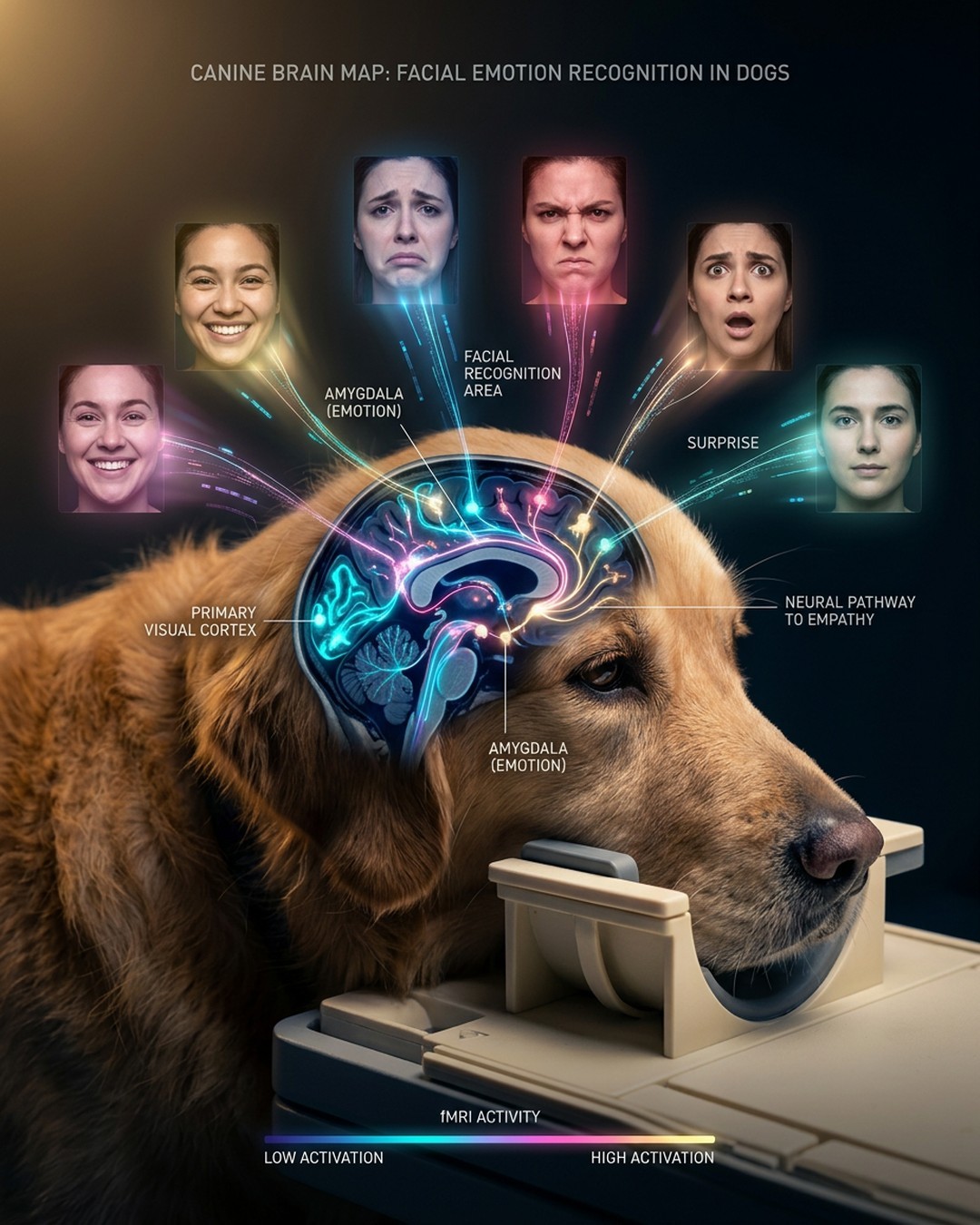
Recent neuroscientific research published on August 10, 2026, in the journal iScience reveals that dogs possess more sophisticated emotional processing capabilities than previously understood. By utilizing functional magnetic resonance imaging (fMRI) scans on 14 trained family dogs, including border collies and golden retrievers, scientists demonstrated that canine brains can distinguish between negative human facial expressions such as anger versus fear without relying on body language, odor, or vocal cues. The study's lead author, Laura Cuaya, a neuroscientist at the University of Vienna, emphasizes that this ability highlights how deeply attuned dogs are to human social signals. While earlier studies established that dogs can differentiate between positive and negative facial expressions, this new research marks the first empirical evidence that canine brains register distinct activity patterns when observing specific negative emotions like sadness and fear compared to anger. The experimental methodology required canine participants like Odin and Kun-Kun to remain perfectly still inside an MRI machine while viewing images of unfamiliar human faces. The findings showed that happy expressions activated the reward centers of the dog brains more intensely than neutral faces, while different negative expressions triggered varied neurological pathways, indicating a nuanced capacity for emotion recognition. These insights not only deepen our understanding of canine cognition and domestic evolution alongside humans but also suggest practical implications for animal behavior studies. Researchers are currently expanding their investigations to explore how dogs process auditory emotional cues, such as joyful vocalizations, potentially opening new avenues for cross-species communication research.

关键点

01

🔹 Core Research Findings on Canine Brain Activity

【📌 Key Finding】Published on August 10, 2026, in iScience, research led by Laura Cuaya at the University of Vienna proves that dogs can distinguish between specific negative human emotions solely by looking at faces. 【🔸 Impact Factors】The study demonstrates that canine brains process subtle facial differences without relying on additional cues like body language, scent, or verbal commands. 【⭐ Data Support】Experiments involved 14 family dogs, including border collies and golden retrievers, trained to stay still inside functional MRI scanners.

02

🔸 Experimental Methodology and MRI Scans

【📌 Procedure】Researchers trained dogs such as Odin and Kun-Kun to remain motionless inside an MRI machine while viewing standardized images of unfamiliar human faces. 【🔸 Brain Responses】Happy human faces activated the reward centers of the dogs' brains more strongly than neutral faces. 【⭐ Differentiation】When exposed to angry or sad faces versus fearful ones, the dogs registered distinctly different neural activity patterns for the first time in scientific observation.

03

⭐ Evolution of Emotion-Sensing Abilities in Dogs

【📌 Evolutionary Context】This research provides a deeper peek into canine cognitive evolution and how dogs became exceptionally attuned to human social signals during domestication. 【🔸 Prior Knowledge】Previous studies only confirmed that dogs could broadly separate positive from negative human expressions and that different areas of the brain were aroused accordingly. 【⭐ Advanced Processing】The new findings confirm that dog brains possess much more detailed processing capabilities than scientists previously assumed.

04

📊 Future Directions and Ongoing Research

【📌 Current Studies】Neuroscientists at the University of Vienna are actively investigating how dogs process auditory cues believed to be the equivalent of human laughter. 【🔸 Sound Response】Researchers aim to measure how canine brains respond when hearing joyful animal vocalizations compared to other sounds. 【⭐ Limitations】Scientists like Raúl Hernández-Pérez note that comparable functional MRI imaging studies in cats would be nearly impossible due to behavioral constraints.

05

💡 Practical Implications for Dog Owners

【📌 Human-Animal Bond】The research reinforces the profound empathetic connection between humans and domestic dogs, validating everyday observations of canine sensitivity. 【🔸 Behavioral Takeaway】Simple human facial expressions are sufficient for dogs to perceive shifts in emotional states. 【⭐ Recommendation】Researchers suggest that smiling and maintaining positive facial expressions when interacting with dogs is meaningful, as pets may genuinely understand these visual cues.

想要创建自己的思维导图?

登录Neumap AI,开始创建专属于你的思维导图!

立即开始