Crude Oil Membrane Energy Breakthrough

SciTechDaily ChemicalEngineering EnergyBreakthrough KAIST MaterialsScience

摘要

心智圖封面圖片
AI 生成的封面圖片

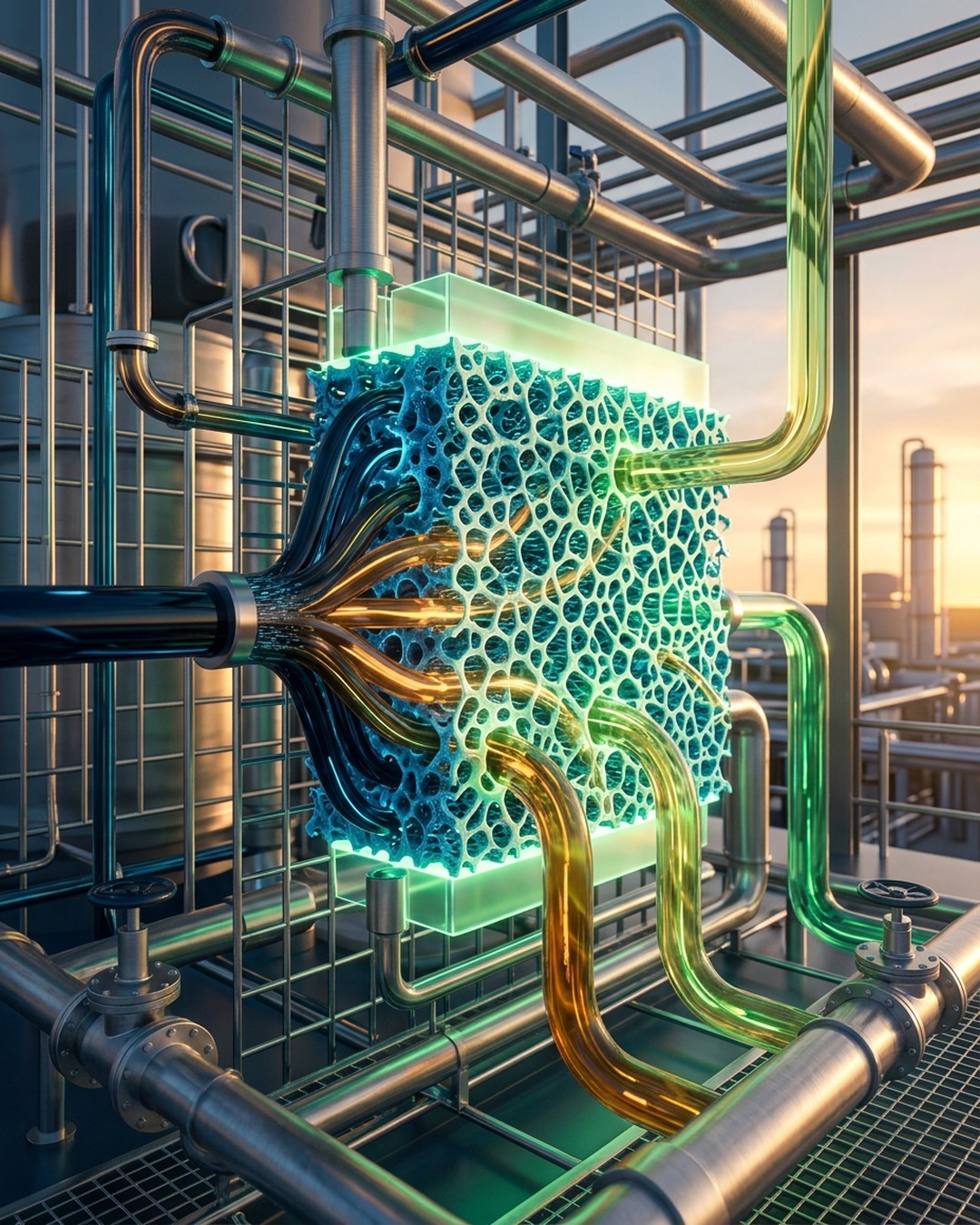
An international research team led by Professor Dong-Yeun Koh of KAIST and Professor Ryan Lively of Georgia Tech has developed an inexpensive synthetic membrane that leverages crude oil deposits to separate lighter components at room temperature. Published in Nature on June 24, 2026, the breakthrough uses bare porous polyacrylonitrile (PAN) to transform conventional membrane fouling into a selective separation mechanism, reducing energy consumption and greenhouse gas emissions. The authors emphasize that shifting from traditional energy-intensive distillation operating above 350 degrees Celsius to a room-temperature membrane pretreatment can drastically improve industrial efficiency. By using real crude oil samples supplied by HD Hyundai Oilbank, the research demonstrates robust industrial viability and scalability for existing refinery retrofits. The core mechanism relies on heavy hydrocarbons selectively depositing on the pore walls of the bare PAN membrane, creating sub-2-nanometer channels that let lighter fractions like naphtha, gasoline, and kerosene pass through rapidly. This spontaneous pore-constriction phenomenon achieves permeation rates roughly 23 times higher than prior state-of-the-art membranes while maintaining stable performance for 28 consecutive days. Process simulations indicate that adopting this technology before conventional distillation could reduce refinery energy consumption by 31.6 percent, carbon dioxide emissions by 37.6 percent, cooling water use by 20.7 percent, and operating costs by 36 percent. Future applications aim to expand this membrane platform into plastic recycling for pyrolysis oil purification, battery solvent recovery, and pharmaceutical manufacturing.

關鍵點

01

🔹 Core Innovation and Separation Mechanism

【📌 Key Finding】Researchers from KAIST and Georgia Tech developed a bare porous polyacrylonitrile (PAN) membrane that uses membrane fouling to its advantage. 【🔸 Impact Factors】Heavy hydrocarbons selectively deposit on pore walls to form channels smaller than 2 nanometers, enabling room-temperature separation without high-temperature distillation. 【⭐ Data Support】The membrane achieved crude oil permeation rates approximately 23 times higher than previous state-of-the-art membranes and remained stable for 28 consecutive days.

02

🔸 Energy Savings and Environmental Impact

【📌 Key Finding】Pretreating crude oil with the new PAN membrane before conventional distillation yields massive efficiency gains. 【🔸 Impact Factors】Process simulations show reductions in energy consumption, carbon emissions, cooling water, and operational costs. 【⭐ Data Support】Simulations indicate a 31.6 percent drop in energy use, a 37.6 percent decrease in carbon dioxide emissions, a 20.7 percent reduction in cooling water usage, and a 36 percent cut in operating costs.

03

⭐ Industrial Retrofitting and Scalability

【📌 Key Finding】The technology is designed to integrate easily into existing refineries as a modular filtration unit. 【🔸 Impact Factors】By avoiding major equipment replacement, refineries can overcome low productivity challenges historically associated with crude oil membranes. 【⭐ Data Support】Adopting this technology across Korea's refining and petrochemical sector could reduce greenhouse gas emissions by approximately 10 million metric tons annually, equivalent to removing 4 million internal combustion vehicles.

04

📊 Collaborative Research and Validation

【📌 Key Finding】The study was led by Professor Dong-Yeun Koh of KAIST in collaboration with Professor Ryan Lively’s group at Georgia Tech and published in Nature on June 24, 2026. 【🔸 Impact Factors】Real crude oil supplied by HD Hyundai Oilbank was used to validate the technology under genuine industrial operating conditions. 【⭐ Data Support】Co-first authors Dr. Jihoon Choi and Dr. Hyeokjun Seo, alongside co-corresponding author Professor Jae W. Lee, helped drive the project supported by the Ministry of Science and ICT of Korea.

05

💡 Future Applications and Expansion

【📌 Key Finding】Researchers aim to precisely control the spontaneous pore-constriction phenomenon for broader chemical processes. 【🔸 Impact Factors】The membrane platform can be adapted for sustainable chemical processes supporting carbon neutrality. 【⭐ Data Support】Proposed future applications include purifying pyrolysis oil from waste plastics, recovering solvents used in battery manufacturing, and aiding pharmaceutical purification.

想要創建自己的心智圖?

登入Neumap AI,開始創建專屬於你的心智圖!

立即開始