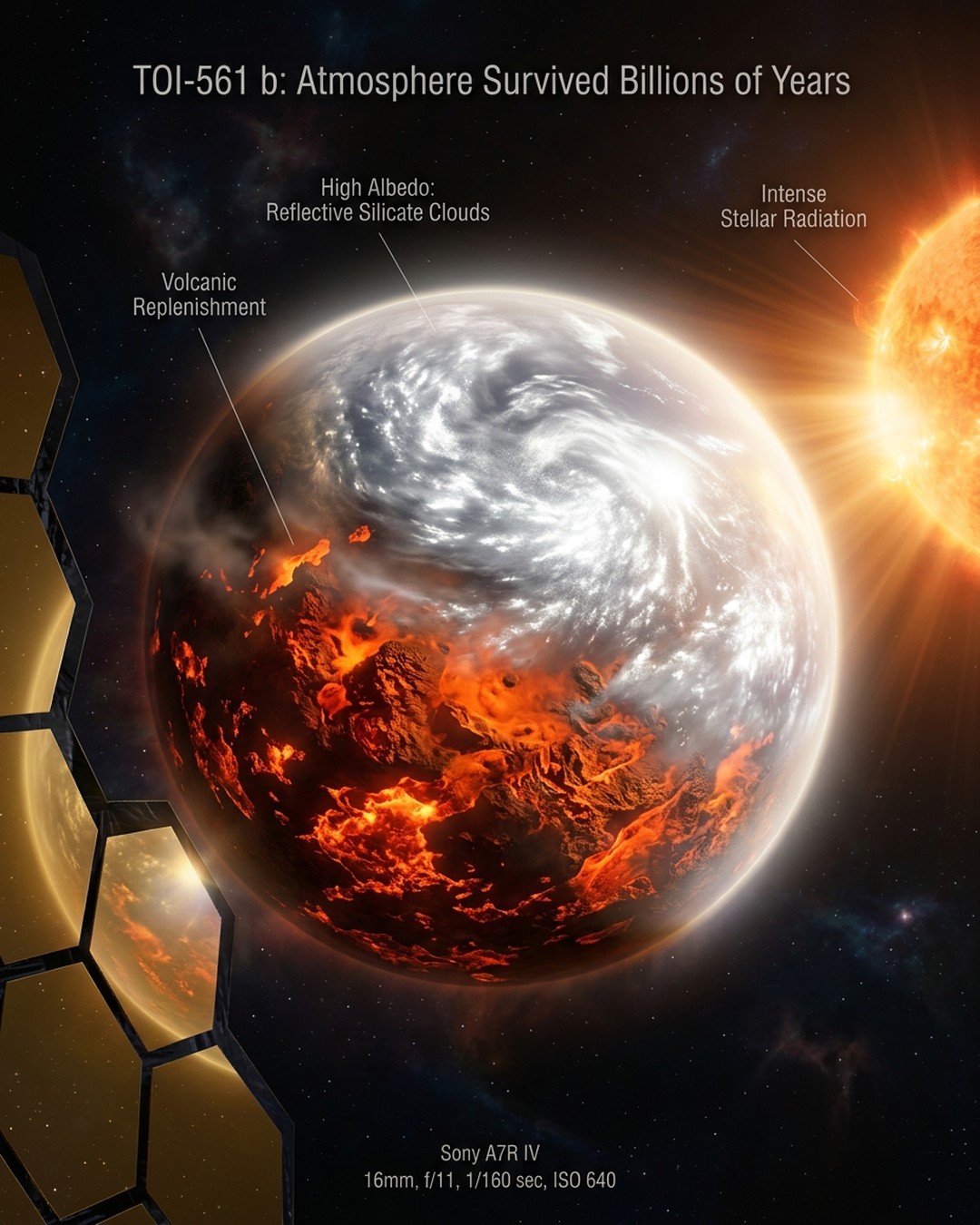
TOI-561 b Atmosphere Survived Billions of Years

scitechdaily astronomy astrophysics exoplanet james-webb-space-telescope

摘要

心智圖封面圖片
AI 生成的封面圖片

Recent observations from the James Webb Space Telescope reveal that the distant exoplanet TOI-561 b possesses a significant and highly reflective atmosphere that should have been stripped away billions of years ago by intense stellar radiation. Located approximately 280 light-years from Earth, this extreme lava world reflects roughly 75% of the starlight it receives, maintaining lower dayside temperatures than expected for an exposed molten rock surface. The research team, led by Professor Lisa Dang and including University of Birmingham astrophysicist Dr. Anjali Piette, monitored the planet across four complete orbits using phase curve measurements. Their findings suggest that silicate-mineral clouds composed of silicon dioxide and magnesium silicate act as a protective sunscreen, shielding the surface from radiation while an atmosphere of carbon dioxide or sulfur dioxide is continually replenished by volcanic activity from the molten interior. This discovery challenges current astrophysical models regarding atmospheric survival on heavily irradiated rocky worlds and raises critical questions about planetary evolution and gas retention. The presence of a persistent gas envelope on such a hot exoplanet indicates that planet-wide volcanic outgassing can sustain atmospheres under extreme conditions. Future research will utilize longer wavelength observations with the James Webb Space Telescope to analyze the precise chemical composition of the atmosphere. Determining whether TOI-561 b resembles Venus or an extreme version of Io will help scientists better understand how planetary atmospheres endure intense stellar bombardment over cosmic timescales.

關鍵點

01

🔹 JWST Observations of TOI-561 b

【📌 Key Finding】Observations by the James Webb Space Telescope published in The Astronomical Journal show that the distant exoplanet TOI-561 b retains a substantial atmosphere despite extreme stellar radiation. 【🔸 Impact Factors】Monitoring the planet for 37 hours across nearly four complete orbits revealed unexpected thermal emission patterns and heat redistribution. 【⭐ Data Support】The planet reflects approximately 75% of the starlight it receives, matching the reflectivity of Venus and defying expectations for a bare lava world.

02

🔸 Silicate Mineral Clouds as Sunscreen

【📌 Protective Mechanism】Computer climate simulations indicate that clouds containing silicate minerals like silicon dioxide (SiO2) and magnesium silicate (MgSiO3) form on the dayside. 【🔸 Radiation Shielding】These exotic mineral clouds reflect stellar radiation away from the planet, keeping dayside surface temperatures significantly lower than expected. 【⭐ Atmospheric Composition】Potential atmospheric scenarios include a dense carbon dioxide layer or a sulfur dioxide rich environment similar to Jupiter's volcanic moon Io.

03

⭐ Volcanic Replenishment and Atmospheric Survival

【📌 Scientific Puzzle】Intense stellar radiation should have stripped away the atmosphere of TOI-561 b over billions of years, making its current existence an anomaly. 【🔸 Volcanic Outgassing】Researchers suggest the ocean of molten rock covering the planet acts as a planet-wide volcano, constantly feeding and replenishing the atmosphere. 【⭐ Theoretical Challenge】Lead researcher Professor Lisa Dang and Dr. Anjali Piette confirm that these findings challenge existing theories of atmospheric retention on heavily irradiated rocky worlds.

04

📊 Research Team and Future Investigation

【📌 International Collaboration】The study was conducted by an international research team including scientists from the University of Birmingham, University of Waterloo, and other institutions. 【🔸 Phase Curve Analysis】Phase curve measurements successfully mapped brightness and heat changes throughout the planet's orbit to confirm heat redistribution. 【⭐ Next Steps】Future research will utilize longer wavelength observations with the James Webb Space Telescope to definitively identify the exact chemical makeup of the atmosphere.

想要創建自己的心智圖?

登入Neumap AI,開始創建專屬於你的心智圖!

立即開始