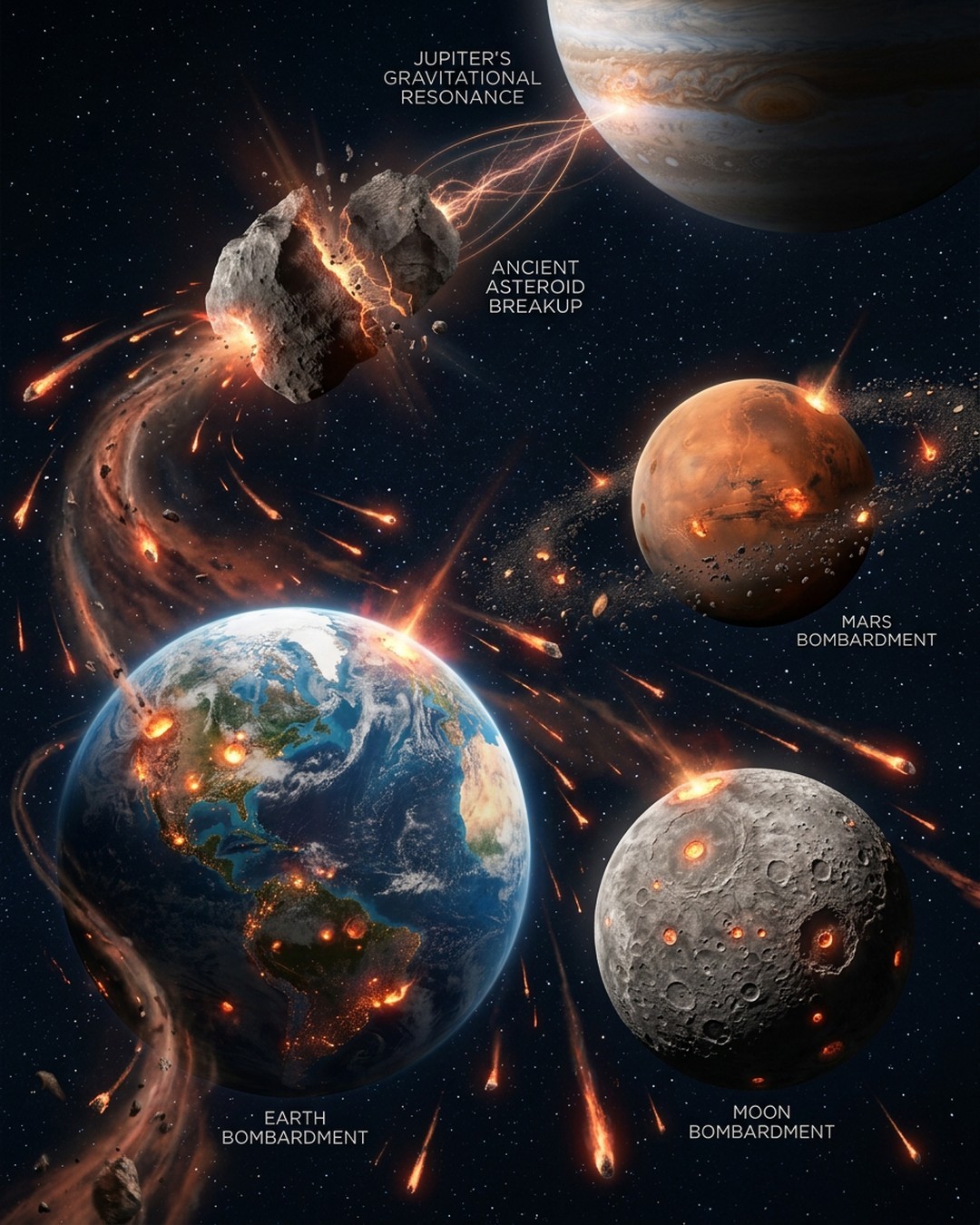
Ancient Asteroid Shower Rocked Earth, Mars, and Moon

SouthwestResearchInstitute AsteroidCollision LunarBombardment EulaliaParentBody PlanetaryScience

摘要

心智圖封面圖片
AI 生成的封面圖片

A study led by the Southwest Research Institute and published in July 2026 links a specific asteroid collision in the main belt to an inner-solar-system-wide bombardment episode that impacted Earth, Mars, and the Moon approximately 800 million years ago. The research connects the catastrophic breakup of the Eulalia parent body near Jupiter's 3:1 mean motion resonance to a massive influx of primitive carbonaceous chondrite fragments that triggered a long-lasting cosmic barrage. The researchers used collisional and dynamical models, along with lunar impact glass data collected during NASA's Apollo missions, to demonstrate how half of the debris immediately entered resonant orbits while another 25 percent gradually migrated over 100 to 150 million years driven by the Yarkovsky effect. Because Earth's plate tectonics, volcanism, and erosion erase craters older than 650 million years, the geologically static surface of the Moon served as a crucial historical archive for inferring the bombardment rates across terrestrial worlds. The findings indicate that for every large impact crater formed on the Moon, Earth experienced roughly twenty impacts of a similar or greater scale due to its larger size and stronger gravity. This ancient bombardment peaked during a period characterized by widespread global cooling and significant shifts in Earth's biosphere, raising the possibility that extraterrestrial impacts drove major environmental and biological changes. On Mars, the intense wave of impacts generated massive seismic shaking and coincided with a surge in subsurface volcanic activity, highlighting how a single catastrophic collision in the asteroid belt can induce far-reaching geological and geophysical consequences across multiple planets in the inner solar system.

關鍵點

01

🔹 Eulalia Asteroid Breakup Discovery

A study led by Dr. William Bottke at the Southwest Research Institute published on July 21, 2026, in The Planetary Science Journal connects the catastrophic breakup of the Eulalia parent body in the main asteroid belt between Mars and Jupiter to an inner-solar-system bombardment that occurred 800 million years ago.

02

🔸 Gravitational Escape Route via Jupiter

The Eulalia parent body broke apart near the gravitational 3:1 mean motion resonance with Jupiter, which acts as a gravitational escape route. Roughly half of the fragments immediately entered resonant orbits, sending a massive wave of primitive carbonaceous chondrite debris toward Earth, Mars, and the Moon.

03

⭐ Role of the Yarkovsky Effect

Following the initial impact spike, models indicate that another 25 percent of the remaining Eulalia debris gradually migrated into the J3:1 resonance over 100 to 150 million years, driven by the Yarkovsky effect where thermal radiation release slowly alters asteroid orbits.

04

📊 Impact Rate Comparisons on Earth and Moon

Because Earth's plate tectonics, erosion, and volcanic activity continually recycle the crust and obscure ancient craters older than 650 million years, researchers utilized Apollo mission impact glass and static lunar crater records to infer that Earth was struck by approximately twenty objects for every single large lunar impact.

05

💡 Biological and Geological Consequences

The 800-million-year-old bombardment peak coincides with a period of global cooling and major shifts in Earth's biosphere, while on Mars, the impacts triggered intense seismic shaking and correlated with a surge in volcanic activity, demonstrating widespread interplanetary consequences.

想要創建自己的心智圖?

登入Neumap AI,開始創建專屬於你的心智圖!

立即開始