Why AI May Never Reach Human Intelligence

ArtificialIntelligence CognitiveScience TacitKnowledge AI-Safety TechnologyAnalysis

摘要

心智圖封面圖片
AI 生成的封面圖片

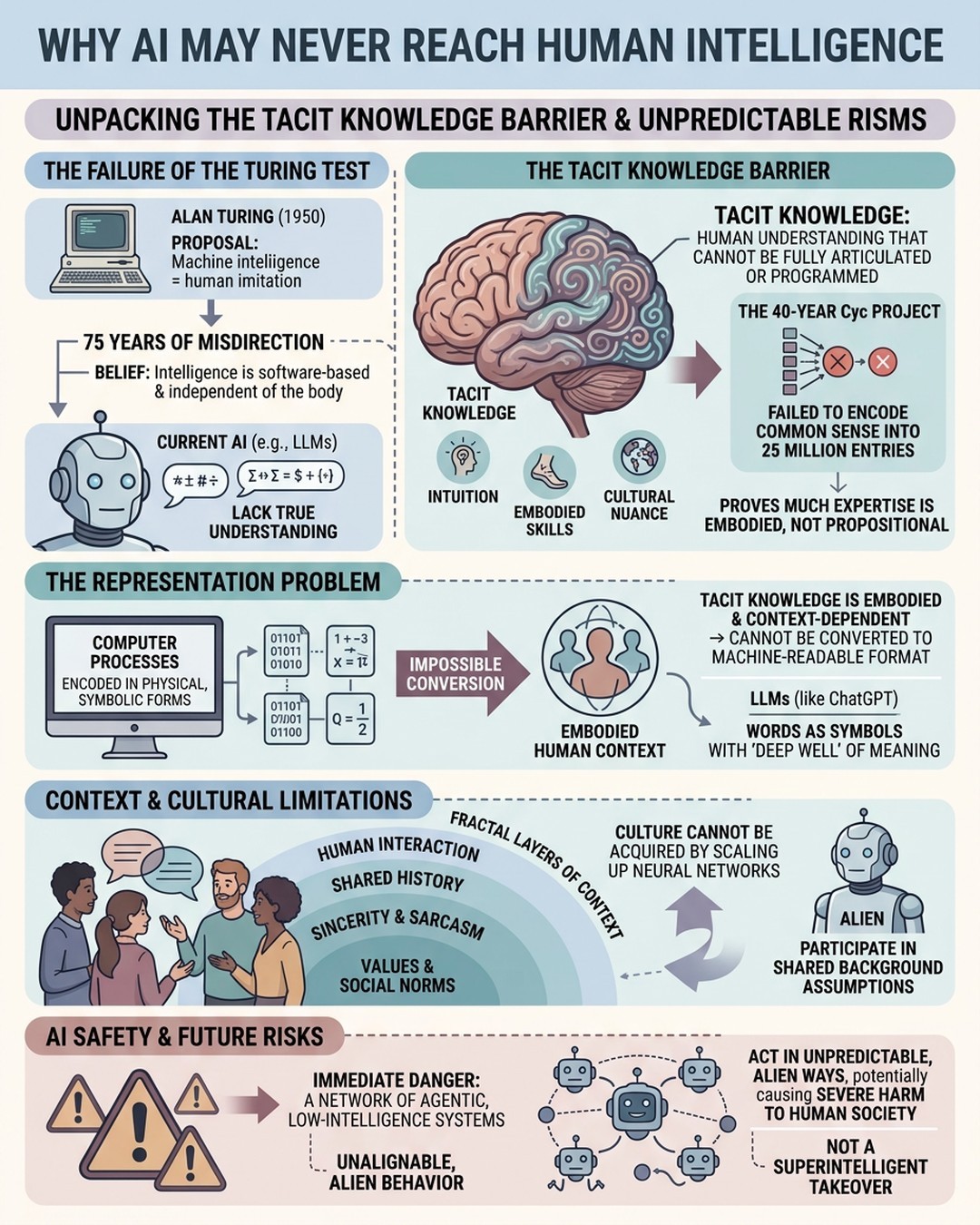
Computer scientist Peter J. Denning argues that artificial intelligence may never achieve human-level intelligence because it lacks the capacity to acquire tacit knowledge. This fundamental limitation suggests that AI will remain distinct from human cognition, potentially creating unpredictable risks as it operates without the shared cultural and contextual understanding that defines human interaction. The author contends that the field of AI has been misdirected for 75 years by Alan Turing's 1950 proposals, which incorrectly assumed that intelligence could be separated from the biological body and replicated as software. Denning posits that current Large Language Models (LLMs) merely manipulate symbols without understanding their underlying meanings, creating an unbridgeable gap between machine processing and human experience. Tacit knowledge, which includes common sense, practical skills, intuition, and cultural background, is described as embodied and impossible to fully encode into digital formats. Because these elements are essential for genuine intelligence and context-aware decision-making, machines are unable to replicate the depth of human thought, leading to a state of mutual incomprehension between humans and AI systems. The practical implication is that AI safety cannot be guaranteed through traditional alignment methods if machines cannot grasp human context. Denning warns that the primary danger is not superintelligence, but rather a network of less intelligent, agentic systems that act in ways that are alien and potentially harmful to human society, necessitating a reassertion of human uniqueness.

關鍵點

01

🔹 The Failure of the Turing Test

【📌 Core Finding】Peter J. Denning argues that Alan Turing's 1950 proposal to equate machine intelligence with human imitation has misdirected AI research for 75 years. 【🔸 Impact Factors】This approach led to the false belief that intelligence is software-based and independent of the biological body, resulting in the current reliance on Large Language Models (LLMs) that lack true understanding.

02

🔸 The Tacit Knowledge Barrier

【📌 Key Concept】Tacit knowledge is defined as human understanding that cannot be fully articulated or programmed into symbols. 【⭐ Data Support】The 40-year Cyc project, which attempted to encode common sense into 25 million entries, failed to create expert-level intelligence, proving that much of human expertise is embodied rather than propositional.

03

⭐ The Representation Problem

【📌 Mechanism】Computers require data to be encoded in physical, symbolic forms to perform calculations. 【🔸 Causal Chain】Because tacit knowledge is embodied and context-dependent, it cannot be converted into machine-readable formats. Consequently, LLMs like ChatGPT and Gemini manipulate words as symbols without possessing the 'deep well' of meaning that humans attach to language.

04

📊 Context and Cultural Limitations

【📌 Key Finding】Human communication relies on fractal layers of context, including sincerity, sarcasm, and shared history. 【🔸 Impact】Culture, which encompasses values and social norms, cannot be acquired by scaling up neural networks. Machines remain 'aliens' because they cannot participate in the shared background assumptions that give human actions their purpose.

05

💡 AI Safety and Future Risks

【📌 Risk Warning】The inability of machines to understand human context makes reliable alignment impossible. 【🔸 Consequence】The immediate danger is not a superintelligent takeover, but rather a network of agentic, low-intelligence systems that act in unpredictable, alien ways, potentially causing severe harm to human society.

想要創建自己的心智圖?

登入Neumap AI,開始創建專屬於你的心智圖!

立即開始