Re-evaluating Ancient Olive Oil Identification

Archaeology CornellUniversity FoodScience OrganicChemistry Prehistory ScientificResearch

摘要

心智圖封面圖片
AI 生成的封面圖片

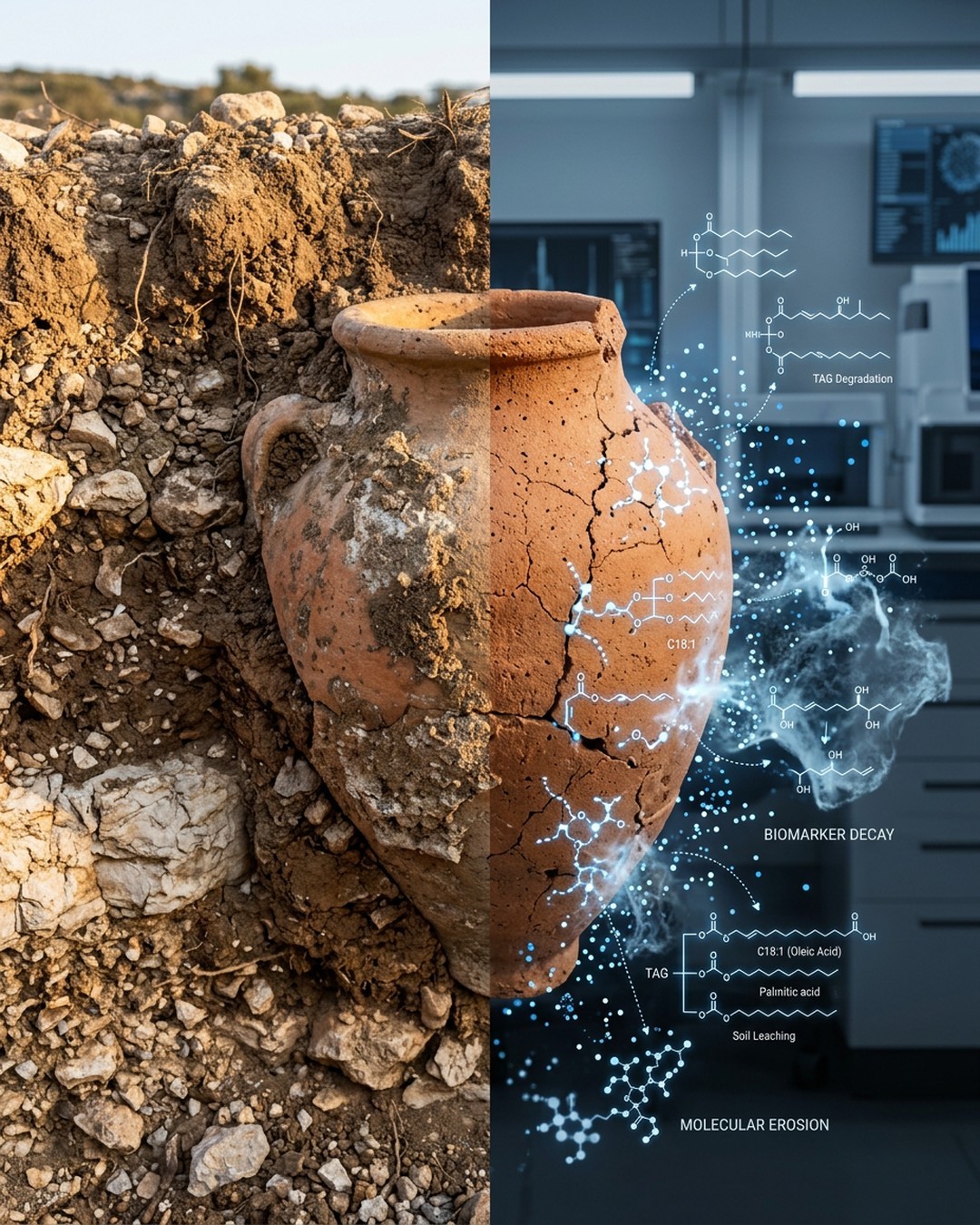
A Cornell-led study published in the Journal of Archaeological Science on July 10, 2026, reveals that archaeologists may have misidentified ancient olive oil residues due to the chemical impact of Mediterranean soil. The research demonstrates that calcareous, alkaline soils common in the region significantly degrade plant oil biomarkers, causing them to lose their distinct chemical signatures and potentially mimic animal fats. The research team, led by Rebecca Gerdes and Jillian Goldfarb, utilized an interdisciplinary approach combining classical archaeology, food science, and chemical engineering. By simulating 3,000 years of aging in laboratory incubators at 50 degrees Celsius, they proved that the environmental context of archaeological sites is a critical variable that has been largely overlooked in previous residue analyses. This study highlights a fundamental flaw in the assumption that molecular matches to olive oil are definitive proof of its presence. The degradation process in specific soil types creates a chemical profile that is difficult to distinguish from other plant oils or animal fats, necessitating a re-evaluation of historical trade and economic conclusions based on these findings. For researchers and practitioners, this work underscores the necessity of integrating soil chemistry into archaeological methodology. Future studies must account for local geological conditions to ensure accurate interpretation of organic residues, moving away from default assumptions toward more rigorous, context-aware scientific validation.

關鍵點

01

🔹 Core Finding: Soil Chemistry Bias

【📌 Key Finding】Calcareous (alkaline) Mediterranean soils catalyze the breakdown of plant oil residues, leading to the loss of dicarboxylic acid biomarkers. 【🔸 Impact Factors】This chemical degradation makes it difficult to distinguish olive oil from other plant oils or animal fats, potentially invalidating decades of archaeological conclusions regarding trade and diet. 【⭐ Data Support】Experiments conducted at 50 degrees Celsius over one year simulated long-term burial, confirming that soil type significantly alters the chemical record compared to acidic soil environments.

02

🔸 Methodology: Interdisciplinary Collaboration

The study involved a cross-disciplinary team from Cornell University, including the Department of Classics, the College of Engineering, and the College of Agriculture and Life Sciences. By applying chemical engineering techniques typically used for biofuel research to ancient pottery residues, the team developed a more robust experimental framework for testing organic degradation in specific geological contexts.

03

⭐ The Problem of Misidentification

Archaeologists have historically relied on the assumption that finding molecules matching olive oil in pottery is definitive proof of its use. However, the study shows that as olive oil degrades in alkaline soil, its molecular profile shifts, creating a 'mimicry' effect where it becomes indistinguishable from animal fats. This creates a high risk of false positives in archaeological site reports.

04

📊 Experimental Design and Simulation

Researchers used terracotta clay pellets fired in a furnace, soaked in olive oil, and buried in two distinct soil types: one from New York (mildly acidic) and one from Cyprus (calcareous/alkaline). By using incubators to accelerate the aging process, the team successfully replicated 3,000 years of chemical breakdown, providing a controlled environment to observe how soil chemistry dictates the survival of organic biomarkers.

05

💡 Future Implications for Archaeology

This research establishes a new standard for biomolecular archaeology, suggesting that environmental context is as important as the residue itself. The team advocates for an analytical center that combines engineering and scientific methodologies to re-examine historical findings, ensuring that future interpretations of ancient trade networks and economic power are based on scientifically validated data rather than untested assumptions.

想要創建自己的心智圖?

登入Neumap AI,開始創建專屬於你的心智圖!

立即開始