NBD-VRAM: Utilizing NVIDIA VRAM as Linux Swap Space

Linux NVIDIA VRAM OpenSource PerformanceOptimization SwapSpace HardwareHacking

摘要

心智圖封面圖片
AI 生成的封面圖片

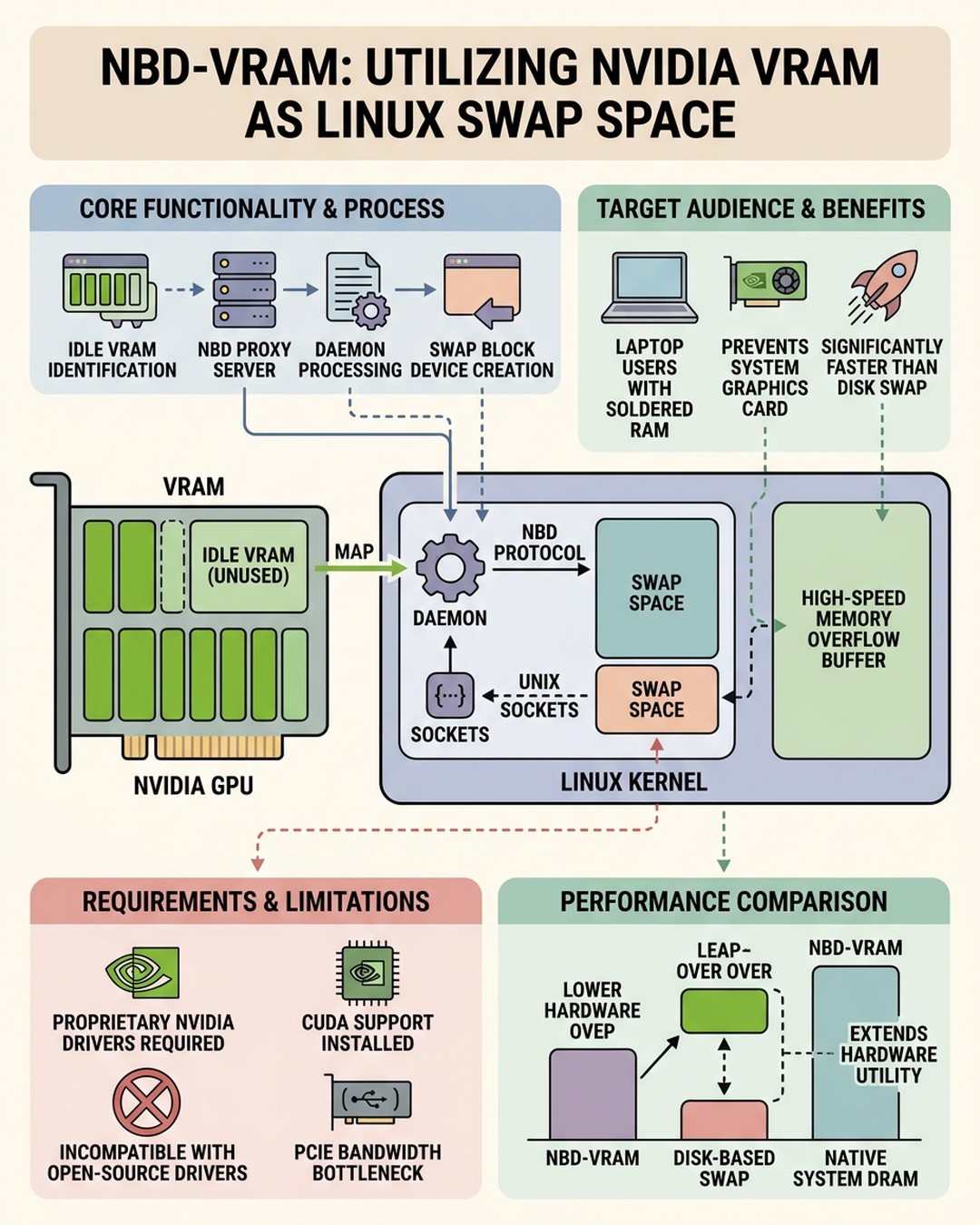
NBD-VRAM is an innovative open-source tool designed for Linux systems that allows users to repurpose idle NVIDIA GeForce video memory (VRAM) as system swap space. By leveraging the Network Block Device (NBD) protocol and NVIDIA CUDA APIs, the tool creates a high-speed memory overflow buffer, effectively mitigating performance bottlenecks in devices with limited or non-upgradable RAM. The developer's primary objective is to provide a practical solution for laptop users facing memory constraints by utilizing the often underutilized VRAM of dedicated RTX graphics cards. This approach offers a significant performance improvement over traditional disk-based swap partitions, despite being constrained by PCIe bandwidth limitations. Technically, the tool operates as a background daemon that maps a portion of VRAM into a Linux block device via Unix Sockets. While it currently requires proprietary NVIDIA drivers and CUDA support, the project is released under the MIT license, encouraging community-driven improvements and potential future support for broader hardware configurations. For Linux users, this tool serves as a strategic optimization method to extend the lifespan and utility of hardware with soldered memory. It is particularly beneficial for resource-intensive tasks where system RAM is frequently exhausted, providing a faster alternative to conventional swap storage.

關鍵點

01

🔹 Core Functionality of NBD-VRAM

NBD-VRAM (Network Block Device-Video Random Access Memory) functions by converting idle VRAM from NVIDIA GeForce GPUs into system swap space. It utilizes a background daemon that communicates via NVIDIA CUDA APIs to allocate a specific memory segment, which is then mapped as a standard Linux block device using the NBD protocol and Unix Sockets.

02

🔸 Target Audience and Problem Solving

The tool is specifically designed for users of laptops with soldered, non-upgradable RAM who possess dedicated RTX graphics cards. It solves the problem of system slowdowns caused by memory exhaustion by providing an additional 'memory overflow buffer' that is significantly faster than traditional hard drive or SSD-based swap partitions.

03

⭐ Technical Requirements and Limitations

To operate NBD-VRAM, users must have the official NVIDIA proprietary graphics drivers and CUDA support installed. It is currently incompatible with open-source drivers like Nouveau or Nova. Furthermore, performance is inherently limited by the PCIe bus bandwidth, meaning it cannot match the speed of native system DRAM.

04

📊 Performance and Strategic Value

While PCIe bandwidth creates a bottleneck compared to native RAM, NBD-VRAM offers a substantial performance leap over conventional disk-based swap. This makes it a highly practical solution for modern software environments where memory demands are constantly increasing, effectively extending the utility of hardware with limited physical memory.

05

💡 Future Development and Licensing

The project is released under the MIT license on GitHub, fostering community collaboration. Future development goals include expanding support to include AMD graphics cards and potentially improving compatibility with open-source driver stacks, which would broaden the tool's accessibility to a wider range of Linux users.

想要創建自己的心智圖?

登入Neumap AI,開始創建專屬於你的心智圖!

立即開始