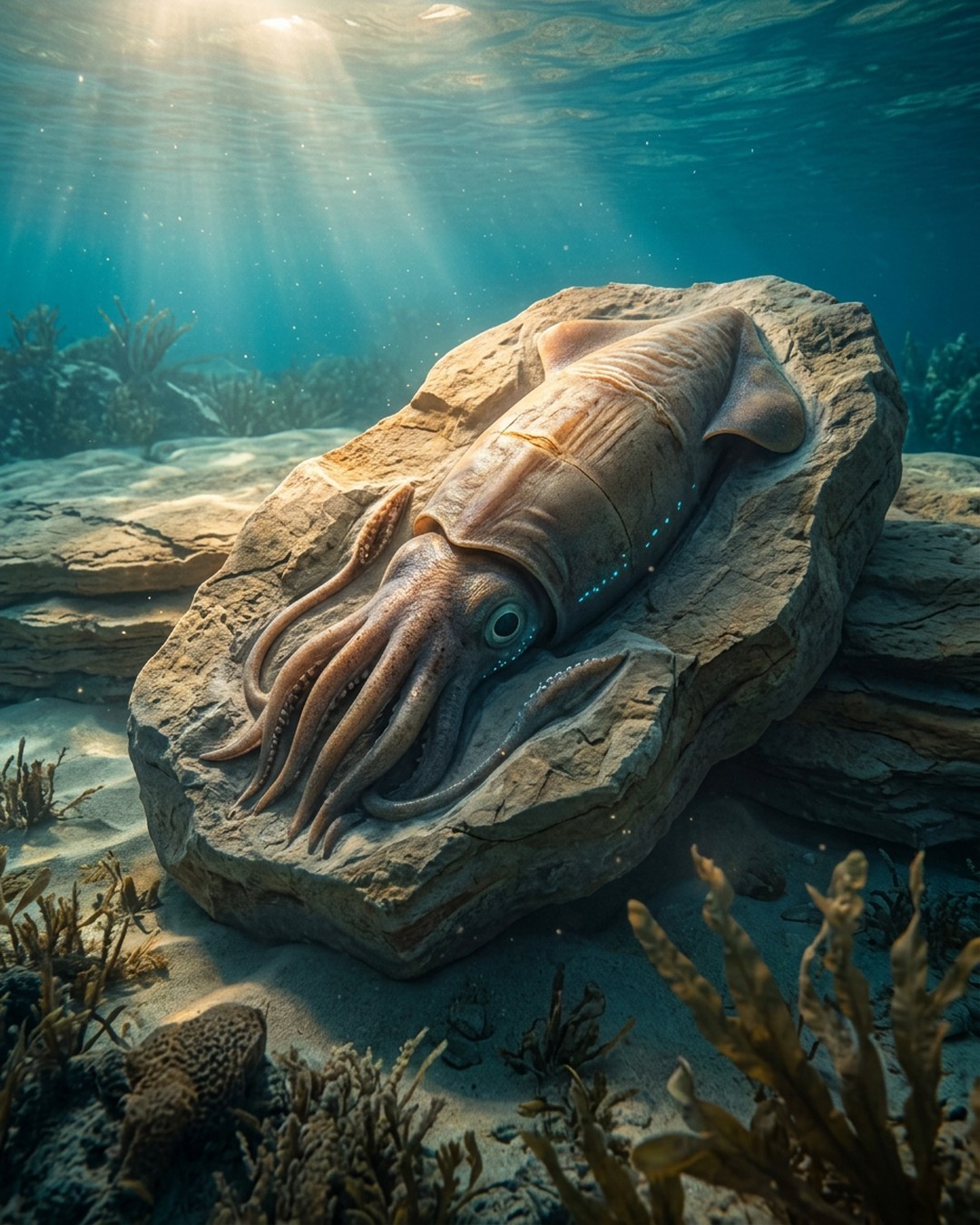
160-Million-Year-Old Chunky Squid Fossil Wyoteuthis linsterorum

scitechdaily paleontology fossils new-species jurassic

摘要

心智圖封面圖片
AI 生成的封面圖片

Researchers have identified Wyoteuthis linsterorum, a new species of belemnite that lived approximately 160 million years ago during the Late Jurassic period in an inland sea covering parts of present-day Wyoming, USA. Preserved within the Sundance Formation, the fossils display the thickest internal support structure or guard ever recorded for this extinct group of squid and octopus relatives, measuring about 10 centimeters long and 6 centimeters across. The international research team from the United States, the United Kingdom, and New Zealand utilized computed tomography scanning to examine the internal features without damaging the rare specimens. Their analysis revealed that the species belongs to a belemnite family previously thought to have vanished millions of years earlier, demonstrating unexpected evolutionary persistence and diversity within the group. The discovery centers on two rare specimens collected nearly three decades apart, with the first found in the late 1990s by Dr. Burkhard Pohl and the second discovered by fossil collector Cliff Linster in 2019 near Ten Sleep, Wyoming. The unique barrel-shaped build likely provided an ecological advantage when hunting smaller co-occurring belemnites such as Pachyteuthis, reflecting predatory behaviors seen in modern cephalopods. This finding underscores the vital contributions of amateur fossil collectors and rockhound enthusiasts to formal scientific research and paleontology. Both specimens are currently preserved and displayed at the Wyoming Dinosaur Center in Thermopolis, Wyoming, immortalizing the Linster family name in scientific literature.

關鍵點

01

🔹 Discovery of Wyoteuthis linsterorum

Researchers identified Wyoteuthis linsterorum as a new species of belemnite living approximately 160 million years ago during the Late Jurassic period. The fossils originate from the Sundance Formation in Wyoming, which preserves evidence of an ancient inland sea.

02

🔸 Extraordinary Chunky Physical Build

Unlike typical slender and bullet-shaped belemnite fossils measuring 5 to 10 centimeters long and 1 to 2 centimeters wide, Wyoteuthis possessed a barrel-shaped internal guard about 10 centimeters long and 6 centimeters across, making it the thickest ever recorded.

03

⭐ Advanced CT Scanning and Classification

Computed tomography scanning allowed scientists to analyze internal features without damaging the specimens. The analysis linked the species to a belemnite family previously believed to have gone extinct millions of years before this animal lived.

04

📊 Specimen Collection History and Timeline

The discovery relies on two rare specimens collected nearly three decades apart. The first was found in the late 1990s by Dr. Burkhard Pohl, and the second was discovered by fossil collector Cliff Linster near Ten Sleep, Wyoming, and donated in 2019.

05

💡 Ecological Role and Hunting Advantage

Paleontologists suggest that the exceptionally large size and broad guard gave Wyoteuthis linsterorum an ecological advantage when hunting smaller co-occurring belemnites of the genus Pachyteuthis, mirroring the aggressive predatory habits of modern squid.

想要創建自己的心智圖?

登入Neumap AI,開始創建專屬於你的心智圖!

立即開始