Human Neuron Computational Power

scitechdaily neuroscience artificial-intelligence hebrew-university pnas

摘要

心智圖封面圖片
AI 生成的封面圖片

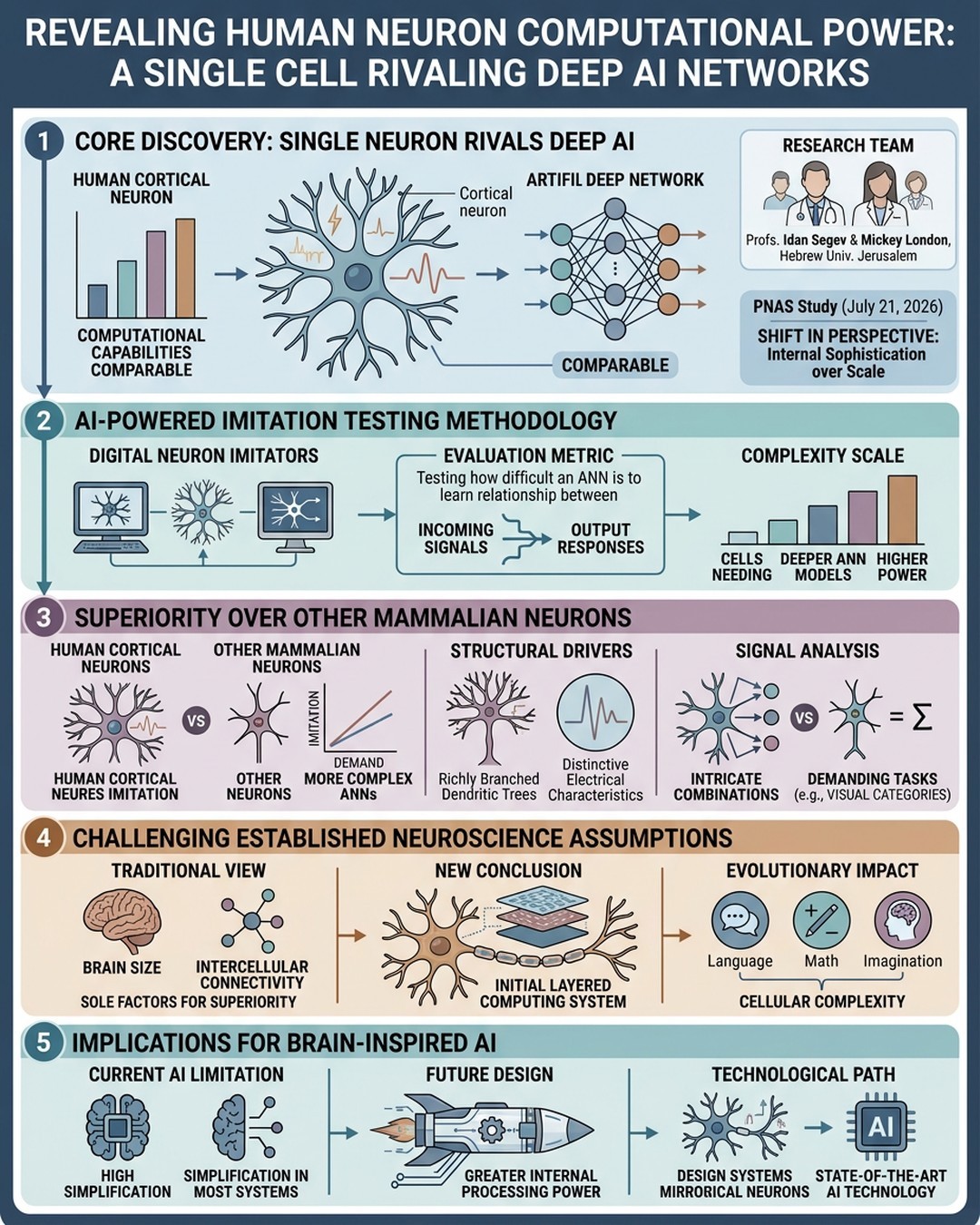
A new study published in the Proceedings of the National Academy of Sciences on July 21, 2026, reveals that a single human cortical neuron possesses exceptional computational power, rivaling the capabilities of a deep artificial neural network. Researchers led by Profs. Idan Segev and Mickey London at the Hebrew University of Jerusalem found that human brain cells act as sophisticated information-processing units rather than simple on-off switches. The research team discovered that human neurons outperform those of other mammals due to richly branched dendritic trees and distinctive electrical characteristics. These complex structural features allow individual cells to analyze combinations of incoming signals rather than merely adding them together, offering a new perspective on the biological foundations of human intelligence. By employing computer modeling and artificial intelligence, scientists built digital imitators to measure neuronal complexity. They determined that human neurons required deeper and more elaborate artificial neural networks to replicate their behavior accurately, establishing a direct connection between cellular morphology and advanced cognitive functions. This breakthrough challenges traditional assumptions that brain power depends exclusively on total neuron count and network connectivity. The findings suggest alternative paths for designing brain-inspired machine-learning technology by incorporating higher computational capabilities directly into individual artificial neural units.

關鍵點

01

🔹 Core Discovery: Human Neuron Computing Power

【📌 Key Finding】A new study published on July 21, 2026, in the Proceedings of the National Academy of Sciences (PNAS) shows that a single human cortical neuron has computational capabilities comparable to a deep artificial neural network. 【🔸 Research Team】Led by Profs. Idan Segev and Mickey London, alongside PhD students Ido Aizenbud and Daniela Yoeli at the Hebrew University of Jerusalem, in collaboration with Prof. Chris de Kock from the Free University, Amsterdam. 【⭐ Shift in Perspective】Intelligence relies not only on the brain's 100 billion neurons and massive scale, but also on the sophisticated processing executed within each individual cell.

02

🔸 AI-Powered Imitation Testing Methodology

【📌 Testing Approach】Researchers built digital imitators for neurons from various mammals using computer modeling and artificial intelligence. 【🔸 Evaluation Metric】They tested how difficult it was for an artificial neural network (ANN) to learn the relationship between incoming biological signals and output responses. 【⭐ Complexity Scale】Cells requiring deeper and more elaborate artificial models to reproduce their behavior accurately demonstrated higher computational power.

03

⭐ Superiority Over Other Mammalian Neurons

【📌 Human Advantage】Human cortical neurons consistently demanded more complex artificial networks to imitate their behavior compared to other mammals. 【🔸 Structural Drivers】This advantage stems from richly branched dendritic trees that receive signals from neighboring cells and distinctive electrical characteristics. 【⭐ Signal Analysis】Instead of simply adding signals together, human neurons analyze intricate combinations of incoming information, supporting demanding tasks like distinguishing visual categories.

04

📊 Challenging Established Neuroscience Assumptions

【📌 Traditional View】For decades, scientists largely attributed human cognitive superiority in language, mathematics, and imagination solely to brain size and intercellular connectivity. 【🔸 New Conclusion】The sophistication built into individual neurons acts as an initial layered computing system before information even moves through the broader network. 【⭐ Evolutionary Impact】Cellular-level computational complexity contributed significantly to the evolution of advanced human cognitive abilities.

05

💡 Implications for Brain-Inspired Artificial Intelligence

【📌 Current AI Limitation】Most existing artificial intelligence systems are built from highly simplified units despite featuring multiple layers. 【🔸 Future Design】Future machine-learning models could incorporate artificial components with greater internal processing power. 【⭐ Technological Path】Designing systems that closely mirror biological neurons provides an alternative route to developing state-of-the-art AI technology.

想要創建自己的心智圖?

登入Neumap AI,開始創建專屬於你的心智圖!

立即開始