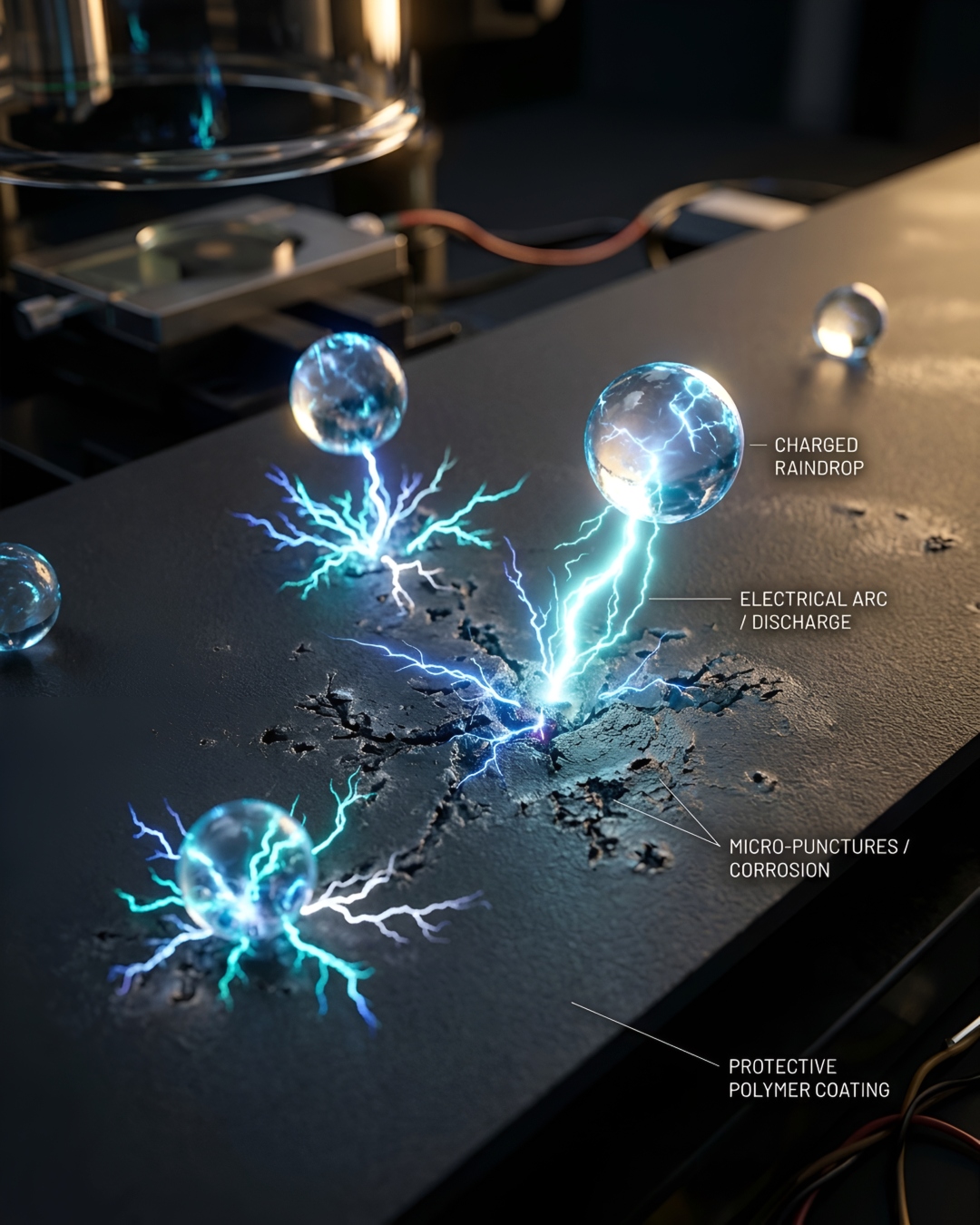
Rain Damage via Electrical Lightning

SciTechDaily MaterialsScience Electricity MaxPlanckInstitute Water

摘要

心智圖封面圖片
AI 生成的封面圖片

Scientists from the Max Planck Institute for Polymer Research and international institutions discovered that moving water droplets accumulate electrical charges and cause corrosion on painted or coated surfaces through tiny, lightning-like electrical discharges. Published in Nature on August 26, 2026, the research demonstrates that when charged water droplets strike coated surfaces such as Teflon, PVC, or polystyrene, they discharge locally and puncture the protective layer. The authors emphasize that this newly identified electrical damage mechanism complements traditional theories of mechanical stress and chemical wear. By conducting experiments with thousands of droplets rolling across various materials before hitting test targets, the team observed that different surfaces generate charge variations of up to a factor of ten, yet all charged droplets cause microscopic coating and substrate damage. The essence of the study lies in revealing friction electricity in water droplets as a hidden factor in material degradation over time. The findings challenge existing paradigms of weather-induced deterioration by proving that electrical micro-discharges play a critical, previously unrecognized role in breaking down protective layers on infrastructure and consumer goods. Practical applications include guiding engineers and manufacturers to develop advanced protective coatings that resist electrical discharge corrosion. These innovations can significantly enhance the durability of high-value assets, cultural heritage landmarks, automotive finishes, and everyday painted household items like garden fences.

關鍵點

01

🔹 Discovery of Electrical Damage by Rain

【📌 Key Finding】Researchers discovered that moving raindrops accumulate electrical charges and damage protective coatings via microscopic lightning-like electrical discharges. 【🔸 Impact Factors】Lead author Zhongyuan Ni and director Hans-Jürgen Butt from the Max Planck Institute for Polymer Research led the study published in Nature on August 26, 2026. 【⭐ Data Support】The research proves that repetitive impacts from 3,000 charged droplets cause permanent microscopic punctures and corrosion down to the underlying metal substrate.

02

🔸 Comparison With Traditional Deterioration Theories

【📌 Key Finding】Weather-induced degradation was traditionally blamed strictly on mechanical stress from impact friction and chemical damage from corrosive substances like acids or salts. 【🔸 Impact Factors】The newly identified electrical charge mechanism adds a hidden dimension to coating failure that operates independently of chemical composition or mere mechanical force. 【⭐ Data Support】Experiments demonstrated that uncharged droplets cause zero visible changes after 3,000 impacts, whereas charged droplets actively puncture and compromise the protective layer.

03

⭐ Experimental Methodology and Materials Tested

【📌 Key Finding】Scientists tested droplet behavior by releasing water across various everyday surfaces before allowing them to strike a uniform Teflon coating. 【🔸 Impact Factors】Materials utilized in the experiments included houseplant leaves, PVC, and polystyrene plastics commonly found in windows. 【⭐ Data Support】The team measured charge accumulation variations of up to a factor of ten depending on the specific substrate the water droplet traversed before impact.

04

📊 Scientific Collaborations and Research Origins

【📌 Key Finding】The groundbreaking research was a collaborative effort involving multiple prestigious international academic and research institutions. 【🔸 Impact Factors】Key contributors include the Max Planck Institute for Polymer Research, the University of Bonn, South China University of Technology, MIT, and Johannes Gutenberg University Mainz. 【⭐ Data Support】Senior group leader Rüdiger Berger noted that friction electricity in droplets is physically much more complex than previously assumed by classical physics models.

05

💡 Implications for Future Protective Coatings

【📌 Key Finding】Understanding droplet-induced electrical corrosion provides a pathway for engineers to design significantly more durable protective materials. 【🔸 Impact Factors】Enhanced coatings will benefit large-scale infrastructure like the Eiffel Tower and Golden Gate Bridge, cultural heritage sites, automobiles, and residential items such as painted fences. 【⭐ Data Support】Published under the DOI 10.1038/s41586-026-10941-6, the study marks a paradigm shift in material science and industrial maintenance protocols.

想要創建自己的心智圖?

登入Neumap AI,開始創建專屬於你的心智圖!

立即開始