⭐ Solar Companion Theory

SciTechDaily Astronomy Astrophysics SolarSystem Stars Sun Extinction

摘要

心智圖封面圖片
AI 生成的封面圖片

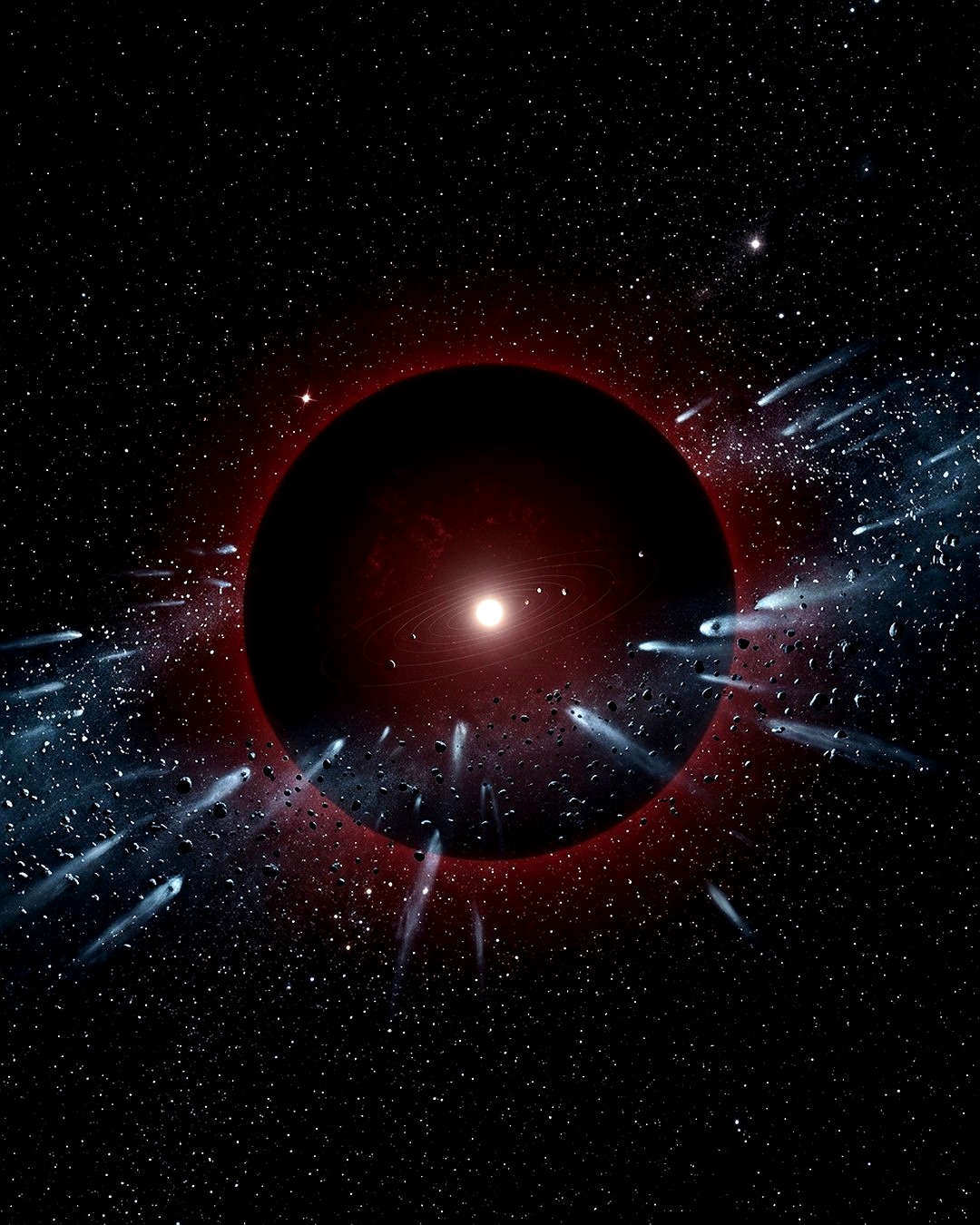
A controversial astronomical theory suggests that an unseen stellar companion to the Sun, designated Nemesis, could be responsible for triggering recurring mass extinctions on Earth every 26 million years. This hypothetical low-mass red dwarf star is proposed to orbit the Sun and periodically plow through the Oort Cloud, sending millions of comets into the inner solar system. Richard Muller, professor emeritus of physics at the University of California, Berkeley, champions this hypothesis, arguing that a recurring cosmic cycle best accounts for a 250-million-year pattern in marine fossil extinction data first published in 1982 by paleontologists David Raup and Jack Sepkoski. While mainstream consensus attributes major impacts like the 66-million-year-old K-T boundary event to asteroids, Muller contends that comet showers remain a viable and under-appreciated explanation. The Nemesis hypothesis relies on the gravitational perturbation of the Oort Cloud, a spherical reservoir of icy bodies extending up to 1.6 light-years from the Sun formed from three distinct sources of material. Because Nemesis shares a center of gravity with the Sun and lacks detectable proper motion along our line of sight, and because it likely resembles a dim 8th or 9th magnitude star near the plane of the ecliptic, direct observation remains exceedingly difficult. For readers interested in astronomy, this theory highlights how modern instrumentation like the Rubin Observatory may soon characterize the Oort Cloud more thoroughly and detect distant long-period comets. Fortunately for life on Earth, Muller estimates that the next destructive comet shower is still 12 to 15 million years away.

關鍵點

01

⭐ The Nemesis Hypothesis and 26-Million-Year Extinction Cycles

A controversial theory proposes that the Sun has an unseen stellar companion named Nemesis, a low-mass red dwarf star orbiting a shared center of gravity. According to UC Berkeley physics professor emeritus Richard Muller, this companion periodically enters the Oort Cloud every 26 million years, triggering extensive comet showers that last for roughly a million years. This recurring cosmic mechanism is suggested to explain a striking pattern of marine fossil extinctions spanning approximately 250 million years, originally identified in a 1982 study by paleontologists David Raup and Jack Sepkoski.

02

📊 Nature and Origin of the Oort Cloud

The hypothetical Oort Cloud is a vast, roughly spherical reservoir of trillions of comets and icy bodies extending as far as 1.6 light-years from the Sun, left over from solar system formation some 4.5 billion years ago. Astrophysicist Sean Raymond notes that the original material forming this cloud came from three distinct sources: planetesimals originating in the Sun's planet-forming disk, planetesimals from other stars in the Sun's birth cluster, and interstellar objects captured during stellar encounters or scattered by Jupiter.

03

🔍 Detection Challenges and Observational Limits

Despite its proposed mass of at least five percent of the Sun, Nemesis has not been directly detected because it moves alongside the Sun around their shared center of gravity, displaying insufficient proper motion across our line of sight. Furthermore, as a dim 8th or 9th magnitude star lying close to the plane of the ecliptic, it blends into a dense field of background stars, making it nearly impossible to spot with the naked eye. The Rubin Observatory, which is currently coming online, offers the best near-term hope for detecting more long-period Oort Cloud comets and characterizing the region.

04

🏛️ Debate Over Asteroids Versus Comets at the K-T Boundary

The scientific consensus attributes the K-T boundary extinction event 66 million years ago, which wiped out the dinosaurs, to a large asteroid impacting the Yucatan Peninsula. However, Richard Muller and UC Berkeley earth and planetary science professor Walter Alvarez note that the evidence distinguishing whether the impactor was an asteroid or a comet is very weak, with Alvarez confirming that researchers could not easily tell the difference from initial data.

05

📌 Timeline and Future Outlook for Earth

While the Nemesis theory remains controversial and unproven, Richard Muller provides a reassuring outlook regarding planetary safety. He calculates that the next catastrophic comet shower capable of causing serious damage to Earth is not expected to occur for another 12 to 15 million years, allowing ample time for advanced astronomical surveys to potentially map out distant outer solar system structures.

想要創建自己的心智圖?

登入Neumap AI,開始創建專屬於你的心智圖!

立即開始