Supercomputer Simulations Reveal How First Stars Changed Universe

astrophysics supercomputer-simulations james-webb-space-telescope stellar-evolution university-of-bath

摘要

心智圖封面圖片
AI 生成的封面圖片

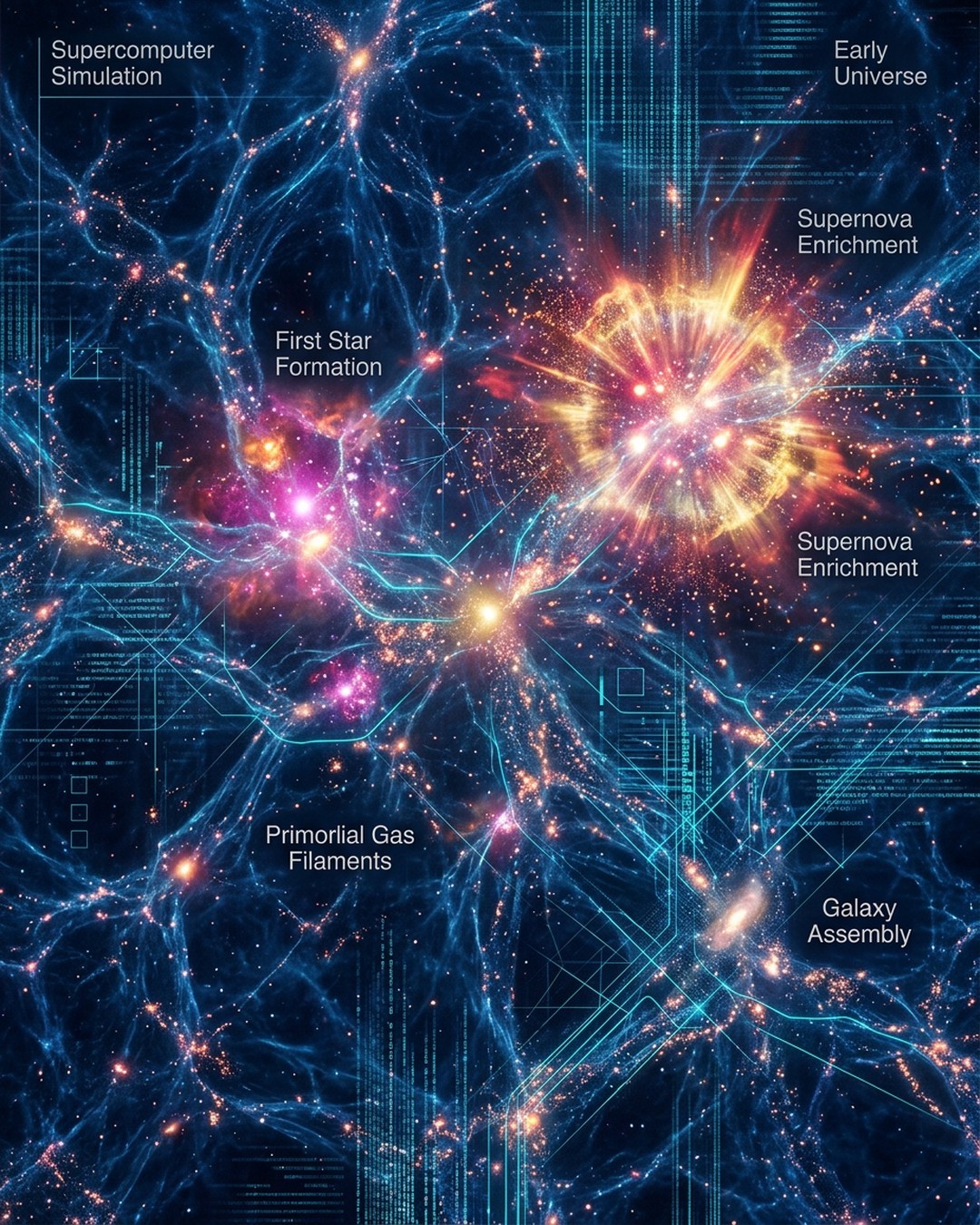
Supercomputer simulations developed by the MEGATRON project led by the University of Bath on October 3, 2026, reveal how the first stars transformed the infant Universe by interacting with surrounding gas and spreading newly forged chemical elements. These high-resolution simulations link galaxies observed by the James Webb Space Telescope with chemical signatures preserved in ancient stars in the Milky Way, providing a comprehensive physical bridge between cosmic dawn and local stellar relics. The researchers emphasize that accurately modeling the complex interplay between starlight, gas dynamics, and chemical enrichment is crucial, as simpler models often underestimate how strongly stellar radiation and chemistry reshape early galactic environments. By tracking young galaxies through billions of years of cosmic time, the MEGATRON project allows astronomers to test competing theories of early star formation and chemical evolution directly against empirical data. The research demonstrates that elements vital for life, such as carbon, oxygen, and iron, originated from the life cycles and supernova explosions of the earliest stellar generations. This advanced modeling framework accounts for radiation, gas motion, and evolving chemical compositions simultaneously, uncovering gas structures that conventional models typically miss. To build upon these insights, the research team has secured 40 million processor hours on national supercomputers in the United Kingdom to execute higher-resolution models incorporating more complete physics. These future efforts will facilitate more direct comparisons with upcoming James Webb Space Telescope observations and ancient star surveys to refine our understanding of cosmic evolution.

關鍵點

01

🔹 MEGATRON Project Overview and Objectives

【📌 Key Finding】The MEGATRON project connects galaxies observed by the James Webb Space Telescope with chemical signatures preserved in ancient stars within the Milky Way. 【🔸 Impact Factors】It provides a physical bridge between the infant cosmos and local stellar relics, helping astronomers reconstruct how the first stars formed and spread new elements through space. 【⭐ Data Support】Published on October 3, 2026, by researchers at the University of Bath in four studies featured in the Open Journal of Astrophysics.

02

🔸 Simulating the Transition of the Infant Universe

【📌 Key Finding】Simulations begin with pristine gas containing no heavy elements, modeling the birth of the first stars, their radiation emission, supernova explosions, and the dissemination of heavy elements. 【🔸 Impact Factors】Simpler simulations underestimate how strongly stellar radiation and chemistry reshape gas around young galaxies, making high-resolution tracking necessary. 【⭐ Data Support】The high-resolution models successfully reveal intricate gas structures that simpler models miss, altering predictions of how radiation and enriched material behave.

03

⭐ Forging Life-Essential Elements

【📌 Key Finding】Essential elements that make our world and life possible, including carbon, oxygen, and iron, were forged by the earliest stars. 【🔸 Impact Factors】Understanding how the first stars formed and enriched their surroundings explains the origin of heavy elements found in later generations of stars and planets. 【⭐ Data Support】The MEGATRON simulations allow researchers to test these ideas directly by comparing detailed models with chemical fingerprints preserved in ancient stars.

04

📊 Future Supercomputing and Observational Plans

【📌 Key Finding】The research team at the University of Bath has been granted 40 million processor hours on United Kingdom national supercomputers. 【🔸 Impact Factors】This computational power will enable simulations to run at higher resolutions with more complete physics and direct comparisons to upcoming observational datasets. 【⭐ Data Support】These models will provide a common physical framework for interpreting James Webb Space Telescope observations and stellar fossil records.

05

💡 Significance of Combining JWST and Stellar Archaeology

【📌 Key Finding】The combination of direct observations from the James Webb Space Telescope and stellar archaeology enables astronomers to study the relics of the earliest times. 【🔸 Impact Factors】These complementary observational methods allow researchers to test competing models of the first stars in ways that were previously impossible. 【⭐ Data Support】The research was documented in multiple studies including reference DOI 10.33232/001c.169605 published on September 30, 2026.

想要創建自己的心智圖?

登入Neumap AI,開始創建專屬於你的心智圖!

立即開始