A Century-Old Mystery in Cat Kidneys Solved by BFA Discovery

scitechdaily biology animalbehavior biochemistry cats wildlifebiology

摘要

心智圖封面圖片
AI 生成的封面圖片

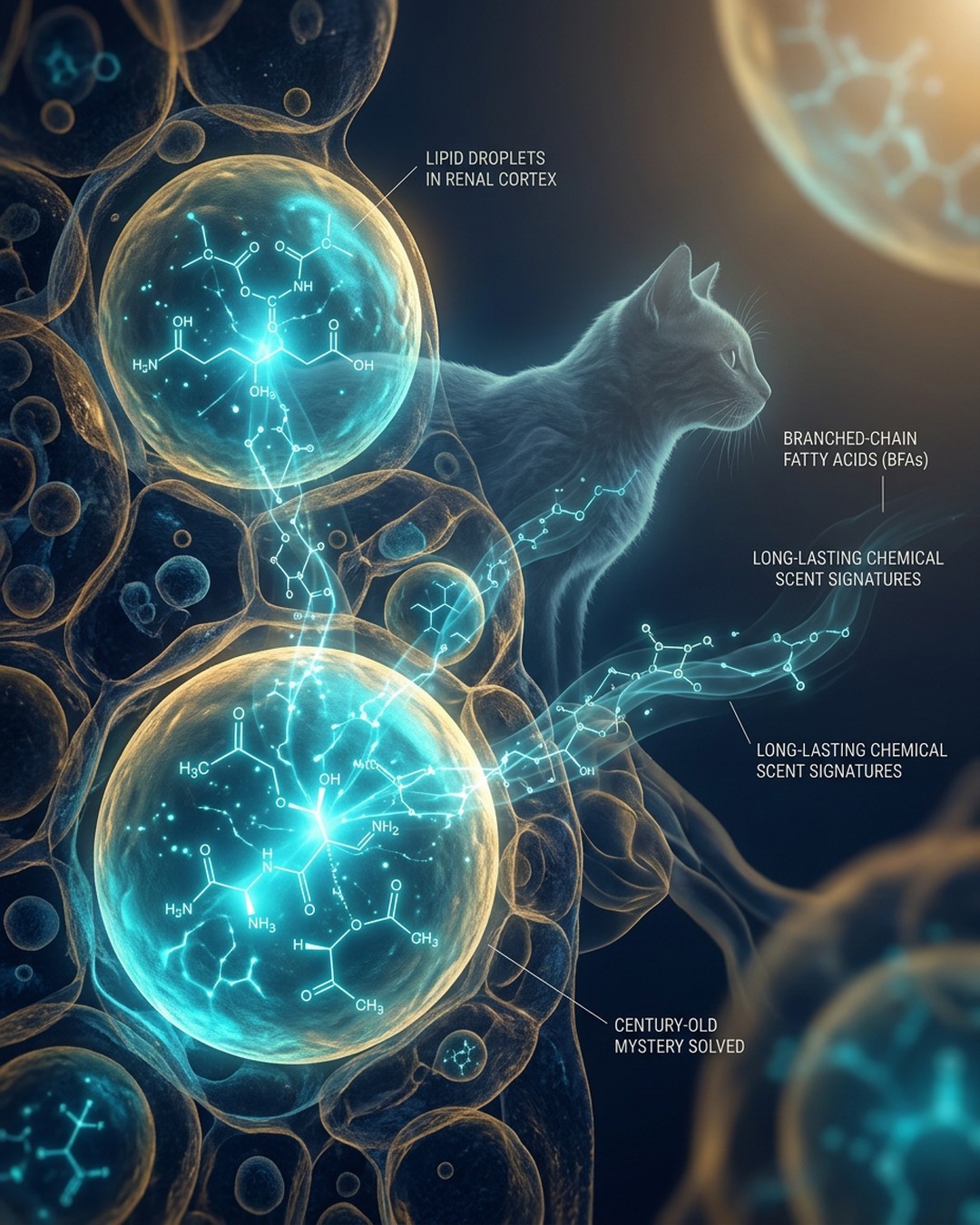
A collaborative international research team led by Iwate University published a study in Current Biology on September 10, 2026, revealing that domestic cats use 13 unusual branched-chain fatty acids (BFAs) found in their urine as stable chemical calling cards to identify one another across time and distance. Researchers discovered that neutral lipid droplets in the renal cortex store BFA-containing lipids, solving a century-old physiological mystery regarding the biological purpose of these abundant kidney lipid structures. The author highlights how these semi-volatile BFAs evaporate much slower than highly volatile odor molecules, maintaining stable individual profiles for at least 24 hours at 25 degrees Celsius and preventing short-term physiological or dietary fluctuations from erasing a cat's scent identity. Through behavioral observations utilizing the flehmen response and controlled chemical tests, the team confirmed that domestic felines can actively perceive and distinguish these donor-specific BFA mixtures. The essence of this discovery lies in identifying a novel mammalian chemical communication system that differs from the major urinary proteins used by mice. By linking specialized renal lipid storage directly to urinary scent stability, the study explains how chemical signals persist reliably in the environment despite environmental degradation and natural molecular breakdown after deposition. This fundamental biological insight opens future pathways for better feline odor management, advanced investigations into renal lipid metabolism diseases, and non-invasive wildlife conservation methods utilizing environmental scent marks to monitor elusive wild felid populations globally.

關鍵點

01

🔹 Discovery of 13 Branched-Chain Fatty Acids (BFAs)

【📌 Key Finding】Researchers identified 13 unusual branched-chain fatty acids (BFAs) in domestic cat urine that have no prior documented reports in mammalian excretions. 【🔸 Impact Factors】Each feline carries a distinct BFA profile based on compound combinations and relative abundance that remains stable across samples. 【⭐ Data Support】Related cats display more familial similarities in their profiles while preserving unique individual chemical identities.

02

🔸 Role of Century-Old Kidney Lipid Droplets

【📌 Key Finding】Abundant neutral lipid droplets in the feline renal cortex function as a biological reservoir for BFA-containing lipids. 【🔸 Impact Factors】This specialized storage mechanism isolates the chemical signature from short-term dietary or physiological shifts. 【⭐ Data Support】Renal lipid droplets have been documented in cat kidneys for over a century, but this study newly resolves their primary purpose.

03

⭐ Behavioral Evidence and Flehmen Response

【📌 Key Finding】Cats utilize the flehmen response (an open-mouthed sniffing expression) significantly more often when investigating unfamiliar urine compared to their own. 【🔸 Impact Factors】Habituation experiments demonstrated that cats exhibit long-term odor memory lasting months for previously encountered urine samples. 【⭐ Data Support】Controlled trials isolating the BFA fraction proved that felines can directly perceive and react to chemical differences in these lipids.

04

📊 Durability and Semi-Volatile Stability

【📌 Key Finding】BFAs are semi-volatile molecules that evaporate considerably slower than typical highly volatile odor compounds found in urine. 【🔸 Impact Factors】Individual-specific BFA patterns remained chemically stable for at least 24 hours when stored at a temperature of 25 degrees Celsius. 【⭐ Data Support】This chemical durability allows scent marks to communicate reliable identity information long after the animal has departed.

05

💡 Evolutionary Conservation Across Felidae

【📌 Key Finding】BFA-related compounds and kidney lipid droplets were detected in multiple wild cat species, including lions, tigers, leopards, jaguars, lynxes, and the Iriomote cat. 【🔸 Impact Factors】Species-specific variations in BFA profiles and droplet distributions indicate evolutionary divergence across the Felidae family. 【⭐ Data Support】These findings suggest future applications for non-invasive wildlife monitoring and conservation of rare wild felids via environmental scent tracking.

想要創建自己的心智圖?

登入Neumap AI,開始創建專屬於你的心智圖!

立即開始