James Webb Space Telescope Finds Chariklo Rings Changing in Opposite Ways

astronomy james-webb-space-telescope chariklo space-research science-advances

摘要

心智圖封面圖片
AI 生成的封面圖片

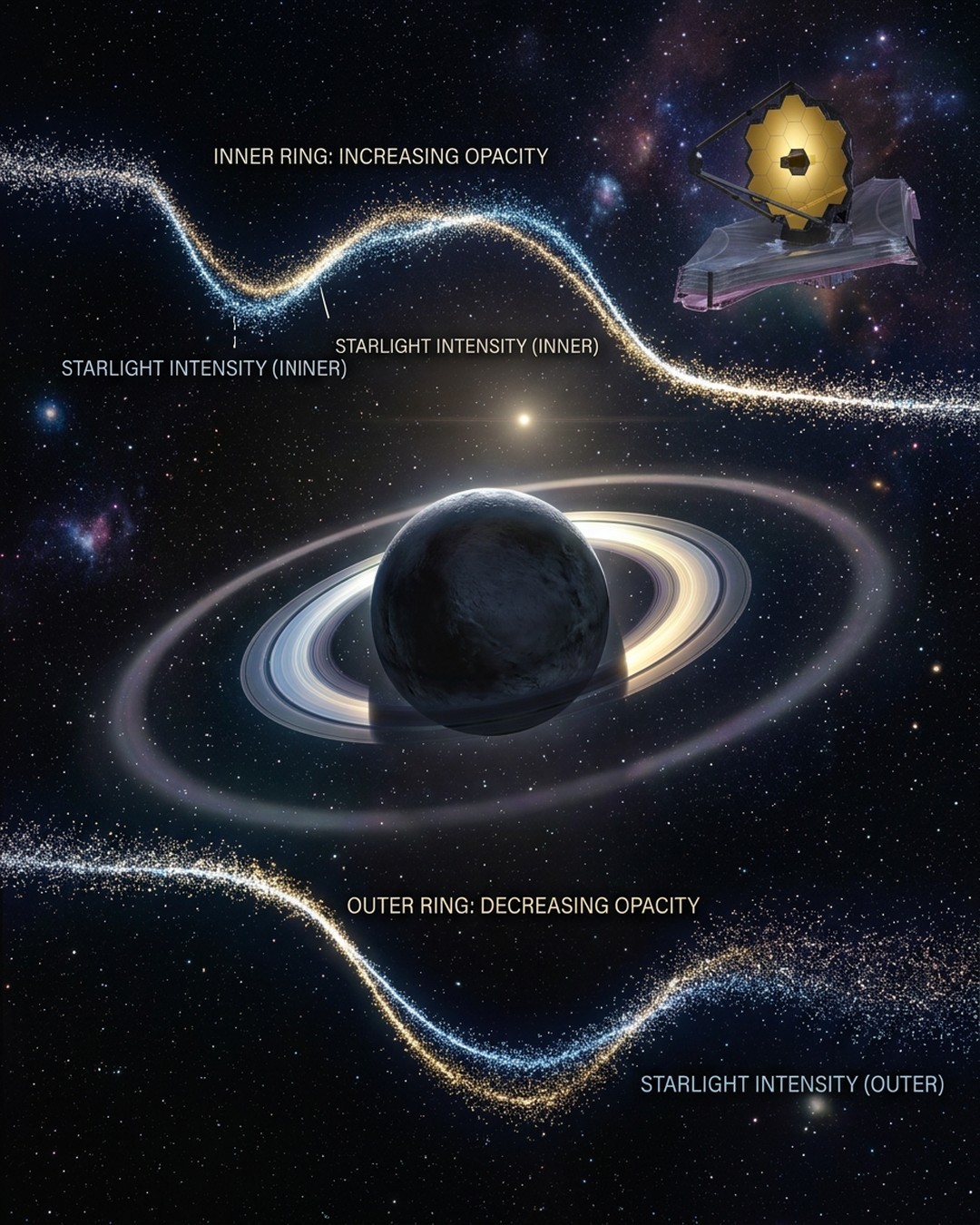
The James Webb Space Telescope has revealed unexpected changes in the two rings of Chariklo, a small centaur body measuring about 250 kilometers across and traveling between Saturn and Uranus at approximately 17 times the Earth-Sun distance. Observations conducted on October 18, 2022, during a stellar occultation led by the Institute of Astrophysics of Andalusia (IAA-CSIC) showed that the inner ring exhibits significantly higher opacity while the outer ring shows lower opacity over the course of just a few years. The researchers emphasize that these contrasting changes challenge the long-held astronomical assumption that ring systems around small Solar System bodies remain static and stable over time. Instead, Chariklo's rings appear to be dynamically active, forcing scientists to rethink the mechanisms governing their formation, evolution, and long-term stability. The study marks a major technical milestone as the first stellar occultation successfully predicted and planned for the James Webb Space Telescope. Achieving this required high-precision orbit modeling of Chariklo, stellar positioning data from the ESA Gaia mission, and precise trajectory management of the telescope around the L2 Lagrange point located 1.5 million kilometers beyond Earth. Astronomers note that while the precise causes of these opposite changes remain uncertain—potentially reflecting genuine physical ring evolution, observation filter differences, or a combination of both—the findings provide an unprecedented window into the complex dynamics of small body ring systems throughout the Solar System.

關鍵點

01

🔹 Discovery of Opposite Ring Changes

【📌 Key Finding】Observations by the James Webb Space Telescope on October 18, 2022, revealed that Chariklo's two rings are evolving in opposite directions over a few years. 【🔸 Impact Factors】While the inner ring shows significantly higher opacity, the outer ring displays lower opacity, challenging the assumption that small body rings are static. 【⭐ Data Support】Chariklo is a small centaur body about 250 kilometers across located between Saturn and Uranus at roughly 17 times the Earth-Sun distance.

02

🔸 Technical Milestone for JWST

【📌 Key Finding】The event marked the first stellar occultation specifically predicted, planned, and successfully observed using the James Webb Space Telescope. 【🔸 Impact Factors】Success required extreme precision in tracking Chariklo's orbit, stellar positioning from ESA Gaia, and trajectory maintenance around the L2 Lagrange point 1.5 million kilometers beyond Earth. 【⭐ Data Support】Chariklo moved relative to JWST at a slow 2.5 kilometers per second, enabling high spatial resolution.

03

⭐ Challenging Theories of Ring Stability

【📌 Key Finding】The newly detected changes force scientists to reconsider how ring systems around small Solar System bodies form, evolve, and maintain stability. 【🔸 Impact Factors】Researchers are currently investigating whether these variations stem from genuine ring evolution or differences in observation filters. 【⭐ Data Support】The findings were published on September 9, 2026, in Science Advances by an international team led by the Institute of Astrophysics of Andalusia (IAA-CSIC).

04

📊 Collaborative International Effort

【📌 Key Finding】The Institute of Astrophysics of Andalusia (IAA-CSIC) directed scientific planning, prediction, data analysis, and ring modeling for the project. 【🔸 Impact Factors】The study involved researchers from multiple institutions across Spain, Brazil, France, Hungary, and the United States. 【⭐ Data Support】Statistical analyses confirmed that the observed opacity changes in the rings are genuine and measurable.

05

💡 Future Implications for Planetary Astronomy

【📌 Key Finding】Detecting active evolution in Chariklo's ring system opens new pathways for understanding ring dynamics across the Solar System. 【🔸 Impact Factors】Astronomers can apply similar stellar occultation techniques to study other distant, small bodies that cannot be resolved directly via imaging. 【⭐ Data Support】Because the rings are extremely narrow and distant, stellar occultations remain the primary method for revealing their fine structures through stellar brightness dips.

想要創建自己的心智圖?

登入Neumap AI,開始創建專屬於你的心智圖!

立即開始