Titan: A Strategic Resource Hub for Space Colonization

SpaceExploration Titan NASA ISRU PlanetaryScience SpaceColonization

Zusammenfassung

Mindmap Titelbild
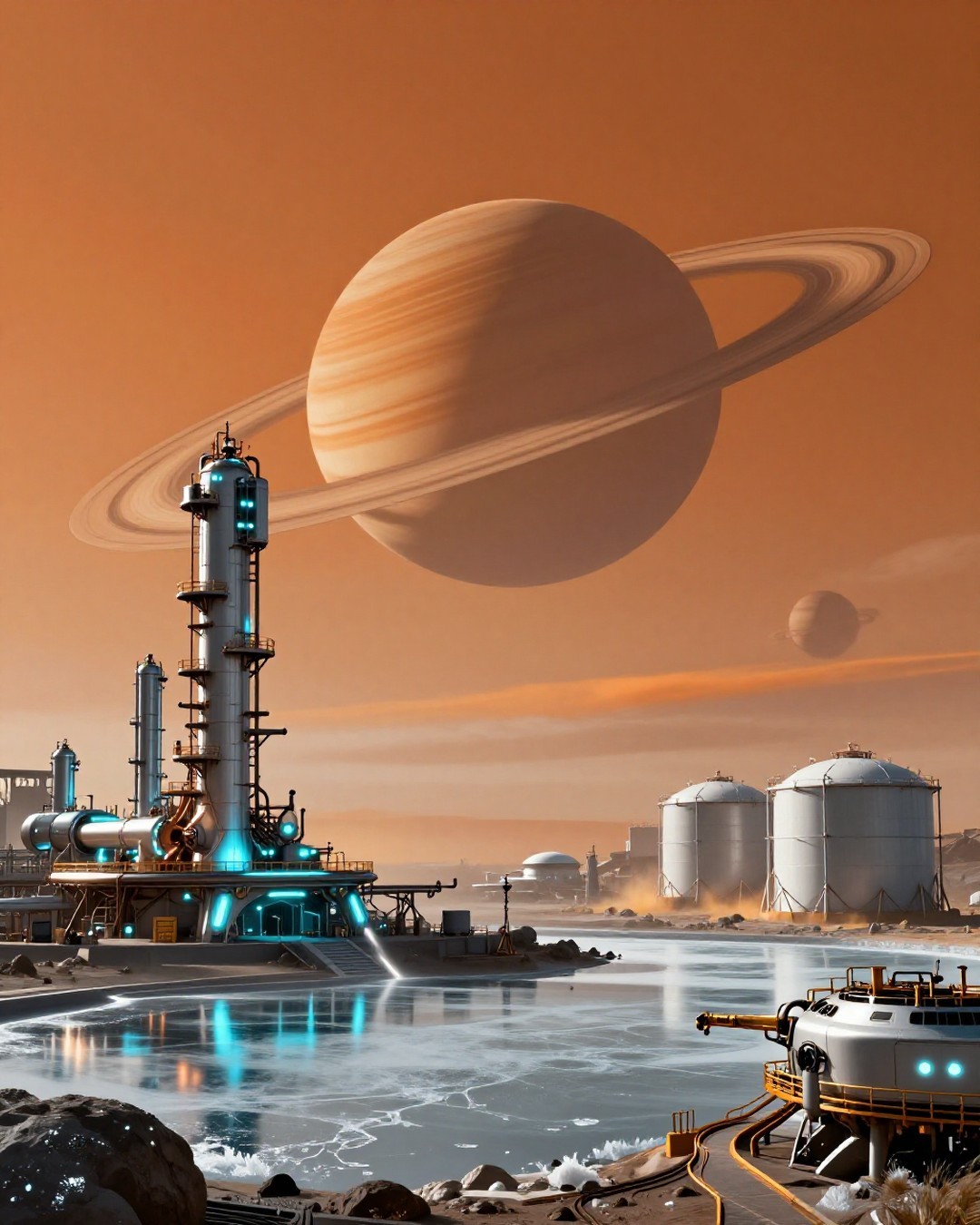
KI Generiertes Titelbild

Titan, Saturn's largest moon, is identified as a prime candidate for future deep space colonization due to its unique abundance of essential resources. A NASA-supported study published in June 2026 highlights that Titan possesses a dense, nitrogen-rich atmosphere and vast hydrocarbon reserves, including methane, ethane, and propane, which can be utilized for fuel, plastics, and chemical feedstocks. The research team, led by Conor A. Nixon, argues that Titan serves as a strategic 'Persian Gulf' of the Solar System. Unlike the Moon or Mars, Titan offers a self-sustaining environment where in-situ resource utilization (ISRU) could support long-term human settlements, manufacturing, and refueling depots for missions traveling to the outer Solar System. Beyond hydrocarbons, Titan's composition is approximately 50% water, which can be harvested for drinking water, oxygen, and hydrogen propellant. While the moon's distance necessitates advanced nuclear propulsion for transit, its resource profile is considered unrivaled for enabling humanity to become a truly interplanetary civilization. For researchers and space agencies, this study provides a roadmap for future exploration, emphasizing that Titan is not just a scientific curiosity but a critical hub for future space infrastructure. Practical applications include developing technologies for hydrocarbon refining and establishing orbital refueling stations to facilitate deep space travel.

Schlüsselpunkte

01

🔹 Titan as a Resource Hub

【📌 Core Finding】Titan is identified as the most resource-rich moon in the Solar System, capable of supporting long-term human presence. 【🔸 Impact Factors】Its dense, nitrogen-rich atmosphere and surface hydrocarbons (methane, ethane, propane) provide the necessary raw materials for fuel, plastics, and pharmaceuticals. 【⭐ Data Support】The study, led by Conor A. Nixon, Ye Lu, and Jennifer E. Ruliffson, was published in June 2026 and is currently under review for Acta Astronautica.

02

🔸 In-Situ Resource Utilization (ISRU) Potential

【📌 Strategic Value】Titan allows for the production of essential supplies locally, reducing the need for Earth-based resupply. 【🔸 Key Resources】Hydrocarbons can be refined into kerosene, gasoline, and synthetic rubber, while water ice (comprising 50% of Titan's mass) can be converted into liquid oxygen (LOX) and liquid hydrogen (LH2) for rocket propellant.

03

⭐ Comparison with Other Destinations

【🔵 Titan】Unique atmosphere, abundant hydrocarbons, and massive water reserves. 【🟠 Moon/Mars】Limited resources compared to Titan, requiring more frequent Earth-based support. 【⚖️ Key Differences】Titan's chemical complexity makes it a superior base for manufacturing and deep-space refueling, though its extreme distance requires advanced nuclear thermal propulsion for transit.

04

📊 Mission Profiles and Infrastructure

【📌 Exploration Support】Titan could serve as a refueling depot for spacecraft traveling to Uranus, Neptune, or other Saturnian moons like Enceladus. 【🔸 Infrastructure】Proposed systems include surface-based refineries and orbital refueling depots, similar to concepts currently being explored by SpaceX for Starship, to sustain long-duration missions.

05

💡 Future Outlook and Scientific Context

【📌 Scientific Significance】Titan is a prebiotic environment, making it a target for the NASA Dragonfly mission (launching no earlier than July 2028). 【🔸 Long-term Goal】By leveraging Saturn's resources, including helium-3 for fusion energy, humanity could establish a permanent, self-sufficient interplanetary civilization capable of meeting all population needs through local manufacturing.

Möchten Sie Ihre eigene Mindmap erstellen?

Melden Sie sich bei Neumap AI an und beginnen Sie mit der Erstellung Ihrer eigenen Mindmaps!

Loslegen