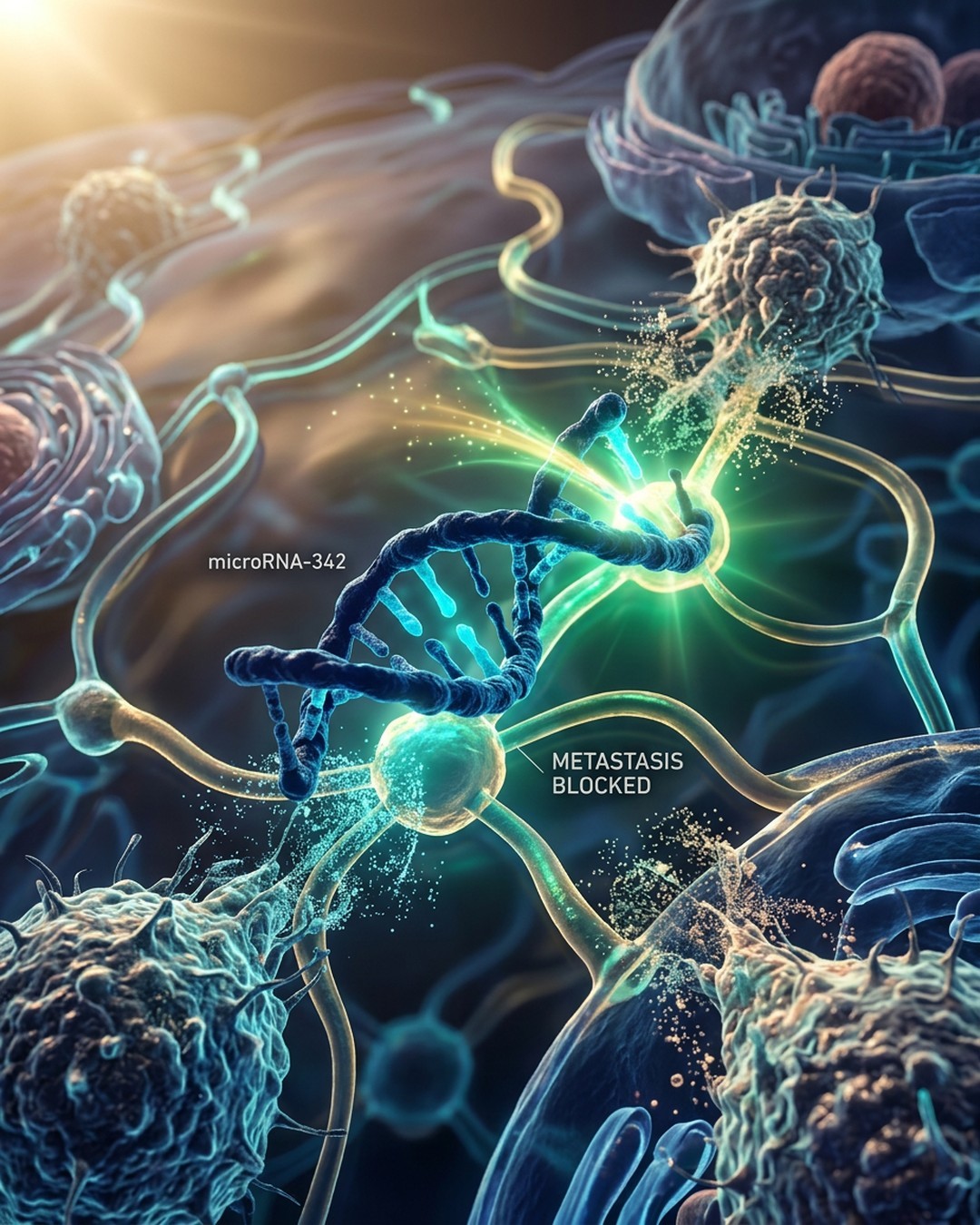
Stopping Aggressive Breast Cancer Metastasis

scitechdaily breast-cancer cancer-research genetics medical-breakthrough

Zusammenfassung

Mindmap Titelbild
KI Generiertes Titelbild

Australian researchers from Adelaide University and the Olivia Newton-John Cancer Research Institute published a study on August 21, 2026, in EMBO Molecular Medicine identifying a promising new approach to stop aggressive triple-negative breast cancer from spreading. The research demonstrates that restoring a naturally occurring molecule called miR-342 significantly reduces the metastasis of cancer cells to distant organs such as the lungs and bones in pre-clinical models. The authors emphasize that the primary danger of triple-negative breast cancer stems from its lack of common molecular targets like estrogen receptors, progesterone receptors, and HER2, making standard targeted therapies ineffective and metastasis life-threatening. The study found that low levels of miR-342 combined with high activity in the cancer-promoting E2F pathway mark patients at much higher risk for metastatic disease. The essence of the strategy involves repurposing an existing cancer drug called palbociclib, which is a CDK4/6 inhibitor normally used for advanced hormone receptor-positive breast cancer. When administered in models with low miR-342 levels, palbociclib successfully suppressed the growth of metastatic tumors by preventing microscopic deposits from developing into secondary cancers. This discovery provides a personalized treatment framework for the 10-15 percent of Australian breast cancer diagnoses categorized as triple-negative, opening the door for future clinical trials to improve patient survival rates and offer targeted therapeutic options after the cancer has spread.

Schlüsselpunkte

01

🔹 Triple-Negative Breast Cancer Challenge

【📌 Key Finding】Triple-negative breast cancer accounts for roughly 10 to 15 percent of Australia's approximately 21,000 annual breast cancer diagnoses and represents an aggressive subtype. 【🔸 Impact Factors】It lacks three common molecular targets including estrogen receptors, progesterone receptors, and HER2 proteins, making standard targeted therapies ineffective. 【⭐ Data Support】Most breast cancer deaths occur due to metastasis where cancer spreads to distant organs rather than from the primary tumor itself.

02

🔸 Role of miR-342 and E2F Pathway

【📌 Key Finding】Research published on August 21, 2026, in EMBO Molecular Medicine identified that low levels of naturally occurring molecule miR-342 combined with high E2F pathway activity indicate a high metastatic risk. 【🔸 Impact Factors】miR-342 acts as a master regulator for genes involved in cancer progression, and its depletion allows dormant cells to form secondary tumors. 【⭐ Data Support】Restoring miR-342 levels in pre-clinical models substantially reduced the spread of breast cancer to distant organs like lungs and bones.

03

⭐ Repurposing Palbociclib for Metastasis

【📌 Key Finding】Scientists tested palbociclib, a CDK4/6 inhibitor currently used for advanced hormone receptor-positive breast cancer, on models with low miR-342 levels. 【🔸 Impact Factors】The drug significantly reduced the growth of metastatic tumors and prevented microscopic metastatic deposits from expanding after cancer spread. 【⭐ Data Support】This discovery offers a method to repurpose existing therapies for patients with triple-negative disease who share this biological weakness.

04

📊 Research Leadership and Funding

【📌 Key Finding】The study was led by researchers from Adelaide University and the Olivia Newton-John Cancer Research Institute, with Associate Professor Philip Gregory and Professor Robin Anderson as co-senior authors. 【🔸 Impact Factors】The work provides a foundation for future clinical trials following confirmation in patient-derived pre-clinical models. 【⭐ Data Support】Funding for the study was provided by the National Breast Cancer Foundation and the National Health and Medical Research Council.

05

💡 Clinical Implications and Future Directions

【📌 Key Finding】Identifying miR-342 levels creates a personalized medicine approach for patients with triple-negative breast cancer. 【🔸 Impact Factors】Rather than shrinking the primary tumor, the treatment focuses on stopping tiny metastatic deposits from developing into life-threatening secondary cancers. 【⭐ Data Support】Researchers plan to confirm findings in patient-derived pre-clinical models before progressing to formal clinical trials.

Möchten Sie Ihre eigene Mindmap erstellen?

Melden Sie sich bei Neumap AI an und beginnen Sie mit der Erstellung Ihrer eigenen Mindmaps!

Loslegen